Used Bus Buying Checklist: 12 Things to Check Before Buying a Second-Hand Bus or Coach
Before you commit to a second-hand bus, check the paperwork and identity first, then inspect the body and chassis for corrosion, then test the brakes, suspension and air systems. The three most expensive hidden problems on a used bus are structural rust, worn air brakes and a missing or incomplete maintenance file.
This used bus buying checklist is written for UK buyers looking at full-size buses, coaches and minibuses. It applies whether you are buying from a dealer, an operator or a private seller, and whether the vehicle will run under a PSV operator’s licence or for private use.
What paperwork should you check before viewing a used bus?
Ask for a photo or scan of the V5C logbook before you travel. The registered keeper should be the person or company selling the bus, and the VIN/chassis number on the V5C must match the number stamped on the chassis or manufacturer’s plate. A missing V5C, or a seller who says the logbook is “in the post”, is a warning sign, not a small detail.
Next, run a vehicle history check. A standard car HPI check may not cover every commercial vehicle, but a specialist history check can flag outstanding finance, a stolen marker or a previous insurance write-off. Always ask the seller for the DVSA annual test certificate and any failure sheets. Full-size buses and coaches do not use a standard car MOT; they pass an annual roadworthiness test at an authorised testing facility.
Maintenance records matter more on a used PSV than on almost any other vehicle. Operators must keep safety inspection records for at least 15 months. Look for dated inspection sheets, roller brake test results, repair invoices and a record of driver defect reports. If the seller cannot produce a proper maintenance file, you have no way of knowing whether the bus was looked after or patched up for sale. A missing maintenance file is as serious as a patchy service history on a used truck.
If the bus or coach has a digital tachograph, ask for a download of the vehicle unit data. That can reveal speed, distance and fault data that may not match the advertised mileage. Vehicle Excise Duty, or road tax, does not transfer when a vehicle changes hands, so you will need to tax the bus before using it. Confirm the taxation class with DVLA, especially if the bus was previously used for a local service or private hire.
What’s the difference between a bus and a coach when buying second-hand?
Buses and coaches are both passenger-carrying vehicles, but the way they have been used changes what goes wrong. A service bus typically does stop-start urban work with constant door cycles, heavy loading and low average speeds. A coach tends to do longer motorway runs with seated passengers, luggage lockers, air conditioning and fewer door cycles.
From a buyer’s perspective, a bus will often show wear in the doors, brake linings, suspension bushes and flooring. A coach may have higher mileage but fewer stop-start cycles; instead you need to check the air conditioning compressor, retarder, seat recliners, toilet system and luggage locker corrosion. Some vehicles are a mix, such as a dual-purpose bus used on school contracts and private hire, so ask the seller what the vehicle actually did day to day rather than what the bodywork looks like.
What second-hand coach problems catch buyers out?
Common second-hand coach problems that end up costing buyers real money include:
- Air conditioning compressors that only work at idle or not at all
- Retarder or exhaust brake warning faults
- Air suspension levelling valves that cause the coach to lean or drop overnight
- Corrosion around luggage locker floors and rear engine bay panels
- Seat belts and recliners that have been damaged or forced
- Toilet and washroom water leaks
If you are looking at a coach, do not assume that high motorway mileage is a bad thing. A well-maintained coach with documented oil changes can be a better buy than a low-mileage school bus that has spent years idling.
Bus inspection tips: how to do a 30-minute walkaround before you call an engineer
Inspection starts the moment you see the vehicle. If the bus is already warmed up when you arrive, ask why. A seller who starts and warms the engine before you get there may be hiding a cold-start fault. You want to hear a cold start, so arrange to view the bus before it has been run that day.
A practical walkaround order is:
- Walk around the bus and check panel gaps, paint finish and accident repairs.
- Open every door, including emergency exits, and check they close properly.
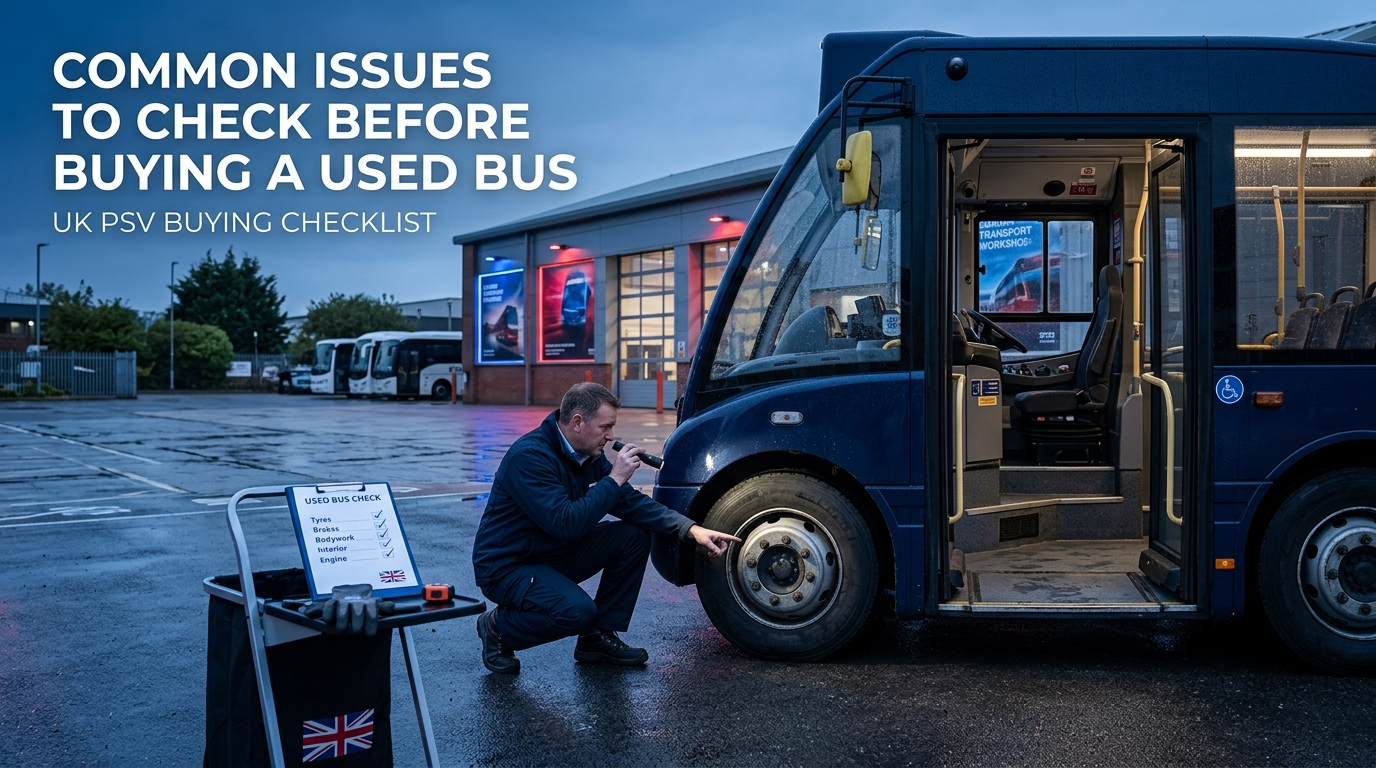
- Look under the wheelarches with a torch; rust around the arches, stepwell and floor supports is expensive.
- Check tyres for tread depth and sidewall cracking; steer-axle tyres should be matched.
- Start the engine from cold and watch the exhaust for smoke.
- Build air pressure and time how long it takes; listen for leaks with the engine off.
- Operate the doors, ramp or lift, wipers, heating and lights.
If the bus has air suspension, use the kneeling function and watch how quickly it lifts. A slow lift, or a bus that leans after a few minutes, points to an air leak or a failing levelling valve.
Which body and chassis issues cause the biggest bills?
Structural corrosion is the number one reason a cheap second-hand bus turns into an expensive problem. Even aluminium-bodied buses have steel subframes, and some older steel-bodied buses and coaches are known in the trade for corrosion around the wheelarches, stepwells and lower skirt panels. Aluminium-bodied buses can still suffer where steel brackets meet the body frame.
Check the floor inside the bus too. Lift any loose matting, especially near the doors, and look for soft spots, rust staining or daylight through the floor. Water leaks from roof hatches or window rubbers often cause rot that is hidden under flooring.
Chassis cracks and welded repairs are a major safety issue. Look for fresh paint or underseal over welded areas, especially around suspension mounts and outriggers. If the seller cannot explain a repair, get an engineer to check it.
Replacement panels for older or low-volume bodybuilders can be difficult to find, which makes accident damage or corrosion repair more expensive. A bus that smells damp inside often has water leaks from roof hatches, window seals or air conditioning drains, and that water eventually reaches the electrics and floor structure.
What should you look for in the engine and gearbox?
Start the engine from cold. A brief puff of smoke on start-up may be normal, but blue smoke that continues points to oil consumption, white smoke can mean coolant or unburnt diesel, and black smoke under load suggests an injector or boost problem. Let the engine idle and listen for knocking, uneven running or a misfire.
Check the oil filler cap and dipstick for milky residue, which can indicate coolant in the oil. Look for oil leaks around the engine, gearbox, power steering and retarder, and look at the coolant expansion tank for oil contamination. If it is a Euro VI bus, ask about AdBlue system faults and DPF regeneration history; those systems can be costly to repair.
Gearboxes in buses and coaches are often automatic or semi-automatic, such as Voith, ZF or Allison. During a test drive, each gear change should be smooth and predictable. A harsh engagement, a delay when selecting drive or a warning light on the dash can be a gearbox fault, not just a quirk. Test the retarder if fitted, because a faulty retarder can be an expensive repair and a roadworthiness issue on steep routes.
Compare the odometer reading with the engine hour meter. A bus used on urban work can spend hours idling with very little mileage, so an odometer of 250,000 miles with 12,000 engine hours tells a different story from 250,000 miles with 6,000 hours. Clocked mileage happens on buses too, so know how to spot clocked mileage on a used vehicle.
How do you check brakes, suspension and air systems?
Air brakes and air suspension are the biggest difference between a bus and a car. Before you drive, turn the ignition on and let the air pressure build. It should reach the governor cut-out pressure within a few minutes. Switch the engine off and, with the park brake applied, note whether the air pressure drops quickly. A slow leak may be acceptable, but a rapid drop means a leak that needs fixing.
Ask for the latest roller brake test results in the maintenance file. Buses and coaches should have a brake performance test at each safety inspection, not just a visual check. If the seller cannot produce a brake test report, or the figures are close to the minimum, plan for brake work in your budget.
Check the visible brake discs or drums for scoring, cracks and heat damage. Look at the air brake actuators and airlines for perishing or leaks. On the suspension, inspect the air bags for cracks and the levelling valves for leaks. Push down on each corner; the suspension should settle and recover without bouncing. If the bus leans or the ride height is uneven, there is likely an air suspension fault.
Check for play in the steering and listen for clunks from the front axle over bumps. Kingpins, track rods and anti-roll bar bushes wear on buses that do tight manoeuvring, especially on school or city routes.
What electrical and accessibility equipment often fails on used buses?
Electrical faults are common on second-hand buses because many vehicles have had multiple operators, aftermarket ticket machines, tracking systems and CCTV fitted. Open and close every door several times. Door interlocks and sensitive edge systems can fail and stop the bus from moving or cause doors to open while driving.
If the bus has a wheelchair ramp or lift, test it under load if possible. Ramps that work fine in the yard can struggle with the extra weight of a passenger. If you need the vehicle for registered local services, the bus must meet PSVAR accessibility requirements, so check what evidence the seller can provide. An older bus without PSVAR compliance may be expensive or impossible to bring up to standard.
Destination displays, route number blinds, stop bells, wipers, heating and air conditioning should all be tested. Check the battery isolator switch and battery condition. Buses often sit for long periods between operators, so dead or weak batteries are common. Look for non-standard wiring under the dash and in the electrical cupboard; badly fitted aftermarket equipment is a source of intermittent faults.
Used bus buying checklist table
| Area | What to check | Red flags |
|---|---|---|
| Bodywork and corrosion | Wheelarches, stepwells, floor, roof, window frames | Bubbling paint, soft floor, rust streaks, fresh underseal |
| Chassis and frame | Main rails, outriggers, suspension mounts | Welded repairs, cracks, misaligned panels |
| Engine | Cold start, smoke, fluid leaks, service records | Blue/white smoke, milky oil, oil in coolant |
| Gearbox and retarder | Gear changes, retarder operation, fluid level | Harsh shifts, delay, warning lights |
| Brakes and air | Air build time, leaks, roller brake test results | Slow build, rapid pressure drop, no brake test report |
| Suspension and steering | Ride height, air bags, dampers, steering play | Leaning, knocking, slow lift |
| Electrics and access | Doors, ramp/lift, lights, displays, heating | Intermittent faults, wiring modifications, ramp failure |
| Tyres and wheels | Tread, sidewall cracks, matching on steer axle | Mixed brands, visible cords, cuts |
| Interior and safety | Seat mountings, belts, emergency exits | Missing bolts, torn belts, exits that don’t open |
Should you get a professional PSV inspection?
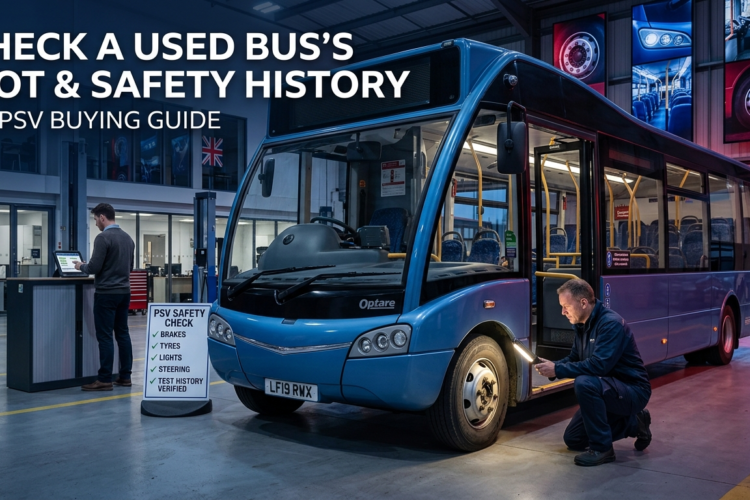
Yes. A car mechanic is not enough for a bus or coach. The ideal inspection is carried out by a DVSA Authorised Examiner or an independent engineer who works on PSVs regularly. Ask the seller if the bus can be inspected at a workshop with a pit or lift, because many chassis and brake parts cannot be assessed properly from a phone torch in a yard.
An independent inspection should include a written report, ideally with photos and a roller brake test if the workshop has the equipment. You may have to pay for the inspection yourself, but it is the cheapest way to avoid buying a bus with a cracked chassis rail or a leaking air system. If the seller refuses an independent inspection or insists on using their own mechanic, treat that as a red flag. If you are buying at auction, get the inspection done before the auction or be prepared to walk away.
What about clean air zones and emissions?
Before you buy a bus, check its Euro emission standard, which should be on the V5C or the manufacturer’s plate. A Euro VI bus or coach is generally compliant with London’s ULEZ and most Clean Air Zones. A Euro V vehicle may be charged daily to enter some cities, and older vehicles may be banned or heavily restricted. If the bus will operate in London, Birmingham, Bristol, Bath, Bradford or another Clean Air Zone, work out the running costs before you commit.
Some Euro V buses have been retrofitted with an approved emissions reduction system; ask for the certificate if the seller claims it is compliant. The rules differ by city, so check the specific zone before you sign anything.
Buying a used PSV: the licensing reality you can’t ignore
If the bus has more than eight passenger seats and you plan to use it for hire or reward, it is a public service vehicle. You cannot simply tax it and start charging fares. You need a PSV operator’s licence from the Traffic Commissioner, a transport manager with the appropriate CPC for a standard licence, a suitable operating centre, and evidence of financial standing. The seller’s operator’s licence does not transfer with the vehicle.
If the bus will be used privately, for example by a school, college, charity or sports club without payment for carriage, there may be exemptions, but you must confirm the position with DVSA or a transport consultant before you buy. Buying a used PSV without a plan for licensing can leave you with a vehicle you cannot legally use.
If you are new to commercial vehicles, many of the inspection principles are the same as those in our guide to buying a used truck. The main difference is that a bus or coach carries passengers, so the safety, accessibility and licensing obligations are stricter.
Short summary
Start with the V5C and maintenance file, then inspect the body and chassis with a torch, then drive it from cold and test the air brakes. If the bus has no useable maintenance history, or the seller won’t allow an independent inspection, walk away. There are enough second-hand buses on the UK market that you do not need to take on somebody else’s hidden corrosion or brake bill.