Selling a Car to Family in the UK: DVLA, Tax & Insurance
Selling a Vehicle to a Family Member in the UK: What You Need to Know
Selling or gifting a car to a family member in the UK requires the same legal process as any private sale: you must notify the DVLA of the change in registered keeper using the V5C logbook or the DVLA’s online service. Even if no money changes hands, the tax and insurance rules are identical to a standard private sale, and the new keeper must tax the vehicle in their own name before driving it. The transfer itself is free and can be completed online in minutes, but the financial and legal consequences of getting it wrong — from unpaid fines to invalidated insurance — are real.
Does selling to family change the legal process?
No. The DVLA does not distinguish between selling to a stranger and transferring a vehicle to your son, daughter, parent, or sibling. The same rules apply whether you charge £5,000 or hand over the keys for nothing. The Vehicle Registration Certificate — the V5C logbook — must be updated to show the new registered keeper, and that person becomes legally responsible for taxing, insuring, and keeping the vehicle roadworthy.
This is a common point of confusion. Plenty of people assume that because the vehicle stays “in the family,” there is no need for paperwork. There absolutely is. Until the DVLA’s records are updated, you remain the registered keeper in the eyes of the law, which means any speeding tickets, parking fines, or congestion charge penalties incurred by your relative land on your doorstep. The DVLA can issue a fine of up to £1,000 for failing to notify a change of keeper.
What actually changes when money doesn’t?
Legally, nothing. The DVLA’s online service asks whether you have “sold” the vehicle. You select “sold it” even when you are gifting it, because the system uses that option to record any change of registered keeper. If you are completing the transfer by post, you write the new keeper’s details in the relevant section of the V5C and note “gift” or “no payment” in the price box for your own records.
The practical difference is that a gift has no receipt of payment — but a written receipt is still a good idea. It costs nothing to write out a simple document stating the date, the vehicle’s registration number, the make and model, and the fact that it was transferred as a gift with no money exchanged. Both parties sign it, and both keep a copy. If there is ever a dispute about who owned the car on a particular date, that piece of paper matters.
How do you transfer the V5C logbook to a family member?
You have two options: online or by post. The online route is faster and simpler, but both achieve the same legal result.
The online DVLA service
You need the 11-digit reference number from the front page of the V5C logbook. Go to the DVLA’s sold-bought-vehicle service on GOV.UK and follow the prompts. Select “sold it,” then “sold it privately” — even though it’s a family transfer, this is the correct category because it is not a sale to a motor trader. Enter the new keeper’s full name and address. The DVLA will cancel your vehicle tax automatically and send a refund for any full remaining months to the address on the old logbook.
Once you submit the online form, you should destroy the rest of the V5C logbook. This is not optional. The DVLA explicitly instructs sellers to destroy the document after completing the online notification, because keeping an old V5C that still shows you as keeper creates confusion and potential liability.
The postal method
If you prefer paper, or if the new keeper lives at the same address and you want a physical record, complete Section 2 of the V5C — “Selling or transferring my vehicle to a new keeper” — with the new keeper’s details. Tear off the green “new keeper” slip (Section 6 on the newer red V5C, or Section 10 on older versions) and give it to your relative. Post the rest of the form to DVLA Swansea SA99 1BD.
Your relative then uses that green slip to tax the vehicle in their name. They cannot legally drive the car until they have done this. The slip is valid for a limited period, so they should not delay.
What if the V5C is lost?
You can apply for a replacement logbook from the DVLA online. It costs £25 and typically arrives within five working days. Do not attempt to transfer the vehicle without a V5C. While it is technically possible to notify the DVLA in writing with all the relevant details, the process is slower and more prone to error, and the new keeper will have difficulty taxing the vehicle without the reference number.
What happens to road tax (VED) when you sell to family?
Vehicle tax does not transfer with the car. It never does, under any circumstances, since the rules changed in 2014. The moment the DVLA processes the change of keeper, your tax is cancelled. You will receive a refund for any full months remaining on your payment, calculated from the date the DVLA receives your notification.
Your family member must then tax the vehicle in their own name before they drive it. This is not a suggestion — it is a legal requirement. Driving an untaxed vehicle can result in a fine, and if the vehicle is not taxed, it cannot be insured. The green new keeper slip from the V5C is the document they use to tax the car online or at a Post Office.
There is no family exemption here. Even if you are handing the keys to your adult child who lives at the same address, the tax is cancelled and must be re-started in their name. It is one of the most common mistakes people make when transferring a vehicle within a family.
If you want to understand the VED rates that will apply to your relative once they tax the car, our guide to road tax for a used car in the UK covers the current bands and how they are calculated.
What about insurance when selling to a family member?
Your insurance policy does not transfer to the new keeper. You should cancel your cover once the transfer is complete. If you are part-way through a policy, your insurer may refund any unused premium, though some charge an administration fee. If you are buying another car, you may be able to transfer the policy instead of cancelling it.
The new keeper — your family member — must arrange their own insurance before driving the vehicle. This is not a grey area. Driving without insurance in the UK carries a fixed penalty of £300 and six penalty points, and the vehicle can be seized. A common mistake is for the seller to assume their comprehensive policy will cover a family member for a few days. It will not, unless that person is specifically named on the policy. Even then, the cover ends the moment the vehicle is legally transferred, because the policyholder no longer has an insurable interest in the car.
A practical point about “fronting”
Some families try to reduce costs by keeping the vehicle insured in the name of an older, more experienced driver while a younger family member is the main user. This is called fronting, and it is insurance fraud. Insurers investigate claims thoroughly, and if they determine that the policyholder misrepresented the main driver, they can void the policy entirely — leaving the young driver uninsured and potentially facing a fraud investigation. It is not worth the risk. The new keeper should be the main policyholder, with all other drivers correctly declared.
Do you need an MOT when transferring to family?
If the vehicle has a current MOT, it remains valid after the transfer. MOT certificates are attached to the vehicle, not the owner. Your family member can drive it legally as long as the MOT has not expired. If the MOT is due within a short period, it is worth getting it done before the transfer so that any issues are addressed while the vehicle is still your responsibility.
For vehicles over three years old, an MOT is a legal requirement. If you are transferring a vehicle that has been declared off-road (SORN), the new keeper cannot simply tax it and drive away — they will need a valid MOT first, and the SORN must be cancelled as part of the taxing process.
Should you do an HPI check on a family transfer?
It sounds excessive, but there is a genuine argument for it. An HPI check confirms whether there is outstanding finance on the vehicle, whether it has been reported stolen, written off, or has any mileage discrepancies. Even in a family transfer, finance is the big one. If you have been paying for the car on a hire purchase or PCP agreement, the finance company is the legal owner — not you. You cannot legally sell or gift a car that has outstanding finance without settling the agreement first, and the finance company’s permission is usually required.
Running an HPI check costs around £10 to £20 and takes minutes. It protects both of you. If the check comes back clear, your relative has peace of mind. If it flags outstanding finance, you deal with it before the transfer rather than after. Our full guide to HPI checks and why UK buyers should never skip one explains exactly what the check covers and how to read the report.
What documents should change hands?
Beyond the V5C, there are a few documents worth passing on. The service history — whether it is a stamped book or digital records — is valuable for future resale and for your relative’s own understanding of the vehicle’s condition. The MOT certificate, if there is a paper copy, should go with the car. Any spare keys, the locking wheel nut key, and the owner’s manual are all part of the vehicle’s practical value.
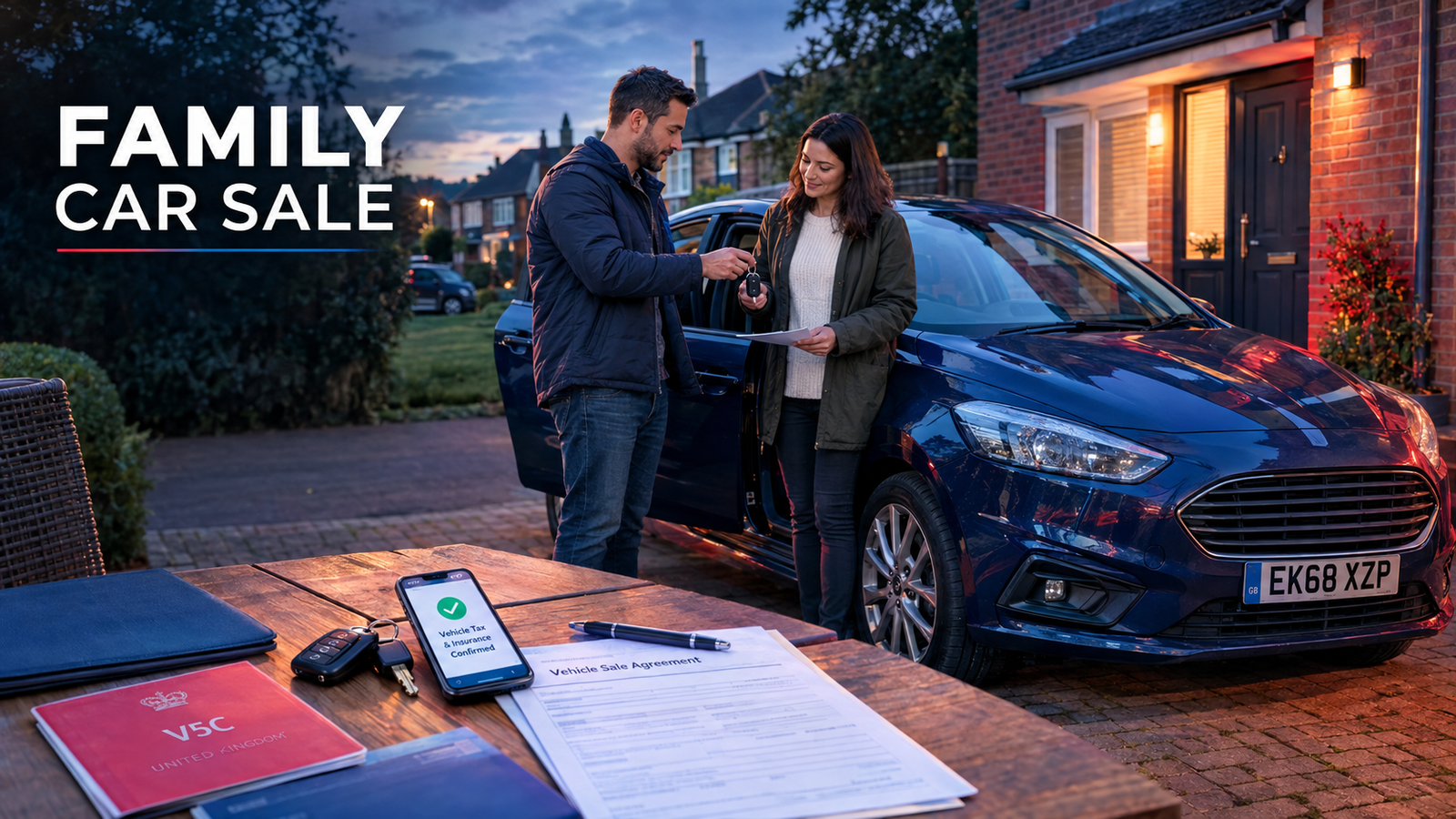
You should also write a receipt. It does not need to be elaborate. A single sheet of paper with the date, the vehicle’s registration number, make and model, the names and addresses of both parties, and the amount paid (or “gift — no payment”) is sufficient. Both parties sign it, and both keep a copy. If your relative ever needs to prove the date of acquisition — for insurance, for a future sale, or for any legal reason — that receipt is the document that does it.
Is there any tax to pay on a family transfer?
For private cars, there is no Capital Gains Tax (CGT) to pay. Cars are specifically exempt from CGT because they are classified as wasting assets — personal possessions with a predictable lifespan of less than 50 years. Even if you sell a classic car that has appreciated in value, the gain is not subject to CGT. This exemption applies whether you sell to a stranger or gift it to your child.
There is also no VAT on a private sale of a car. VAT applies to commercial sales by registered traders, not to private individuals selling their own vehicle. If you are VAT-registered and the vehicle is a commercial vehicle that was used in your business, the rules are different. You may need to account for VAT on the sale, and you should speak to an accountant before transferring a business vehicle to a family member. For the vast majority of private car sales, neither CGT nor VAT is a concern.
What about inheritance tax?
If you are gifting a vehicle to a family member and you pass away within seven years of the gift, the value of the vehicle could be counted as part of your estate for Inheritance Tax purposes. This is only relevant if your estate exceeds the nil-rate band, and it is a matter for your executor rather than something that affects the transfer itself. For most families transferring an ordinary used car, it is not a practical issue.
Common mistakes when selling to family
The most frequent error is not notifying the DVLA at all. Families often assume that because the car stays within the household, the paperwork can wait. It cannot. The registered keeper remains legally responsible for the vehicle until the DVLA updates its records, and that responsibility includes fines, penalties, and any legal notices that arrive in the post.
The second most common mistake is failing to tax the vehicle in the new keeper’s name. This is often a genuine oversight — people assume tax transfers with the car. It does not. The new keeper must tax the vehicle before driving it, and they need insurance to do so. Without tax and insurance, the vehicle is not legally on the road.
The third mistake is assuming insurance will cover the transition. It will not. The seller’s policy ends when the vehicle is transferred, and the new keeper needs their own cover from that moment. There is no grace period and no automatic cover for family members.
A short checklist for the transfer
- Confirm there is no outstanding finance on the vehicle
- Run an HPI check if you want full peace of mind
- Complete the V5C transfer online (or by post)
- Give the green new keeper slip to your relative
- Destroy the rest of the V5C if you used the online service
- Write and sign a simple receipt
- Cancel your insurance and claim any refund
- Ensure your relative taxes and insures the vehicle before driving it
- Pass on service history, MOT certificate, spare keys, and the owner’s manual
If you are also thinking about how to price the vehicle fairly for a family sale, our guide to negotiating a used car price in the UK covers the valuation factors that matter, even when the negotiation is happening at the kitchen table rather than across a forecourt.
The bottom line
Selling or gifting a vehicle to a family member in the UK is not complicated, but it is not optional either. The DVLA must be told, the tax must be restarted in the new keeper’s name, and insurance must be arranged before the car moves. Do those three things, keep a written record of the transfer, and the process is straightforward. The families who run into trouble are almost always the ones who assumed that a transfer within the family was somehow outside the rules. It is not. The same rules apply to everyone, and following them protects both of you.