Sell a Bus UK | Step-by-Step Guide – TopSellUKCars
Selling a bus or coach privately in the UK takes more preparation than selling a car, mainly because you are dealing with commercial vehicle operators, licensing paperwork, and specific legal classifications. You need to establish the correct category of vehicle (PSV or minibus), assemble a full service and compliance history, set a price based on spec and remaining MOT, then market it through the right channels to reach dealers, fleet buyers, or smaller operators.
This guide walks through the entire process, from knowing what type of vehicle you actually have to completing the sale without falling foul of DVLA rules.
What Counts as a Bus or Coach When Selling in the UK?
Before you write an advert, you need to know exactly what you are selling. The legal definition affects who can drive it, what licence is required, and how it should be advertised.
Buses vs Coaches vs Minibuses
In the UK, the DVLA and the traffic commissioners distinguish between different passenger-carrying vehicles (PCVs):
Bus – A public service vehicle typically used on local or scheduled routes. It often has standing passenger capacity, multiple doors, and is designed for stop-start urban work. A classic example is a double-decker or single-deck city bus.
Coach – A PCV designed for longer-distance seated travel. Coaches have high-backed seats, under-floor luggage storage, and usually a single passenger door. They are generally more powerful and comfortable for motorway work.
Minibus – A vehicle with 9 to 16 passenger seats. These can be driven on a standard car licence in certain limited circumstances, but most commercial use requires a D1 or D category licence.
When you list a bus for sale, the category matters because the buyer pool differs. A 70-seat double-decker appeals to a completely different type of purchaser than a 16-seat minibus used for school runs.
The Legal Status: PSV or Not?
A vehicle with more than 8 passenger seats used for hire or reward is generally classed as a Public Service Vehicle (PSV). This means it needs a PSV operator’s licence (O-licence) if used commercially, unless an exemption applies.
When you sell the vehicle, you are not responsible for the buyer’s operator licence. However, you should be clear in the advert about whether the vehicle has a current Certificate of Initial Fitness (COIF) or, for newer vehicles, a type approval certificate. Many older buses and coaches hold a COIF, which is evidence the vehicle met construction standards when new. A buyer who operates under a PSV O-licence will want to see this.
What Paperwork Do You Need to Sell a Bus or Coach?
The documentation for a commercial passenger vehicle is more involved than for a private car. Missing paperwork will genuinely reduce the selling price, because an operator buying a bus needs to prove compliance to the DVSA and the traffic commissioner.
The V5C Logbook
The V5C is required for any registered vehicle in the UK. You must check the details match the vehicle exactly, including the number of seats, taxation class, and vehicle category. The taxation class for a bus or coach is usually “BUS” or “PRIVATE HGV” depending on use.
When you sell the bus, you complete section 6 of the V5C (for a private sale) and give the green slip (V5C/2) to the buyer. You then notify the DVLA online or by post. If you are selling to a dealer or export trader, the process may differ slightly — the dealer will usually ask you to complete section 9 if they are adding it to trade stock.
MOT Certificate and Compliance Documents
Buses and coaches over 16 passenger seats are not subject to a standard Class 4 MOT. They require a Class VI MOT if used as a PSV, or a Class V MOT for larger private vehicles. The test is carried out at a DVSA authorised testing facility (ATF), not your local garage.
A Class VI MOT for a PSV is comprehensive. It covers brakes, steering, suspension, bodywork, emergency exits, and passenger safety systems. It must be renewed annually.
If your bus or coach has a current Class VI MOT with several months remaining, that is a strong selling point. If the MOT has lapsed, you can still sell the vehicle, but it is effectively sold as a project or for export — expect significantly lower offers. Some buyers specifically want buses without MOT for conversion to motorhomes or static accommodation, but they will pay accordingly.
Service and Maintenance Records
Commercial operators are legally required to keep maintenance records for their fleet. A private seller who can show a complete service history — oil changes, brake inspections, tyre replacements, and safety system checks — will always achieve more than someone selling with no paperwork.
Genuine service records should include dates, mileage, and ideally the name of the garage or maintenance provider. If the vehicle has been maintained under an O-licence, the operator will have used a digital or paper defect reporting system. Ask for copies of recent safety inspection reports if you can.
Certificate of Initial Fitness (COIF) or Type Approval
For older buses and coaches, the COIF is a critical document. It confirms the vehicle was originally built to the required standard for carrying passengers. If you do not have the COIF for a pre-1990s vehicle, a buyer intending to use it as a PSV may struggle to get it re-certified. The DVSA can provide duplicate documents in some cases, but the process is not quick.
Newer vehicles (generally registered from the late 1990s onwards) will have European Community Whole Vehicle Type Approval (ECWVTA) instead. This is normally recorded electronically, but having the original certificate helps.
Tachograph Records (If Applicable)
Some buses and coaches over 7.5 tonnes, or those used for certain commercial operations, require a tachograph. If your vehicle has a digital or analogue tachograph, the buyer will want to know it is present and working. A missing or faulty tachograph can be an MOT failure on relevant vehicles.
How Do You Value a Bus or Coach for Sale in the UK?
Valuing a commercial passenger vehicle is different from pricing a used Ford Focus. There is no single “book price.” The value depends on specification, condition, remaining MOT, and the current market for that type of vehicle.
Factors That Determine Price
Seating capacity and layout – A 70-seat double-decker has a different market value to a 33-seat coach. Seatbelts, wheelchair access, and luggage capacity all affect desirability.
Age and mileage – Mileage on buses and coaches can be extremely high. A well-maintained coach with 500,000 miles may be worth more than a neglected one with 200,000 miles. Service history matters more than raw mileage.
MOT status – A full Class VI MOT with 10 months remaining adds genuine value. A bus with no MOT is essentially a project or export vehicle.
Floor type and accessibility – Low-floor buses with wheelchair ramps and kneeling suspension are easier to sell to operators running accessible routes. High-floor coaches are less accessible but still in demand for private hire work.
Emissions compliance – Clean Air Zones and Ultra Low Emission Zones in cities like London, Birmingham, and Manchester have changed the market. A bus that is not Euro VI compliant is harder to sell to an operator running into these zones, unless they plan to retrofit or use it elsewhere.
Realistic Price Ranges
You should research actual asking prices, not just listed prices. Look at what similar vehicles are listed for on commercial vehicle platforms, then consider that asking prices are often 10-15% above what sellers actually accept.
As a very rough guide based on observed UK listings:
| Vehicle Type | Condition | Indicative Private Sale Range |
|---|---|---|
| 16-seat minibus, 2015-2018 | Good, with MOT | £12,000–£22,000 |
| Single-deck bus, 2010-2015 | Ex-service, with MOT | £8,000–£25,000 |
| Double-decker bus, 2005-2012 | Ex-service, with MOT | £15,000–£40,000 |
| Coach, 49-57 seats, 2012-2017 | Good, with MOT | £35,000–£90,000 |
| Any bus or coach, no MOT | Project or export | 20-40% of MOT’d value |
These are not guaranteed prices — they are broad indicators based on what similar vehicles have been advertised for on UK commercial vehicle sites. The market shifts with seasonal demand (school contracts, summer tour work) and regional factors.
What Is the Best Way to Advertise a Bus for Sale in the UK?
Choose the Right Platform
A bus or coach is a specialist item. While some sellers try general classified sites, you will reach more serious buyers through channels that commercial operators actually use.
Specialist commercial vehicle sites are the obvious starting point. These platforms allow you to list specific details like passenger capacity, MOT expiry, and engine type that general car sites do not cater for.
General classifieds can work for smaller minibuses that appeal to community groups, churches, or private buyers who can drive them on a car licence. A 9-seat or 12-seat minibus in good condition is closer to a large car sale.
For larger buses and coaches, also consider trade magazines and operator forums. Some independent operators actively search for ex-fleet vehicles through networking rather than online listings.
Write an Honest, Detailed Advert
The best adverts for commercial vehicles are not flashy. They are precise. An operator needs to know:
- Make, model, and year of registration
- Engine type and size (e.g. Cummins 6.7-litre, DAF MX-11)
- Gearbox (manual, automatic, Allison, ZF)
- Number of seats and layout
- MOT expiry date and class
- COIF or type approval status
- Tachograph fitted (yes/no, digital/analogue)
- Recent maintenance work carried out
- Any known faults or advisories
If there is rust in the wheel arches or a warning light that comes on intermittently, say so. Commercial buyers will inspect thoroughly, and being upfront protects you from later disputes.
Photographs That Actually Sell
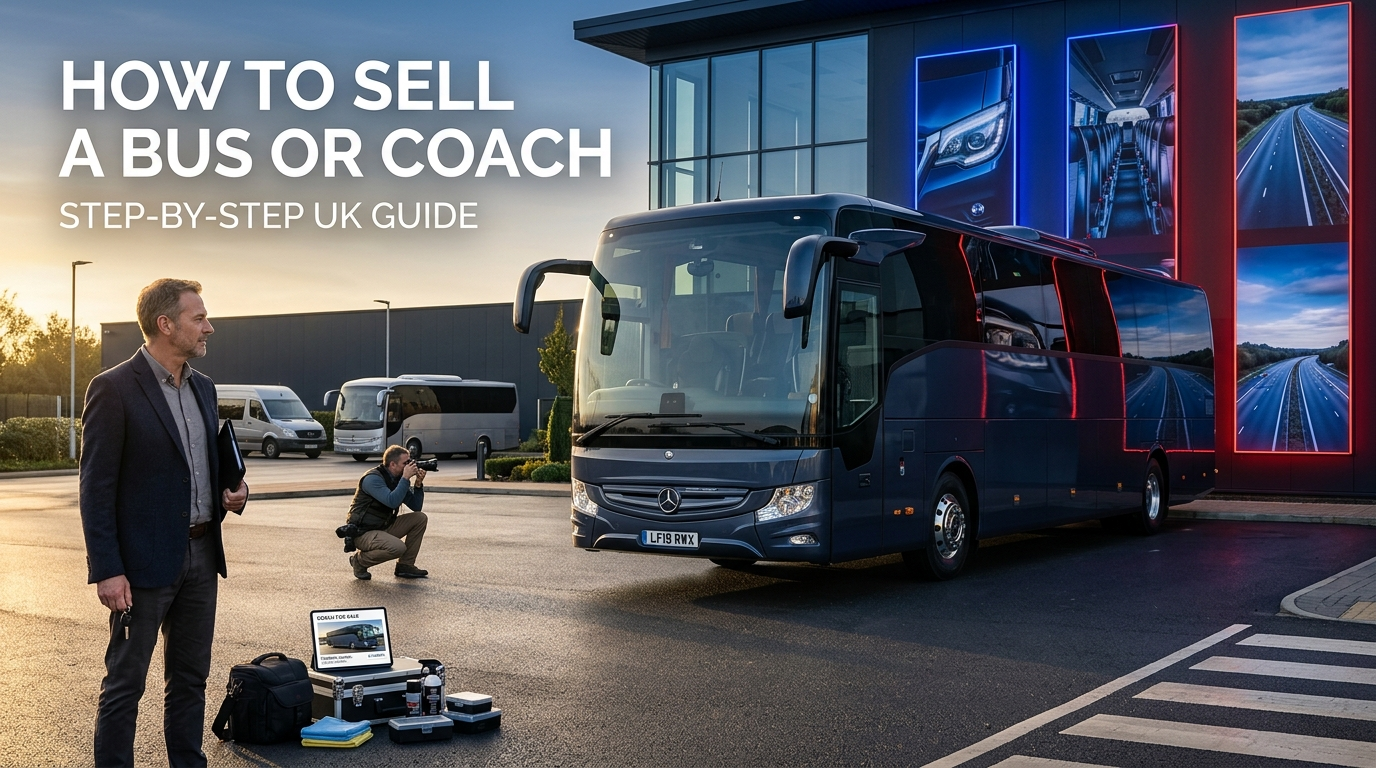
Take photographs in daylight, showing all four corners, the interior passenger area, the driver’s cab, the engine bay, and the luggage compartments. If the bus has a wheelchair lift or toilet, photograph those too. A video walk-around showing the vehicle starting from cold is genuinely useful for a buyer who may be 300 miles away.
Do not photograph a dirty bus. Operators buy from people who look after their vehicles. A valet or deep clean before photographing is worth the cost.
Who Buys Buses and Coaches in the UK?
Private Operators and Fleet Buyers
The most common buyers are small and medium-sized independent operators who run school contracts, rail replacement services, private hire work, or local bus routes. They want vehicles that can go to work immediately with minimal downtime.
These buyers will ask detailed questions about fuel consumption, parts availability, and known faults. They may send an engineer or mechanic to inspect the vehicle before agreeing a price.
Export Buyers
A large number of used buses and coaches from the UK are exported to Africa, the Middle East, Eastern Europe, and Latin America. Export buyers typically want vehicles with no MOT, or they buy at a price point where they can handle the shipping and re-registration themselves. They often buy in bulk.
Selling to an export buyer is legitimate, but you must be careful about the V5C process. You should always complete the permanent export section of the V5C if the vehicle is leaving the UK. You are also responsible for notifying the DVLA.
Conversion Buyers
Some buyers want a bus or coach not for passenger use but for conversion into a motorhome, catering unit, or static accommodation. These buyers usually want a vehicle with no or minimal MOT because they are going to strip the interior. They will often pay more for a well-maintained chassis and engine, even if the passenger seats are worn.
How Does the Sale Process Work?
1. Receiving Payment
Do not accept a cheque from a stranger for a bus. For a private sale, the only realistic payment methods are:
Bank transfer (CHAPS or Faster Payments) – The buyer sends the money to your account. You should confirm the funds have cleared in your own banking app before releasing the vehicle. Faster Payments are usually instant, but there are limits. CHAPS is used for larger amounts and carries a fee, but it is completed the same day.
Cash – For smaller amounts, cash is acceptable, but for a bus costing £30,000 or more, carrying that much cash is impractical and carries risk. If you accept cash, pay it into your bank immediately and keep a receipt.
Escrow or dealer transfer – If you are selling through a dealer or broker, they may handle payment. This is less common for private sales.
Never release the vehicle until the money is in your account and cleared. Do not accept PayPal for a bus — the fees and chargeback risk are not worth it.
2. Completing the V5C
You must complete the V5C correctly. If the buyer is taking the vehicle within the UK, fill in the new keeper details and give the green slip to the buyer. Notify the DVLA online immediately — the buyer gets a new V5C within a few weeks, and you receive confirmation that you are no longer the registered keeper.
If the vehicle is being exported, you complete the permanent export section. Keep a record of the buyer’s name and address, and the date of sale.
Do not hand over the full V5C to the buyer and rely on them to notify the DVLA. That leaves you liable for any speeding tickets, congestion charge penalties, or other issues.
3. Removing Your Operator’s Licence Details
If the bus or coach was part of an O-licence, you must inform the traffic commissioner that the vehicle has been sold. If you simply sell the vehicle without notifying the Office of the Traffic Commissioner, the vehicle may still appear on your licence. That can cause problems at your next audit or when the new owner operates it.
For a sole trader or small operator selling their only vehicle, the O-licence may need to be surrendered or amended. The Central Licensing Office in Leeds handles these notifications.
4. Road Tax (VED) Refund
Buses and coaches are subject to VED, but the rates differ from cars. If you sell the vehicle and notify the DVLA online, you will automatically receive a refund for any full months of remaining road tax. This is the same process as selling a car, but the amounts can be substantial for a large vehicle.
Do not expect the buyer to pay you separately for the remaining tax. The DVLA refunds you directly and the buyer must tax the vehicle from their end.
Common Mistakes When Selling a Bus or Coach
Advertising Without an MOT
Listing a bus with “no MOT but easy fix” is a red flag. Operators do not want to buy an unknown problem. If the vehicle is genuinely sound, spend the money on a fresh Class VI MOT before advertising. A £300-£500 test could add several thousand to the sale price.
Not Knowing the Actual Weight
If you are selling to an export buyer or someone who will transport the bus, they will ask for the unladen weight and gross vehicle weight. You can find this on the manufacturer’s plate, normally in the engine bay or near the driver’s step. Have the figure ready.
Forgetting the Keys and Locking Wheel Nut
It sounds basic, but a bus with one ignition key and no locking wheel nut key is a headache for the buyer. Gather all keys, fuel caps, and security devices before handing over. If there is a digital tachograph, make sure the driver card slot works and you have the company card (if applicable).
Not Checking the Buyer’s Intentions
If the buyer says they are collecting the bus for export but actually re-registers it in the UK under a different identity, you could be drawn into a stolen vehicle investigation. Always complete the V5C with the buyer’s real name and address. If they are evasive about where the vehicle is going, be cautious.
Do You Need to Pay Tax on the Sale?
If you are selling a bus or coach that was used in a business, the sale may have VAT implications.
If you are VAT-registered, you must charge VAT on the sale unless the vehicle qualifies for a margin scheme or is sold as a business asset outside the scope of VAT. For a bus or coach sold privately by a non-VAT-registered individual, no VAT is charged.
If the vehicle was owned by a limited company and you are selling it to yourself or a third party, speak to your accountant. The sale price may be treated as a capital disposal.
For most private sellers, there is no tax to pay on the sale itself. If the vehicle was used for a business and you claimed capital allowances, the sale proceeds may reduce the allowance claimed.
How to Complete the Sale and Hand Over the Vehicle
On the day of collection:
- Check the payment has cleared in your bank account.
- Complete the V5C and give the green slip to the buyer.
- Print two copies of a simple sale receipt: vehicle reg, date, price, buyer’s name and address, seller’s name and address, both signatures.
- Remove your personal items, tachograph charts, and any O-licence discs from the windscreen.
- Notify the DVLA online before the buyer drives away.
- Notify your insurance company that you have sold the vehicle.
If the buyer is sending a transporter, take photographs of the vehicle being loaded and keep them. This protects you if there is a dispute about damage in transit.
What About Selling a Coach Specifically?
The process for selling a coach is the same as for a bus, but the buyer pool is more focused on private hire operators, tour companies, and long-distance contractors. Coaches are higher-value vehicles, and buyers are more likely to ask for an independent inspection before purchase.
If you are selling a coach, highlight:
- The engine make and model (many operators have strong preferences for DAF, Volvo, or Mercedes-Benz)
- The gearbox type (ZF automatic vs manual)
- The heating, ventilation, and air conditioning system
- The luggage capacity in cubic metres
- Whether the coach has a toilet, kitchenette, DVD system, or Wi-Fi
A coach with a good service history and a recent Class VI MOT is a genuinely saleable asset. A coach with no MOT and worn seating is likely to attract only export or conversion buyers.
Final Summary
Selling a bus or coach privately in the UK comes down to three things: having the right paperwork, being honest about the vehicle’s condition, and pricing it realistically against the current market. A vehicle with a current Class VI MOT, a complete service history, and a clear V5C will always find a buyer more quickly than one with missing documents and a vague advert.
For smaller vehicles like minibuses, the process is closer to selling a car, and you can read our guide on how to sell a used car privately in the UK for the basics. If you are also considering buying a used truck or HGV, our complete beginner’s guide to buying a used truck in the UK covers the other side of the commercial vehicle market. And before you hand over any money or accept an offer, check our advice on common used vehicle scams in the UK and how to avoid them.
The key is to treat the sale as a commercial transaction, not a casual private sale. Operators and dealers expect documentation, honesty, and a realistic price. Provide those three things and you will sell the vehicle without unnecessary delay