How to Sell a Commercial Truck Quickly in the UK | TopSellUKCars
How to Sell a Commercial Truck Quickly in the UK
To sell a commercial truck quickly in the UK, price it against real sold and asking prices, get the paperwork ready before you advertise, and present the vehicle honestly with good photos. The fastest sales usually happen when a truck has a fresh MOT, a clear service history, and an asking price that matches its condition rather than what the owner hopes it is worth.
Selling a commercial vehicle is not the same as selling a car. Buyers are often owner-operators, haulage firms, builders, tree surgeons, or export traders. They know what a particular DAF, Iveco, Mercedes, Volvo or MAN is worth. They will ask about gross vehicle weight, axle configuration, gearbox type, body length, and whether the tail lift works. The more of that you can answer immediately, the fewer days your truck sits unsold.
What actually makes a commercial truck sell fast in the UK?
Speed comes down to five things: price, paperwork, presentation, placement and honesty. If one of those is wrong, the phone does not ring as often as it should.
A truck priced £3,000 above comparable examples will be ignored even if the photos are excellent. A truck with 10 months of MOT but no service history will still sell, but it will attract lower offers than one with a folder of invoices. A truck listed on a general car site may get views, but many of those viewers cannot legally drive it. Listing where commercial buyers actually browse matters.
The UK commercial vehicle market is quite specific. A 3.5-tonne flatbed or tipper can be driven on a standard car licence in many cases, so it appeals to small builders and landscapers. A 7.5-tonne DAF LF or Iveco Eurocargo needs a C1 licence, which narrows the buyer pool. A 12-tonne or 18-tonne rigid needs a Category C licence. An articulated unit needs CE. You do not need to write a licence guide in your advert, but stating the gross vehicle weight and the licence category helps serious buyers self-select. If you are unsure of the categories, it is worth reading our guide to HGV licence categories in the UK.
What paperwork should you sort before you list a UK truck for sale?
Paperwork is where private sellers lose time. A commercial buyer may be travelling from Birmingham, Glasgow, Cardiff or Newcastle to view the truck. If you cannot show the logbook or service records when they arrive, the deal often stalls.
V5C logbook and registered keeper
The V5C is the most important document for a private sale. It proves you are the registered keeper, not legal owner, but it is the document every serious buyer expects to see. If you have lost it, apply for a replacement from the DVLA before listing. You can still sell without it, but you will need to explain the delay and some buyers will walk away.
When the sale completes, you can transfer the vehicle online via the DVLA service or complete the relevant section of the V5C. Give the new keeper the green slip. You must notify the DVLA yourself. Do not leave this to the buyer.
Service history and maintenance records
For a commercial truck, service history is not just a stamp book. It can include oil change invoices, brake replacement receipts, tyre invoices, tachograph calibration records, and safety inspection sheets. A folder arranged by date can add hundreds or even thousands of pounds to the perceived value. If you are buying or selling a truck, checking the service history properly matters. We have a separate guide on how to check a used truck’s service history before buying that covers what to look for.
MOT and roadworthiness
A commercial goods vehicle over 3,500kg is tested through the annual test for heavy vehicles, commonly still called the MOT. The DVSA runs the testing scheme. Buyers can check the MOT history for free through the DVLA’s online service using the registration number.
A truck with a short MOT is not necessarily a bad truck, but it will attract lower offers because the buyer has to factor in the test fee, possible repairs, and downtime. If the MOT has less than six months left, consider putting it through its test early. A fresh MOT usually pays for itself in a faster sale and a stronger price. This is especially true for older trucks where the test risk is higher.
HPI and mileage checks
An HPI check or equivalent vehicle history check shows outstanding finance, recorded write-offs, stolen status, and mileage discrepancies. Do this before you advertise. You do not want a buyer to discover a finance marker you did not know about during the negotiation. If the check is clear, you can say so in the advert and show the certificate at viewing. If it is not clear, you need to resolve it or disclose it. For a broader explanation of what these checks cover, see our article on what an HPI check is and why UK buyers should never skip one.
VAT and invoicing
If you are VAT-registered and selling a commercial vehicle through your business, state clearly whether the asking price is plus VAT or includes VAT. A VAT-registered buyer may want a proper VAT invoice. A non-VAT-registered buyer will care about the total amount leaving their account. If the truck is owned personally, no VAT applies. If you are unsure about your VAT position, speak to your accountant before you advertise, because changing the price mid-sale creates suspicion.
Here is a quick reference table for the documents and details you should have ready:
| Document or item | Why it matters | What to do before listing |
|---|---|---|
| V5C logbook | Proves registered keeper and makes transfer possible | Have it ready; if lost, apply to DVLA |
| MOT certificate and history | Shows current roadworthiness | Check expiry and consider early test |
| Service records and invoices | Builds buyer confidence in mechanical condition | Organise by date and keep in the cab |
| HPI or history check | Reveals finance, write-offs and mileage issues | Run one and keep the report |
| VAT invoice details | Needed by business buyers if VAT applies | State VAT status clearly in the advert |
| Private number plate retention | Needed if you want to keep the plate | Apply to DVLA on form V317 before sale |
| Tachograph records or calibration details | Relevant for commercial use | Note what is included |
How do you price a used commercial truck realistically?
The fastest way to kill a commercial truck sale is to price it using what you spent on it rather than what the market will pay. A truck that cost £42,000 four years ago may now be worth £18,000. That is normal depreciation, not a reflection on your care.
Start by looking at completed or currently advertised examples on commercial vehicle listing sites, including TopSellUKCars. Search for the same make, model, year, engine, gearbox, body type and approximate mileage. Do not compare a 2014 DAF LF 45 with a 2019 model and assume the newer price applies.
Then look at what dealers are asking and subtract a realistic margin. A private seller will usually get less than a dealer because they cannot offer a warranty, finance, or a trade-in. That does not mean you should give the truck away, but you need to be honest about the difference. If a dealer has a similar truck up for £22,000, a private sale at £19,000 to £20,000 is more likely to move than £21,995.
Auction results can be useful, but they often reflect trade prices and can be lower than private sale values. If you need a fast sale, a price near the trade end of the range will generate more calls.
The key pricing factors are:
- Gross vehicle weight and body type
- Engine size, Euro emissions standard and fuel type
- Gearbox type and condition
- Mileage relative to age
- MOT length
- Service history and recent major repairs
- Tyre condition across all axles
- Body, chassis and load bed condition
- Tail lift, fridge unit, crane or other fitted equipment
- Whether the truck is ULEZ or Clean Air Zone compliant
If your truck is non-compliant with the London ULEZ or other clean air zones, say so. Many buyers specifically want older non-compliant trucks for work outside these zones, but they need to know before travelling. Hiding it wastes everyone’s time.
Where should you advertise a commercial truck to get the fastest genuine enquiries?
Not all listing platforms are equal for commercial vehicles. A general car classified site may have lots of traffic, but a 7.5-tonner can sit unnoticed among thousands of hatchbacks. A specialist commercial vehicle platform, or the commercial section of a mixed platform like TopSellUKCars, usually works better because the buyers are already looking for trucks, buses or vans.
Consider these channels:
- TopSellUKCars for UK-wide commercial vehicle exposure
- Local trade and haulage Facebook groups
- Specialist truck and plant sales websites
- Word of mouth with other operators or trade contacts
- Auction houses if the truck is older, high-mileage or needs to move in days
Wherever you advertise, include the registration year, gross vehicle weight, body type, mileage, MOT expiry, engine and gearbox details, and a clear price. Adverts with “price on application” get fewer responses from private buyers, although they are common in trade sales.
How should you photograph and describe a commercial truck?
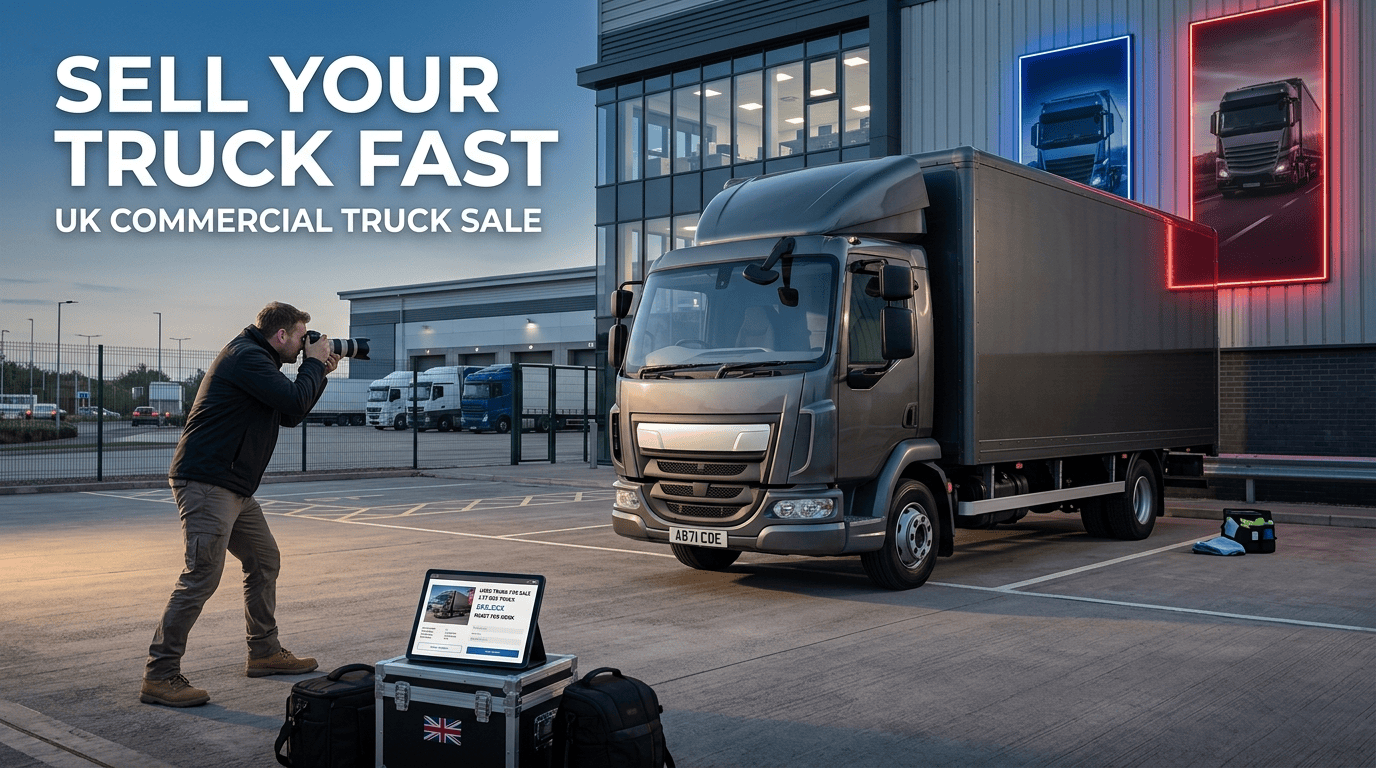
Commercial buyers want to see the working parts, not just a clean cab. Good photos save you from dozens of phone calls asking basic questions.
Take photos of:
- Front, rear and both sides, in daylight
- Cab interior and dashboard with mileage visible
- Engine bay if reasonably accessible
- Chassis rails from underneath where possible
- Load bed, floor, sides and any body damage
- Tyre tread across all axles
- Tail lift, crane, fridge unit or other fitted equipment
- MOT certificate or service records if you want to show them
A short walk-around video helps because it shows the truck starts and moves. That can reduce time-wasting viewings.
In a used truck listing in the UK, the description is often the difference between a phone call and a scroll past. Be specific. Write something like:
“2016 DAF LF 45 4×2 rigid, 150,000 miles, 4.5-litre engine, manual gearbox, curtainside body, MOT until October 2026, tail lift tested in May, ULEZ compliant, full service history, no known faults except small dent on nearside rear bumper.”
That tells a buyer most of what they need to know before they pick up the phone. Avoid vague phrases like “good condition for age” without backing them up. If it has a known fault, state it briefly. A buyer who discovers a hidden fault will either lower their offer or leave.
What should you say and not say to a buyer?
Be honest, but do not overshare in a way that makes the truck sound neglected. There is a difference between “the clutch bites high but works fine” and “the clutch is on its last legs”. If you know something is unsafe or likely to fail, say so clearly. Commercial buyers often know more about the vehicle than a private seller, and they will test your credibility quickly.
Do not say “no timewasters” or “no tyre kickers” at the top of the advert. It makes the listing sound aggressive and puts off genuine buyers. Instead, add enough detail that timewasters filter themselves out. If you only want serious buyers, say “viewings by appointment after a phone call” rather than “no dreamers”.
Do not claim the truck has never had an accident unless you can prove it. Do not claim it is ULEZ compliant unless you have checked against the registration. A simple registration check on the Transport for London website takes a minute.
How do you handle viewings and test drives for an HGV or van-based truck?
Viewings for commercial vehicles are often at a yard, depot or farm rather than a home address. That is fine, but be aware of safety and security. If you are meeting a stranger, bring someone with you and keep the keys secure until they prove they are serious and licensed.
For a test drive, check the buyer’s licence. A 7.5-tonne truck requires a C1 category on their licence unless the vehicle is exempt or being driven under specific conditions. A truck over 7,500kg requires a Category C licence. An artic or drawbar combination requires CE. If they do not have the right entitlement, they cannot drive it on public roads. You can read more about this in our guide to truck licence categories in the UK.
Your insurance needs to cover the buyer for the test drive. Many private motor policies do not cover an unknown driver in a commercial vehicle. If you are not sure, do not allow the test drive until the buyer arranges their own cover. A short run at low speed in an industrial estate is not worth an insurance offence.
If the truck has no MOT or is not roadworthy, do not allow a test drive on public roads. The buyer can inspect it, start the engine, and perhaps drive it on private land with permission, but you must not encourage or allow an illegal road test.
What is the legal process for completing the sale and transferring ownership?
Once you agree a price, get payment first in cleared funds. For commercial trucks, that usually means a bank transfer. A CHAPS transfer can clear the same day; a standard Faster Payment usually clears within two hours but can sometimes be held by the bank. Do not hand over the keys until the money is in your account.
Avoid cash for high-value sales unless you are comfortable with the risks and can verify the notes. Avoid personal cheques unless you are willing to wait for full clearance. Be cautious with payment from someone who is overseas or claims to be sending an agent. Common vehicle sale scams are covered in our guide to common used car scams in the UK, and the same patterns apply to trucks.
When the payment clears, complete the V5C transfer. You can do this online with the DVLA using the 11-digit document reference number from the V5C. The DVLA will update the registered keeper instantly and you will get an email confirmation. Alternatively, complete section 6 of the V5C and give the green slip to the buyer. Keep a photo or scan of the completed section.
You cannot transfer road tax when you sell a commercial vehicle in the UK. The VED or road tax does not follow the vehicle to the new owner. If you have any full months of tax remaining, the DVLA usually refunds them to you automatically once you notify them of the sale. The buyer must tax the vehicle before driving it away on public roads. This catches out a lot of buyers, so mention it before they arrive.
If you have a private number plate on the truck and want to keep it, you must apply to retain it before the sale. Use DVLA form V317. If you sell first, the plate goes with the vehicle.
Can you sell a commercial truck with no MOT or known faults?
Yes, you can sell a truck with no MOT or known faults, but you need to be honest about it. Some buyers want a project, a donor vehicle, or an export truck. They will still buy, but they will expect a lower price because they cannot test drive it on public roads and they have to factor in recovery or transport.
If the truck is off the road, say so in the advert. State the reason, such as failed MOT on corrosion, engine fault, or accident damage. Do not pretend it is a simple fix unless you know that for certain. A buyer who travels from Manchester to Peterborough expecting a runner and finds a non-runner will be angry, and for good reason.
If the truck has failed an MOT, you can show the failure sheet. That is actually useful to a buyer because it tells them exactly what the tester found. If you have repair quotes, include them. This turns a negative into a more transparent sale.
Quick checklist for selling a commercial truck in the UK
Use this before you advertise:
- Find the V5C and check the registered keeper details
- Run an HPI or history check and keep the report
- Check the MOT expiry and consider an early test
- Gather service records and invoices in date order
- Decide your VAT status and whether the plate is being retained
- Research comparable sold and asking prices
- Take photos of the cab, body, chassis and fitted equipment
- Write a specific description with mileage, weight, body type and faults
- List on a commercial vehicle platform and any local trade groups
- Prepare a payment and ownership transfer plan before viewings begin
Summary
Selling a commercial truck quickly in the UK is rarely about luck. It is about having the paperwork ready, pricing against real market evidence, showing the truck honestly, and putting it in front of buyers who can actually use it. If you do those things, the sale usually follows. If you try to hide defects, overprice it, or wait for someone who loves it as much as you do, you can be waiting for months. For more buying and selling guides, visit the TopSellUKCars blog or read our guide on buying a used truck in the UK.