
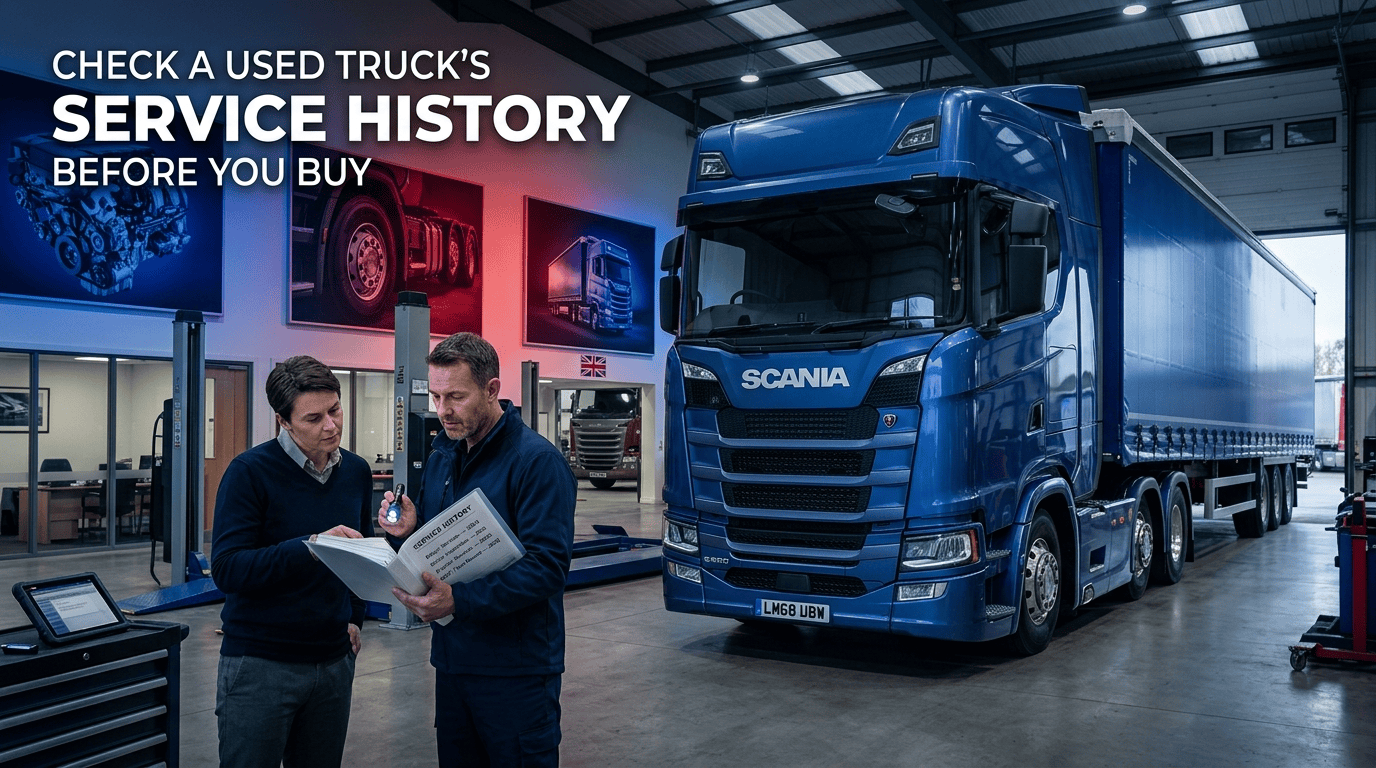
How to Check a Used Truck’s Service History Before Buying (UK Guide)
How to Check a Used Truck’s Service History Before Buying
To check a used truck’s service history in the UK, start by asking the seller for the V5C logbook and any paper or digital service records, then verify the MOT history online using the DVLA’s free MOT checker. Cross-reference the recorded mileage on service documents with the MOT history to spot clocking or fraud. For commercial vehicles, it is also wise to run a paid commercial vehicle history check through a provider like HPI or the RAC to uncover outstanding finance, write-offs, or mileage discrepancies.
Buying a used truck is a significant financial decision for an owner-operator or a fleet manager in Birmingham, Manchester, or Glasgow. Unlike a car, a truck is a working tool. If it has been neglected, it will cost you money in downtime, failed inspections, and expensive component failures. The engine, gearbox, and braking system on a modern HGV can cost thousands of pounds to rebuild or replace. The best way to protect yourself from buying a liability is to scrutinise the vehicle’s documented past before you hand over any cash.
Why a Truck’s Service History Matters More Than a Car’s
A car can often survive on sporadic maintenance. A truck cannot. Commercial vehicles operate under immense stress, often covering 100,000 miles a year while hauling heavy loads. Under the rules set by the Traffic Commissioner and the DVSA (Driver and Vehicle Standards Agency), operators of goods vehicles over 3.5 tonnes must demonstrate that the vehicle is maintained in a roadworthy condition.
For an HGV, a full and verifiable service history is not just a “nice to have”—it is a core requirement for passing roadside inspections and keeping your Operator’s Licence (O-Licence) clean. If you buy a truck with a missing history, you are inheriting a risk. The Driver and Vehicle Standards Agency (DVSA) can issue prohibitions for vehicles with defective brakes or tyres, regardless of whether the fault existed when you bought it.
When looking at a truck, you need to look beyond the polished paintwork. The real value of the vehicle lies in the quality of the oil that has been running through the turbo, the frequency of brake adjustments, and the condition of the DPF (Diesel Particulate Filter). None of these are visible from the outside; they are only proven by paperwork and digital records.
Where to Find the Truck’s Service Records
The first stop is the seller. You need to request the physical documentation before you even travel to view the truck. If a seller is hesitant or claims the records are “at the accountant’s office,” treat that as a major red flag.
There are three main types of service history for a used truck in the UK:
- Main Dealer History: Trucks maintained by official marque dealers (Scania, Volvo, DAF, Mercedes-Benz, MAN, Iveco, Renault) will have records in the manufacturer’s digital database. If the seller provides a registration number and VIN, you can often call the local dealer and verify the service stamps.
- Independent Commercial Garage History: Many reputable haulage firms use independent heavy goods vehicle workshops. These garages should provide itemised invoices detailing the work carried out, the parts used (OEM vs aftermarket), and the mileage at the time of service.
- In-House Maintenance: Some large fleets have their own O-Licence and maintain vehicles using their own employed fitters. This is common in logistics hubs in the Midlands and the North West. For this to be valid, there must be a rigorous PMI (Preventive Maintenance Inspection) sheet trail.
The Difference Between a Service Book and an Inspection Sheet
Do not be fooled by a stamped book. A stamp is easy to forge. You want to see the actual invoices.
A genuine service history for a commercial vehicle should include:
- PMI Sheets: Heavy trucks require safety inspections every 6 to 12 weeks, depending on the operation. These sheets list brake wear percentages, tyre tread depths, and defect reports.
- Lubrication Records: Proof of regular oil and filter changes. For modern trucks, this should adhere to the manufacturer’s specified oil drain intervals (often between 50,000 and 80,000 miles depending on usage).
- Tachograph Calibration Records: While not strictly a “service” item, the tachograph must be calibrated every two years. A truck with a history of late tachograph checks suggests a careless operator.
- MOT Certificates: You can verify these independently.
How to Run a Free MOT History Check on a Truck
The fastest, most reliable fact-check you can do is to look at the truck’s MOT history. This is a free government service provided by the DVSA.
To run a truck MOT history check, you need the vehicle registration number (the number plate). You can find this on the DVLA website.
Navigate to the “Check the MOT history of a vehicle” service on GOV.UK. Enter the registration number. You will be presented with a complete history of every MOT test the truck has passed or failed since 2005 (or since it was first registered).
When reviewing this history, look at the following:
1. The Mileage Graph
The most revealing part of the MOT history is the recorded mileage at each test. In the UK, the DVLA records the odometer reading at every MOT. If a truck was doing 80,000 miles a year for three years, then suddenly drops to 20,000 miles a year, ask why. Has the operation changed, or has the odometer been tampered with? If you see a mileage reading in a later test that is lower than an earlier one, the vehicle has been “clocked.” Walk away.
2. The Failure and Advisory Pattern
A clean pass with no advisories is good. A pass with a long list of advisories for corroded brake pipes, worn kingpins, or oil leaks tells you the previous owner ran the truck on a budget. If the same advisory appears year after year—for example, “brake disc worn, pitted or scored but not seriously weakened”—it means the owner ignored maintenance until it became a fail. This is a sign of reactive maintenance rather than proactive maintenance.
3. The Test Location
MOT test stations are listed on the certificate. If a truck has been tested in Leeds for five years, it suggests a stable base. If it bounces between test stations in different cities every year with different owners, it may have been a rental or spot-hire vehicle that was passed around.
How to Verify the Paperwork with the DVLA
The V5C logbook proves the registered keeper, but it does not prove ownership. It is essential to check that the details on the V5C match the physical vehicle.
Check the following against the V5C:
- VIN (Vehicle Identification Number): This is usually stamped on the chassis rail on the driver’s side or on a plate in the cab. It must match the document exactly. If the plate looks like it has been re-riveted or the numbers look uneven, be suspicious.
- Chassis Number: For trucks, the chassis number is often the last 6 digits of the VIN. This tells you the sequence of the build.
- Revenue Weight: This confirms the gross vehicle weight the truck is plated for. A 44-tonne tractor unit is a very different proposition from an 18-tonne rigid.
You can check the vehicle’s tax (VED) status and MOT status online. Be aware that for Heavy Goods Vehicles, the tax class is different. Many trucks run on “HGV” tax class, which is based on weight and axle configuration. If the truck is currently taxed as “Private HGV” but you intend to use it for hire or reward, you must change the tax class with the DVLA.
Running a Commercial Vehicle History Check
While the DVLA gives you free data, a paid check gives you the “hidden” data. When buying a truck, a basic £10 car check is not enough. You need a commercial vehicle history check that searches for finance agreements.
Why is this critical for trucks? Because commercial vehicles are often financed. A business might lease a fleet of trucks through a finance house. If the seller is struggling financially, they might try to sell a truck that still has an outstanding lease agreement on it. If you buy a truck with outstanding finance, the finance company can repossess it from you, even if you paid the seller in good faith.
Use a provider like HPI Check, Experian AutoCheck, or the RAC Commercial Vehicle Check. When you run this check, you will need the registration number and the VIN. The report will tell you:
- If the truck is recorded as stolen.
- If the truck has outstanding finance (a logbook loan or lease).
- If the truck has been written off as a Category A, B, S, or N insurance loss.
- If the truck has been subject to a safety recall that has not been actioned.
The Owner-Operator vs. Fleet Truck History
When buying a truck, you will encounter two distinct types of sellers.
The Fleet Disposal
These trucks come from companies like DHL, Stobart, or smaller regional hauliers in places like Avonmouth or Peterborough. These trucks are usually sold because they have reached a certain age or mileage threshold (e.g., 4 years old or 500,000 miles). The advantage is that these companies usually follow strict maintenance schedules because their O-Licence depends on it. The service history is usually computerised and complete. The disadvantage is that the trucks have often been driven by multiple different drivers who may not have treated the clutch or gearbox with care.
The Owner-Operator
These trucks are often higher specification (leather seats, better sound systems, polished alloys). The owner is usually selling the truck because they are retiring or upgrading. The history here can be a mix of dealer stamps and private receipts. You should pay close attention to the “downtime” records. A truck that has spent weeks in a workshop for a major engine rebuild might actually be a better buy than one that has never been opened up, provided the work was done by a reputable specialist.
Spotting Red Flags in the Service History
You need to be forensic. Look for gaps in the timeline. A truck that has no service records for the first three years of its life, then suddenly has a full history, likely lost its warranty due to poor maintenance early on.
Look at the types of parts used. If you see invoices for cheap aftermarket brake pads and unbranded oil filters, the previous owner was cutting corners. For a modern Euro 6 truck, using the wrong specification of engine oil can destroy the DPF (Diesel Particulate Filter) and the EGR (Exhaust Gas Recirculation) valve. The oil must meet the manufacturer’s ACEA specification (e.g., ACEA E6 or E9 for many modern trucks). Check the invoices to see if the correct oil was used.
Watch out for “Clockers.” Odometer fraud is rife in the commercial vehicle world. Because trucks do high miles, reducing the odometer by 200,000 miles can increase the sale price by thousands of pounds. Compare the wear on the driver’s seat and pedals to the mileage. A truck showing 200,000 miles should not have a seat cushion that is collapsed and a brake pedal worn smooth. Check the mileage on the tachograph unit and the engine ECU if possible; these are harder to tamper with than the dashboard display.
Inspecting the Truck to Verify the History
The paperwork is the plan, but the physical inspection is the proof. You should always inspect the truck in daylight and, ideally, dry weather.
Look for evidence that matches the records. If the history says the brake pads were changed 10,000 miles ago, they should look relatively thick. If the history says the truck had a new fifth wheel coupling fitted, it should look new.
Check the tyre dates. Tyres have a four-digit date code (e.g., 4523 means week 45 of 2023). If the service history shows new tyres fitted recently but the tyres are old, the history is false.
A Quick Checklist for Your Viewing
Here is a quick checklist to print out and take with you:
| Check Item | What to Look For | Good Sign | Bad Sign |
|---|---|---|---|
| MOT History | Mileage progression, failure list | Consistent annual mileage, few failures | Mileage drops, repeat brake/electrical fails |
| PMI Sheets | 6-12 weekly inspections | Grease stains, actual driver defect reports | Clean, computer-generated boxes with no notes |
| Oil Changes | Frequency and specification | Every 40-60k miles, correct ACEA grade | “Top-up” only, cheap bulk oil |
| Coolant | Colour and level | Clear, correct colour (red/blue) | Brown sludge, oil film in expansion tank |
| Chassis Rails | Cracks, welding, straightness | Straight, factory underseal | Fresh underseal hiding rust, cracked crossmembers |
| Fifth Wheel | Wear on the jaw | Greased, minimal slack | Deep grooves, missing locking clip |
What to Do If There Is No Service History
Sometimes you find the perfect truck at the perfect price, but the seller has “lost” the service history. Should you buy it?
The honest answer is: only if you factor in the risk. If there is no history, you must assume the worst. Assume the oil has not been changed on time. Assume the DPF is clogged. Assume the brakes need immediate attention.
If you still want to proceed, you should arrange for an independent pre-purchase inspection by a qualified HGV mechanic. This is different from an MOT. An MOT confirms the minimum road safety standard on the day of the test. An inspection tells you what is about to break. The mechanic can drain a small amount of oil to look for metal fragments, check the turbo shaft for play, and use a diagnostic computer to read the ECU for logged fault codes. A truck that has been neglected will often have a history of fault codes for low oil pressure or overheating stored in the engine computer, even if the dashboard light is not currently on.
The Cost of Getting It Wrong
To give you a concrete perspective, consider the cost of a failed turbocharger on a 13-litre engine. A replacement turbo can cost between £1,500 and £3,000, plus fitting. A set of six injectors can cost over £2,000. A clutch replacement on a tractor unit can easily exceed £1,000.
If a truck is cheap because it lacks a service history, it is not cheap. It is just the down payment on the repair bill.
Summary
Checking a used truck’s service history is about verifying the mileage, confirming the maintenance schedule, and ensuring the vehicle is not hiding a major mechanical issue or outstanding finance. Start with the free DVLA MOT checker, then verify the paper invoices, and finish with a physical inspection that tests the claims made on paper. If the seller cannot provide a coherent history, walk away or budget for the immediate repair costs. A commercial vehicle is a business asset; its history is the roadmap to whether it will make you money or drain it.

















Comments
3
[…] The guide to buying a used truck in the UK covers those basics properly, and the used truck service history checklist walks through the records you should expect to […]
[…] Service history: a missing service history on a modern Euro VI truck is a bigger risk than on an old mechanically injected lorry. Look for regular oil changes, brake inspections and any aftertreatment repairs. We have a separate article on checking a used truck’s service history. […]
[…] Trucks and pickups: For pickups, check the chassis for off-road damage and the load bed for dents that suggest genuine commercial use. Look for signs the previous owner towed heavy trailers, which accelerates transmission wear. For larger trucks, you need a different level of diligence: tachograph records, laden weight certificates, and a full commercial service history. A cheap 7.5-tonner with no service records is not a bargain — it is a liability. We have a dedicated guide on checking a used truck’s service history before buying. […]