
Truck Licence UK: HGV Categories C1, C and C+E Explained | TopSellUKCars
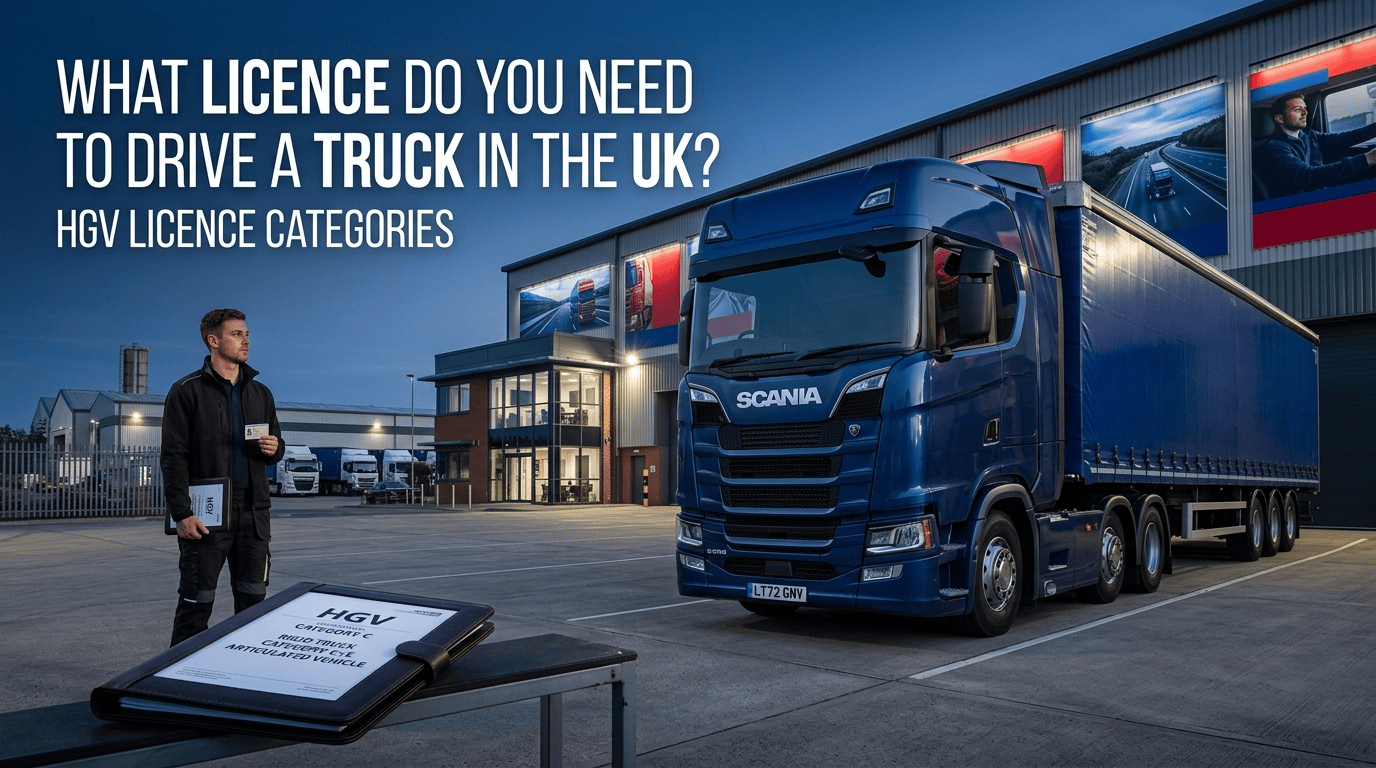
What Licence Do You Need to Drive a Truck in the UK?
To drive a truck professionally in the UK, you will almost always need a Category C licence (Class 2) for rigid vehicles or a Category C+E licence (Class 1) for articulated lorries, plus a valid Driver Certificate of Professional Competence (CPC). However, if you are only moving house, driving a horsebox, or collecting a classic truck privately, you may be able to drive certain vehicles weighing up to 7.5 tonnes on a standard car licence obtained before 1997. The exact licence you need depends on the vehicle’s Maximum Authorised Mass (MAM), when you passed your car test, and whether you are driving for hire or reward.
Understanding the different UK truck licence categories
The UK licensing system for lorries can seem deliberately confusing, largely because the DVLA uses European harmonised categories that look like a bowl of alphabet soup. If you are browsing trucks for sale on TopSellUKCars and wondering if you can legally drive one home, you need to cut through the jargon.
The two main categories you will see on the back of a UK photocard licence are C and C+E.
Category C is often called “Class 2” in the trade. It allows you to drive a rigid vehicle over 3,500kg (3.5 tonnes) with a trailer up to 750kg. Think of a standard bin lorry, a tipper truck, or a 7.5-tonne box van used for local deliveries.
Category C+E is known as “Class 1” in the haulage industry. It permits articulated lorries (artics) or rigid vehicles towing trailers over 750kg. This is the licence held by long-distance HGV drivers moving goods between depots in Manchester, Glasgow, or Cardiff.
There is also Category C1, which covers vehicles between 3,500kg and 7,500kg with a trailer up to 750kg. This is the “7.5-tonner” licence, commonly used by ambulance drivers, small horsebox owners, and delivery drivers. A C1+E allows you to tow a trailer over 750kg behind a 7.5-tonne vehicle, provided the combined MAM does not exceed 12,000kg.
When people talk about an “HGV licence” or “LGV licence,” they generally mean Category C or C+E. Officially, the DVLA calls them Large Goods Vehicle (LGV) licences, but the term HGV (Heavy Goods Vehicle) is still used by nearly everyone in the industry, including most training schools.
Can I drive a truck on a normal UK car licence?
This is the question that causes the most confusion, and it comes up constantly from buyers looking at smaller trucks on our listings.
If you passed your car driving test before 1 January 1997, you automatically have “grandad rights” for Category C1 and C1+E. That means you can legally drive a vehicle up to 7.5 tonnes MAM without taking a separate lorry test. You can also tow a trailer as long as the combined weight does not exceed 8.25 tonnes. This is why you sometimes see a 68-year-old farmer driving a 7.5-tonne horsebox with no HGV badge on the windscreen.
If you passed your car test on or after 1 January 1997, your standard Category B licence only covers you for vehicles up to 3,500kg MAM. That includes a large van like a Ford Transit or Mercedes Sprinter, but it does not cover a 7.5-tonne truck. To drive anything heavier than 3.5 tonnes, you need to pass the Category C1 or C test.
There is one partial exception introduced in 2021: if you passed your car test after 1997 and you want to drive an alternatively-fuelled vehicle (electric or gas-powered) between 3,500kg and 4,250kg, you can do so on your normal licence. However, this only applies if you have held your licence for at least two years and you are not towing a trailer. It is designed to accommodate the extra weight of batteries in electric vans, not to let you drive a diesel 4.5-tonne truck for free.
A practical note for truck buyers: you can legally buy any truck you like with a standard car licence. There is no requirement to hold a Category C licence to purchase a 26-tonne rigid or even a 44-tonne artic. The licence only matters when you come to drive it. If you are buying a truck to be driven by an employee or a contractor, ensure they can produce the right category on their licence before you hand over the keys.
What is the difference between C1, C, and C+E licences?
To avoid a wasted trip to a DVSA test centre or a hefty fine from a roadside inspection, it is worth understanding exactly what each category allows. Here is a simple table that sets out the main distinctions:
| Licence category | Common name | Vehicle weight allowed | Trailer allowed | Typical vehicles |
|---|---|---|---|---|
| C1 | 7.5-tonne | 3,500kg – 7,500kg | Up to 750kg | Horsebox, ambulance, small delivery truck |
| C1+E | 7.5-tonne + trailer | 3,500kg – 7,500kg | Over 750kg (combined MAM max 12,000kg) | 7.5-tonne truck with livestock trailer |
| C | Class 2 | Over 3,500kg | Up to 750kg | Rigid tipper, skip lorry, 18-tonne box truck |
| C+E | Class 1 | Over 3,500kg | Over 750kg (no upper combined limit) | Articulated lorry, drawbar combination |
The key distinction between C1 and C is weight. The key distinction between C and C+E is whether the trailer exceeds 750kg. Most professional haulage work requires C or C+E. Most private use of a medium-sized truck can be covered by C1, provided you have the relevant entitlement.
Grandad rights: driving a truck if you passed your car test before 1997
Drivers who passed their car test before 1 January 1997 hold a unique position in the UK licensing system. The DVLA automatically granted them Category C1 and C1+E entitlements when the new categories were introduced, as well as Category D1 (minibus up to 16 seats) and various others.
This means a pre-1997 licence holder can get behind the wheel of a 7.5-tonne truck without ever having taken a lorry driving test. They do not have Category C or C+E. If they want to drive a rigid truck over 7.5 tonnes, they still need to take the Category C test.
There are a few conditions attached to grandad rights. The Category C1 entitlement on a photocard licence expires when the holder reaches 70, unless they complete a D4 medical form and renew it. If you let this lapse, you lose the entitlement and would need to take a C1 test to regain it. Many older drivers have been caught out by this, particularly those who bought a horsebox in their sixties and assumed they could drive it forever.
Also, grandad rights do not include the Driver CPC. If you want to drive a 7.5-tonne truck professionally—say, for a small removals firm in Leeds—you still need to complete the initial CPC qualification, even though you already hold the underlying licence entitlement. You can drive the same truck privately without a CPC, but not for commercial work.
If you are buying a 7.5-tonne truck and plan to drive it yourself, check the date on your car licence first. It could save you thousands in training costs.
How to get a Category C licence (Class 2)
The process for obtaining a Category C licence is more involved than a car test, but it is straightforward once you understand the steps.
Step 1: Check your eligibility. You must be at least 18 years old to hold a Category C licence. You must already hold a full Category B (car) licence. If you want to drive for a living, you will also need to be able to pass a medical.
Step 2: Complete a D4 medical. You need to book a medical with a doctor who is registered with the DVLA. Many training providers can recommend a local doctor who does D4 medicals for around £50–£80. The doctor will check your eyesight, blood pressure, and general fitness. They then complete the D4 form.
Step 3: Apply for a provisional Category C entitlement. Send your D4 form and your photocard licence to the DVLA, or complete the application online if your doctor submits the medical electronically. The DVLA will return your licence with provisional C entitlement added.
Step 4: Pass the theory tests. You need to pass two theory modules: the multiple-choice test (Part 1a) and the hazard perception test (Part 1b). These are taken at an approved theory test centre. The pass mark is 85 out of 100 for the multiple-choice and 67 out of 100 for hazard perception.
Step 5: Take professional training. Most people book a training course with an approved LGV training school. A typical Category C course is around 3–5 days, depending on your experience. Training costs vary by region—expect to pay roughly £1,200–£1,800 in the south of England, and slightly less in the Midlands or the North.
Step 6: Pass the practical test. The practical test for Category C lasts about 90 minutes and includes vehicle safety questions, reversing exercises, and on-road driving. You need to demonstrate that you can handle a large rigid vehicle safely in real traffic.
Step 7: If driving professionally, complete the Driver CPC. To drive a lorry for hire or reward, you need the initial Driver CPC qualification. This involves a separate theory test (case studies) and a practical demonstration test covering vehicle safety and loading. Once you have passed, you receive a Driver Qualification Card (DQC) valid for five years.
How to get a Category C+E licence (Class 1)
The route to Class 1 follows the same steps as Category C, with one important difference: you must first pass your Category C test before you can take the C+E test. You cannot go directly from a car licence to C+E.
The additional training for C+E focuses on coupling and uncoupling trailers, reversing an artic, and managing the different handling characteristics of a tractor unit and trailer. A typical C+E course takes 3–5 days and costs between £1,500 and £2,200. The practical test lasts around 90 minutes and includes an off-road reversing exercise and an on-road driving section.
If you are considering a career change into haulage, many employers in cities like Birmingham, Bristol, and Newcastle will sponsor your Category C or C+E training in return for a commitment to work with them for a set period. This is worth investigating if the upfront training costs are a barrier.
What is the Driver CPC and do I need it?
The Driver Certificate of Professional Competence (CPC) is a separate qualification from your driving licence. It is required for anyone driving a lorry, bus, or coach professionally within the UK or the EU.
You need a Driver CPC if:
- You drive a Category C, C1, C+E, or C1+E vehicle for your job
- You are paid to drive, or driving is a core part of your role
- You are self-employed and your main activity involves driving trucks
You do not need a Driver CPC if:
- You drive a truck purely for personal use (e.g., moving your own furniture, taking your own horsebox to a show)
- You are a farmer driving within 100km of your holding as part of agricultural work (certain exemptions apply)
- You are taking the vehicle to a pre-booked MOT test or to a DVSA inspection
The initial CPC involves two additional tests: a case studies theory test and a practical demonstration test. After passing, you receive a Driver Qualification Card (DQC), which you must carry whenever you drive professionally. Drivers who passed their Category C or C+E test before 10 September 2009 automatically have “acquired rights” to the CPC and do not need to take the initial qualification, but they must still complete 35 hours of periodic training every five years.
If you employ truck drivers, checking their DQC and licence categories should be part of your standard recruitment process. Driving without a valid CPC can result in a £300 fixed penalty for the driver and potential prosecution for the operator.
What truck can I drive for private use?
Plenty of people buy trucks for reasons that have nothing to do with professional haulage. You might be restoring a classic Scania, building a race truck to transport a rally car, or converting a 7.5-tonner into a motorhome. The rules for private use are considerably less demanding.
For private use, you only need the correct licence category for the vehicle’s weight. You do not need a Driver CPC, you do not need an operator’s licence (O-licence), and you do not need to fit a tachograph unless the vehicle’s unladen weight exceeds 7.5 tonnes (for pre-2006 vehicles) or it is used commercially.
However, “private use” is strictly interpreted. If you carry any goods for payment, or if the truck is used to transport materials connected with a business—even your own business—it is considered commercial use. A self-employed builder driving a 7.5-tonne tipper to carry sand is driving commercially, not privately.
Also note that vehicles over 3,500kg registered before 1 January 2006 may need a tachograph fitted if they are capable of carrying goods and are used commercially. Modern trucks (registered after 1 May 2006) must have a digital tachograph if used commercially.
Do I need an operator’s licence to drive a truck?
This is a separate requirement from your driving licence, and it catches out new truck owners more often than any other regulation.
If you use a goods vehicle over 3,500kg for commercial purposes—carrying goods for hire or reward, or transporting your own goods in connection with a trade or business—you need a Goods Vehicle Operator’s Licence issued by the Traffic Commissioner. This applies whether you own one van or a fleet of fifty artics.
There are three types of O-licence: Standard International (for carrying goods for hire or reward, including abroad), Standard National (for carrying your own goods or others’ goods within the UK), and Restricted (for carrying only your own goods).
Applying for an O-licence involves proving you have a suitable operating centre (where the vehicle is parked), sufficient financial standing (currently £8,000 for the first vehicle and £4,450 for each additional vehicle for standard licences), and a nominated transport manager with a Certificate of Professional Competence in Road Haulage. The application is made through the DVSA’s VOL system.
If you buy a truck and only use it privately, you do not need an O-licence. If you lend it to a friend who uses it to move their sofa, that is still private. But the moment money changes hands for transport services, you are operating commercially and need the paperwork to prove it.
Can I drive a truck on trade plates?
Trade plates are issued by the DVLA to motor dealers, repairers, and vehicle testers. They allow the holder to use an untaxed vehicle on the road for specific purposes, such as delivering it to a customer, taking it to an MOT test, or testing it after repair.
Trade plates do not exempt you from the requirement to hold the correct driving licence category. If the vehicle is over 3,500kg and you only hold a car licence, you cannot legally drive it on trade plates, unless you have grandad rights for C1 and the vehicle is under 7.5 tonnes.
Trade plates also do not exempt you from insurance requirements. The vehicle must be covered either by a trade policy held by the plate holder or by a specific policy for that vehicle.
If you are buying a truck from a dealer on TopSellUKCars and you are not licensed to drive it home, you have a few options. You can pay for delivery, hire a professional driver, or have a friend or employee with the correct licence collect it. It is common for truck buyers to arrange a transporter for heavier vehicles, which is often cheaper than the fuel and time involved in driving a truck halfway across the country anyway.
How much does it cost to get a truck licence in the UK?
Costs vary depending on where you train, how quickly you learn, and whether you need CPC as well. As a rough guide, a complete Category C licence from scratch—including medical, provisional licence, theory tests, training, and practical test—typically costs between £1,800 and £2,500. A Category C+E licence on top of that adds another £1,500 to £2,200.
If you are eligible for grandad rights, you may only need to complete a CPC if you want to drive professionally, which costs around £300 for the two initial CPC tests, plus any training you choose to take.
Some training schools offer an intensive package that takes you from car licence to C+E with CPC in about 10–14 days, costing £3,500 to £4,500 depending on location. If you are in Scotland, Northern Ireland, or the more rural parts of Wales, you may have fewer training providers to choose from, which can push prices up.
There are also government-backed skills bootcamps that periodically offer funded or part-funded HGV training. These are run by the Department for Education and are designed to address the driver shortage. Eligibility criteria change from year to year, so it is worth checking the current position with local training providers in cities like Liverpool, Sheffield, or Nottingham.
Common mistakes when buying a truck and sorting the licence
From years of seeing trucks change hands on TopSellUKCars, a few recurring mistakes crop up.
Buying a 7.5-tonne truck without checking licence entitlement. A small haulage company in Essex once bought a 7.5-tonne DAF LF for local deliveries, only to discover that two of their three drivers passed their car tests after 1997. The drivers had to be booked onto Category C1 tests, leaving the truck idle for six weeks.
Assuming a C1 licence covers all trucks. Category C1 stops at 7.5 tonnes MAM. It does not cover a 12-tonne rigid, let alone an 18-tonner. The weight limit is printed on the vehicle’s VIN plate and listed on the V5C logbook.
Forgetting the CPC for professional drivers. A scaffolder who bought a 7.5-tonne flatbed to carry his own materials thought he could drive it with a 1990s car licence. He could—privately. But because the truck was used commercially, he needed a CPC and an O-licence. He ended up being stopped by DVSA and fined.
Not budgeting for insurance. Lorry insurance is significantly more expensive than car insurance, especially for new drivers with no no-claims bonus. A newly qualified Category C driver can expect to pay £1,500–£3,000 a year for insurance on a 7.5-tonne or 18-tonne truck, depending on use, location, and security.
Ignoring the tachograph. If your truck has a tachograph fitted and you use it commercially, you must use it. That means the driver needs a valid tachograph card, and the operator must download and retain data. DVSA inspectors take a dim view of anyone who thinks the tachograph is optional.
Buying a truck on TopSellUKCars: what to check before you collect it
If you have found a truck on our site that you want to buy, the licensing side is only one part of the picture. Before you arrange collection, run through this checklist:
- Check the V5C logbook. Confirm the vehicle’s MAM (Maximum Authorised Mass) and unladen weight. These are shown on the V5C. The MAM determines which licence category you need.
- Check the MOT status. Trucks over 3,500kg need an annual MOT. You can check the current MOT status and expiry date on the DVSA website using the number plate.
- Run an HPI check. This will reveal any outstanding finance, previous write-off status, or mileage discrepancies. It is a small price for peace of mind on a vehicle that could cost tens of thousands of pounds.
- Confirm the VED (road tax) class. Trucks are taxed differently to cars. The VED rate depends on the vehicle’s weight and emissions, and some older trucks have surprisingly high road tax. Make sure you know what the annual bill will be before you commit.
- Check for a valid tachograph calibration if applicable. If the truck has a digital tachograph, it needs to be calibrated every two years. Ask the seller for the calibration certificate.
- Verify the operator’s licence status if you are buying a truck already in commercial use. The O-licence does not transfer with the vehicle, so you will need your own if you plan to use it commercially.
- Sort out insurance before collection. Most policies will allow you to add a vehicle with a phone call, but a truck needs a commercial policy. Do not assume your car insurer will cover it.
Summary
The truck licence you need in the UK depends on three things: the vehicle’s MAM, when you passed your car test, and whether you are driving privately or commercially. Most professional truck work requires Category C (Class 2) or C+E (Class 1) plus a Driver CPC. If you passed your car test before 1997, you may already have C1 entitlement for vehicles up to 7.5 tonnes. If you are buying a truck on TopSellUKCars and you are not sure whether you can drive it, check your photocard licence first, then check the vehicle’s weight on the V5C. That combination of information will give you a definitive answer—and if you are still unsure, call a local LGV training school or the DVLA before you pay for the vehicle.















Comments
5
[…] If your business needs anything above 3.5 tonnes, read our guide to truck licence categories C1, C and CE explained in the UK. […]
[…] The UK commercial vehicle market is quite specific. A 3.5-tonne flatbed or tipper can be driven on a standard car licence in many cases, so it appeals to small builders and landscapers. A 7.5-tonne DAF LF or Iveco Eurocargo needs a C1 licence, which narrows the buyer pool. A 12-tonne or 18-tonne rigid needs a Category C licence. An articulated unit needs CE. You do not need to write a licence guide in your advert, but stating the gross vehicle weight and the licence category helps serious buyers self-select. If you are unsure of the categories, it is worth reading our guide to HGV licence categories in the UK. […]
[…] vans into a 7.5-tonne electric truck, your standard car licence may not cover it. The guide to truck licence categories in the UK explains the C1, C and CE requirements in plain […]
[…] The licence requirements follow a similar split. If you passed your car test after 1 January 1997, you cannot simply drive a 7.5-tonne truck on a standard car licence; you generally need a C1 category. Larger rigids need a category C, and artics usually need C+E. We’ve covered the full breakdown in our guide to truck licence categories in the UK. […]
[…] Trucks and pickups: This is where buyers get caught out. A Ford Ranger or Toyota Hilux is fine on a Category B licence provided the gross vehicle weight stays under 3,500kg. However, many larger flatbeds, tippers and box trucks require Category C1 (3,500kg to 7,500kg) or Category C (over 7,500kg). If you are looking at a 7.5-tonne lorry on a classifieds site, you need a medical, a provisional entitlement and to pass the relevant HGV test. For a detailed breakdown, read our guide on truck licence categories and what C1, C and CE actually mean. […]