Converting a Used Bus in the UK: Licence, Costs & DVLA Rules
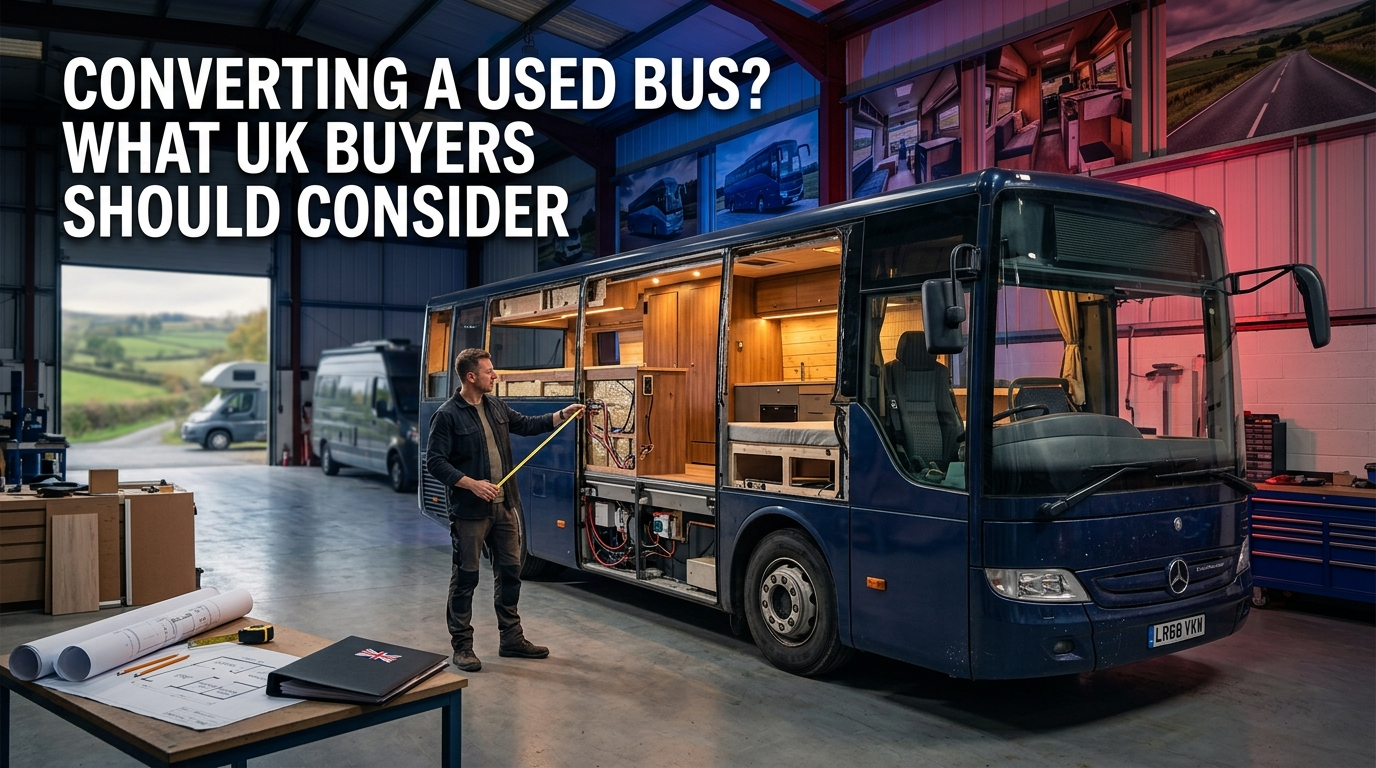
Converting a Used Bus: What UK Buyers Should Consider
Converting a used bus into a motorhome, catering trailer, or mobile business is a serious project that can cost anywhere from £15,000 to over £50,000 depending on the base vehicle and finish. Before you buy anything, you need to confirm that you can legally drive the bus on your current licence, that you can afford the insurance and maintenance, and that the vehicle is structurally sound enough to justify the conversion work. This guide walks through the legal, mechanical, and financial realities of buying a bus to convert in the United Kingdom.
What Licence Do You Need to Drive a Converted Bus in the UK?
This is the first question to answer because it can rule out a large number of vehicles immediately.
If you passed your car driving test before 1 January 1997, you likely have a C1 entitlement on your licence. C1 allows you to drive vehicles between 3,500kg and 7,500kg maximum authorised mass (MAM). Many short and mid-size buses fall into this bracket, but not all of them.
If you passed your car test after 1 January 1997, you only have a Category B licence, which restricts you to vehicles up to 3,500kg MAM. Most full-size buses and coaches exceed this weight. A 12-metre single-decker can weigh 11,000kg to 12,000kg empty, and a double-decker is typically 10,000kg to 14,000kg. To drive those, you would need to pass a Category C (rigid lorry) test, which involves a medical, a theory test, and a practical test.
There is an exemption for private use. If you register the bus as a motor caravan and use it solely for private, non-commercial purposes, you may be able to drive a vehicle over 3,500kg on a Category B licence if it was originally built as a bus and you are not carrying passengers for hire. However, this area is genuinely confusing, and the DVLA has tightened its interpretation in recent years. Do not rely on forum advice for this. Check your own licence online using the DVLA’s View Driving Licence service and, if in doubt, write to the DVLA with the specific vehicle registration number and VIN before you part with any money.
What Counts as a “Motor Caravan” in DVLA Terms?
DVLA reclassification is the single biggest stumbling block for UK bus converters. If you buy a bus and convert it, you do not automatically get to call it a motor caravan on the V5C logbook.
The DVLA published updated guidance for motor caravan conversions in 2019. To be reclassified from a bus or minibus to a motor caravan, the vehicle must meet specific external and internal criteria. Externally, it needs at least two of the following: a high-top roof or pop-top, a rear door or side door, a step, a canopy or awning, a separate gas locker, or graphics and decals indicating a motorhome. Internally, it needs to look and function like living accommodation, with a bed, a cooking facility, and a seating/dining area. These must be permanently fixed, not simply camping equipment placed inside.
A common mistake is buying a bus with all the seats still in it and assuming a mattress and a camping stove will get it reclassified. It will not. The DVLA requires photographic evidence and sometimes an inspection. If your conversion does not meet the bar, the vehicle remains classified as a bus on the logbook, which affects road tax, insurance, speed limits, and the MOT class. A bus that is not reclassified cannot legally be driven on a standard car licence unless the weight is under 3,500kg.
What Are the Speed Limits for a Bus or Converted Bus?
Speed limits change depending on how the vehicle is registered. This matters for daily driving, not just for passing the MOT.
A vehicle registered as a bus or coach with more than eight passenger seats is limited to 50 mph on single carriageways, 60 mph on dual carriageways, and 70 mph on motorways. However, a motor caravan under 3,050kg unladen weight is treated like a car for speed limit purposes: 60 mph on single carriageways, 70 mph on dual carriageways, and 70 mph on motorways. If the motor caravan is over 3,050kg unladen, the limits drop back to 50 mph, 60 mph, and 70 mph.
A converted bus that still carries the original bus classification on the V5C must obey the lower bus speed limits, even if you have removed the seats and fitted a kitchen. This is one of the practical reasons why getting the DVLA reclassification sorted is worth the paperwork.
Is a Bus Exempt from MOT, Tax, or ULEZ?
Age and registration status determine this.
A bus used privately and not for hire or reward requires an annual MOT if it is over one year old, just like a car, provided it is registered as a motor caravan or private vehicle. If it remains registered as a bus with more than eight passenger seats, it falls under a different testing regime. Passenger-carrying vehicles used for hire or reward need a PSV test, but a privately owned bus conversion should not be used for hire.
Road tax (VED) for a motor caravan is currently charged as Private Light Goods (PLG) if the vehicle is under 3,500kg, which means £190 per year at the 2025 rate. If the motor caravan is over 3,500kg, it falls into the Private HGV class, which is currently £165 per year. That sounds cheap, but the cost comes from the MOT class and insurance, not the VED itself.
ULEZ and Clean Air Zone rules are where bus conversions can become expensive. A converted bus that does not meet Euro 6 diesel standards will face daily charges in London’s ULEZ, Birmingham’s Clean Air Zone, and similar zones in Bristol, Bath, Bradford, Portsmouth, Sheffield, and Tyneside. London’s ULEZ charge for non-compliant vehicles over 3,500kg is £100 per day, and it applies 24 hours a day, every day. If your conversion project involves a 2005 diesel bus, driving it through central London will cost you a small fortune. Check the specific vehicle registration against the TfL ULEZ checker and the government’s Clean Air Zone checker before buying.
How Much Does a Used Bus Cost in the UK?
Prices vary enormously depending on what you are buying.
Ex-local authority minibuses and small buses from the mid-2000s to early 2010s regularly appear at auction for £2,000 to £6,000. These are typically 16-seat to 33-seat vehicles built on chassis from Iveco, Mercedes-Benz, or Ford. They have often been well maintained by council workshops, which is a plus, but they will have high mileage and often significant rust, particularly around wheel arches and step wells.
Full-size single-decker buses from operators like Stagecoach, First, or Arriva are sold through dealers such as Ensignbus in Purfleet or via specialist auctions. A 2008 to 2012 single-decker with 400,000 to 600,000 miles on the clock will typically sell for £3,000 to £8,000. That sounds cheap, but a full repaint can cost £4,000 to £8,000 on its own, and mechanical repairs on a full-size bus are not priced like car repairs. A replacement gearbox for a ZF automatic fitted to a Volvo or Scania bus can cost £2,500 to £5,000 fitted.
Double-deckers are cheaper to buy but more expensive to run. A 2005 to 2009 double-decker can be bought for £2,000 to £5,000, partly because they are heavy, slow, and hard to park. They also have more glass, more bodywork to maintain, and more things to leak.
What Should You Check Before Buying a Bus to Convert?
This is not like buying a used car. You are buying what is effectively a commercial vehicle, and the failure costs are high.
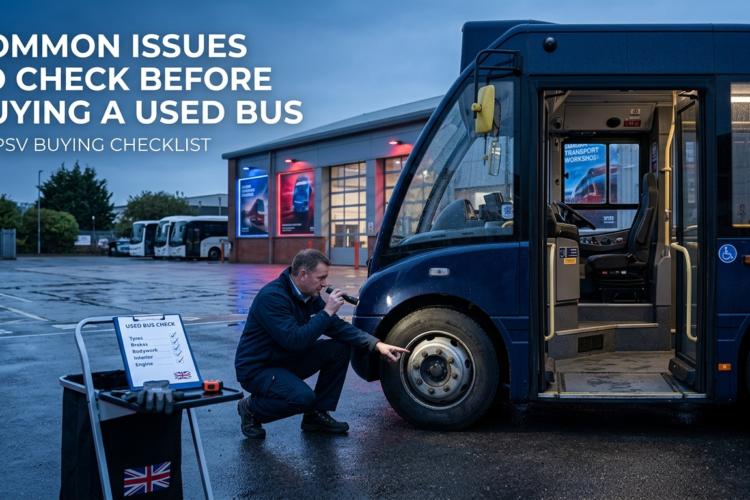
Rust is the biggest issue. Buses live outside. They are washed with pressure washers, driven through flooded streets, and subjected to road salt. Check the chassis rails, the step well, the wheel arches, the floor around the rear emergency door, and the roof. Take a torch. If you see bubbling paint or rust staining, dig a little. A bus with significant chassis rust is a parts donor, not a conversion candidate.
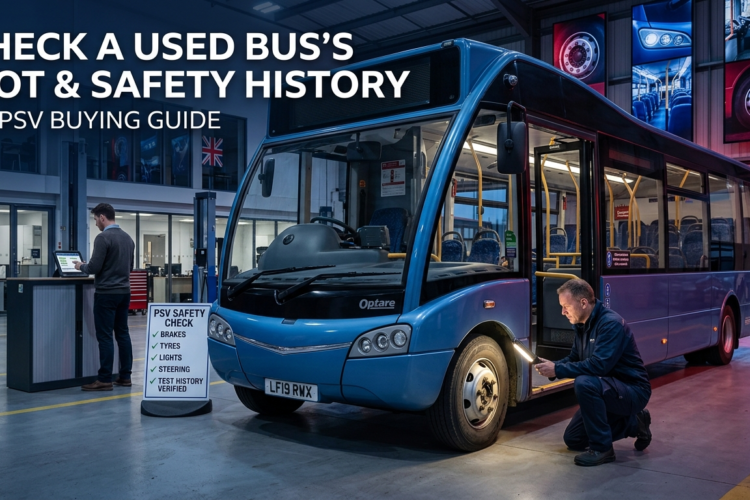
Check the service history and inspection records. Commercial operators keep records because the Traffic Commissioner requires them to. A bus with a full operator compliance history, including safety inspection sheets every six to eight weeks, is worth more than one with a gap in the paperwork. If the seller cannot produce service records, treat it as a high-risk purchase.
Check the mileage and engine hours. A bus that has spent its life on urban routes may have 300,000 miles but the engine will have run for 20,000 hours or more. Engine hours are the more meaningful figure. Many modern bus dashboards display total engine hours. A high-hours engine that has been well maintained can still be fine, but you need to budget for injectors, turbo, and cooling system work.
Run an HPI check. For a used commercial vehicle, you want to know if it has outstanding finance, is recorded as stolen, or has been written off. You should also check the MOT history on the DVSA website using the registration number. Look for repeated failures on brakes, suspension, or corrosion.
Get an independent inspection. This is especially important if you are buying from a dealer hundreds of miles away. A commercial vehicle inspector can check the chassis, brakes, air system, and bodywork and give you a written report. Expect to pay £200 to £500 for this. It is money well spent when the alternative is buying a bus with a cracked chassis rail.
What Does a Bus Conversion Actually Cost?
A realistic budget matters more than an optimistic one. The table below gives a rough breakdown for a typical mid-size single-decker conversion.
| Item | Typical UK Cost |
|---|---|
| Base bus (2008-2012 single-decker) | £4,000 – £8,000 |
| Delivery or collection (if not driving) | £300 – £800 |
| Seat removal and interior strip | £0 if DIY, £500 – £1,500 if hired |
| Rust repair and bodywork prep | £1,500 – £6,000 |
| Full respray (optional) | £4,000 – £8,000 |
| Windows, vents, roof lights | £500 – £2,000 |
| Insulation, flooring, wall panels | £1,000 – £2,500 |
| Kitchen, bathroom, furniture | £2,000 – £8,000 |
| Electrical system (leisure batteries, inverter, solar) | £1,500 – £5,000 |
| Gas or diesel heating | £500 – £1,500 |
| Plumbing and water tanks | £400 – £1,200 |
| DVLA reclassification and paperwork | £0 – £200 |
| Contingency (10-15%) | £1,500 – £4,000 |
| Total | £18,000 – £47,000 |
The single biggest cost most people underestimate is rust repair. A bus that looks solid in an auction photo can hide thousands of pounds of welding. The second biggest cost is time. A full conversion done properly on weekends and evenings can take 12 to 24 months.
Where Can You Park and Keep a Bus While Converting It?
This is a problem that stops projects before they start.
A full-size bus is roughly 12 metres long and 2.5 metres wide. It will not fit on a standard driveway. You need to think about where the bus will live while you work on it and after it is converted.
Options include renting a yard or storage space, which typically costs £50 to £150 per month in rural areas and £150 to £400 per month near cities. Some people use a friend’s farm or industrial unit. Others rent a council garage, but those are rarely big enough for anything over a short wheelbase van.
You also need to check whether you can get the bus to your property at all. Low bridges, weight-restricted roads, and narrow lanes can make delivery impossible. A 12-metre bus has a turning circle of roughly 20 metres. If you live on a modern housing estate, you may not be able to get it anywhere near your house.
What Insurance Do You Need for a Bus Conversion?
Insurance for a converted bus is not the same as car insurance. You need a specialist broker.
During the conversion, you need laid-up or project insurance, which covers the vehicle for fire, theft, and damage while it is not on the road. This is relatively cheap, often £150 to £300 per year.
Once the bus is converted and on the road, you need motorhome insurance. Many standard motorhome insurers will not touch a home-converted bus. You will need a specialist broker such as Adrian Flux, A-Plan (now Howden), or Brentacre, who deal with unusual conversions. Expect to pay £500 to £1,500 per year depending on the value of the conversion, your postcode, and your driving history. Some insurers will require an engineer’s report or a professional inspection before they will quote.
Should You Buy a Bus Already Converted?
For many people, this is the better option, but it comes with its own risks.
A professionally converted bus, or one converted by a meticulous private owner, can save you a year of work and a lot of money in materials. The problem is that the quality of conversions varies wildly. Some are beautifully finished with proper electrical certification and gas safety checks. Others are death traps with unvented gas appliances, undersized wiring, and no documentation.
If you buy a converted bus, ask for the following: the original conversion photos, gas safety certificate (if gas is fitted), electrical installation certificate, proof of DVLA reclassification to motor caravan, and a current MOT. If the seller cannot produce these, treat the purchase as you would any high-risk used vehicle: get an inspection, negotiate the price, and assume you will need to spend money fixing things.
What About Converting a Coach Instead of a Bus?
A coach conversion follows the same basic principles but with some differences. Coaches tend to have better insulation and more comfortable seating from the factory, but they are heavier, longer, and more expensive to run. A 12-metre coach can weigh 14,000kg to 18,000kg fully loaded, which puts it firmly into HGV territory for driving licence purposes. Coaches also tend to have more complex air systems, which can be expensive to repair. The purchase price is often very low for older coaches, sometimes under £5,000 for a 1990s vehicle, but the running costs will eat through any savings quickly.
What Are the Most Common Mistakes Bus Conversion Buyers Make?
The first mistake is buying the bus before checking the licence and DVLA reclassification rules. The second is buying on price alone and ignoring rust. The third is underestimating the cost of insulation and electrics. A bus is a large metal box. It is cold in winter and hot in summer. Proper insulation using closed-cell foam or sheep’s wool, plus a vapour barrier, is essential and not cheap. The fourth mistake is starting the project without a clear plan for water, gas, and electrical routing. Retrofitting these after you have built the interior is miserable work.
The final mistake is assuming you can sell the converted bus for more than it cost to build. Home conversions rarely recover their full cost. If your motivation is purely financial, buy an already-converted vehicle. If your motivation is having exactly the layout you want and you accept the cost, then a conversion project makes sense.
Summary
Converting a used bus in the UK is a viable way to get a genuinely spacious motorhome for less than the cost of a new coachbuilt vehicle, but it is not a cheap shortcut. You need to confirm your driving licence covers the vehicle, check the DVLA reclassification requirements before you start, buy a bus with a solid chassis and good service history, and budget realistically for rust repair, insulation, and specialist insurance. A converted bus can be a brilliant thing to own, but the projects that succeed are the ones where the buyer understood the legal and mechanical realities before handing over the money.
If you are at the early stage of researching a vehicle purchase, read our guide to checking a used vehicle’s history before buying. For more on road tax and VED rates, see our explanation of UK vehicle tax.