Truck Insurance UK: HGV & Commercial Vehicle Cover Explained
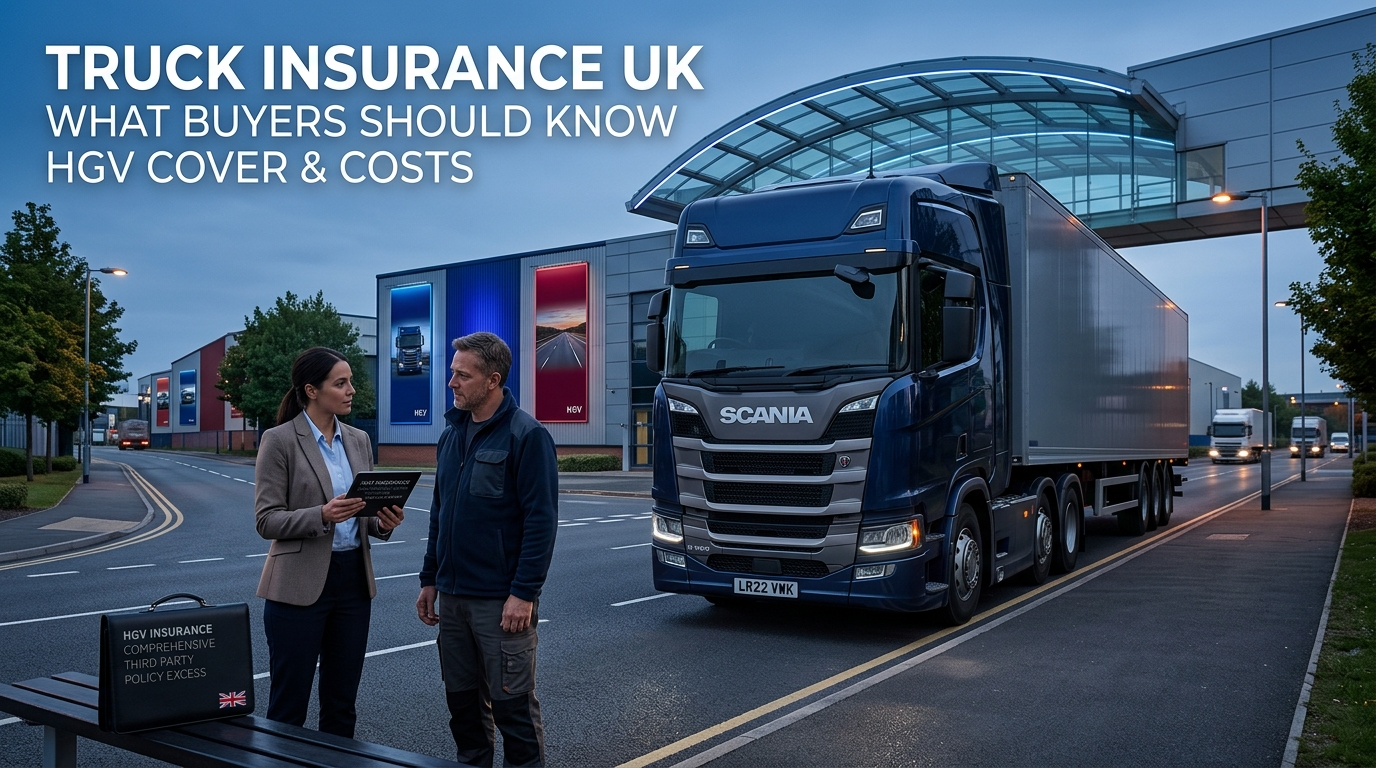
Truck insurance in the UK is not a single product with one price. The cover you need depends on the vehicle’s gross weight, the work it does, the driver’s age and experience, and where it is parked overnight. A pickup or small tipper used privately might fall under a van policy, while a 32-tonne tipper working for hire or reward needs specialist HGV cover, and the quote can differ by thousands of pounds even for similar vehicles.
Before you commit to a truck, run an insurance quote on the exact registration you’re considering. It can expose running costs that the advertised sale price never tells you about. If you’re still at the browsing stage, our guide to buying a used truck in the UK is worth reading first.
What counts as a truck for insurance purposes in the UK?
Insurers tend to group trucks by gross vehicle weight, licence category and body type. The term “truck” on a classified listing could mean several different things, so the insurance position changes sharply.
A pickup or long-wheelbase van up to 3.5 tonnes usually falls under light commercial vehicle or van insurance. A 7.5-tonne box truck often needs a separate light HGV policy, even though many drivers call it a truck rather than an HGV. A 26-tonne rigid or a 44-tonne articulated lorry is firmly in specialist heavy goods vehicle insurance territory.
The licence requirements follow a similar split. If you passed your car test after 1 January 1997, you cannot simply drive a 7.5-tonne truck on a standard car licence; you generally need a C1 category. Larger rigids need a category C, and artics usually need C+E. We’ve covered the full breakdown in our guide to truck licence categories in the UK.
From an insurance underwriter’s point of view, the key facts are the plated gross vehicle weight, axle configuration, body type and intended use. A flatbed doing local builder’s work is not the same risk as a refrigerated box on long-haul trunking.
What types of truck insurance can you buy in the UK?
The policy structure is the same as car and van cover in broad terms, but the practical decisions are different.
| Policy type | What it covers | Who it might suit |
|---|---|---|
| Third party only | Damage or injury you cause to other people and their property. It does not cover damage to your own truck. | Legal minimum only; usually a poor fit for anything you rely on to earn a living |
| Third party, fire and theft | Third party cover plus fire damage and theft of your own vehicle. | Mid-value trucks where full accidental damage cover is not cost-effective |
| Comprehensive | Third party cover plus accidental damage to your own truck, often with a range of add-ons such as windscreen or breakdown assistance | Financed vehicles, newer trucks, owner-operators and anyone who cannot afford to repair or replace the truck out of pocket |
If you finance the truck, the lender will normally require comprehensive insurance as a condition of the finance agreement.
One point that catches people out: motor insurance for a truck does not automatically include goods in transit cover. The load, tools, pallets or machinery being carried are usually insured separately. If you carry other people’s goods for payment, you may also need haulage liability cover and, in many cases, an operator’s licence.
Do you legally need truck insurance if the vehicle is parked up or SORN?
Yes, unless you make a Statutory Off Road Notification, or SORN.
Under the Continuous Insurance Enforcement rules, every UK-registered vehicle must either be insured or declared off the road with a SORN to the DVLA. This applies to trucks exactly as it applies to cars. If you buy a truck, park it in a yard and cancel the insurance without making a SORN, the registered keeper can receive a fixed penalty notice of £100, and the vehicle can be clamped, impounded or destroyed.
Driving a truck without insurance is treated more seriously again. It can result in a £300 fixed penalty and six points on your licence, and if the case goes to court the fine is unlimited and a driving ban is possible.
The practical rule for any buyer is simple. If the truck is not insured, SORN it immediately through the DVLA. If it is insured, make sure the policy is in your name or the registered keeper’s name before it goes anywhere near a public road.
How much does HGV insurance cost in the UK?
There is no honest single answer to this question, and any website that gives you a fixed HGV insurance cost without asking for the vehicle’s registration, use and driver details is not giving you a usable quote.
A small 7.5-tonne rigid used for carriage of own goods by an experienced driver in a low-risk area will quote very differently from a 44-tonne artic hauling general freight for hire or reward from a depot in Birmingham or Glasgow. The vehicle’s use class is often the biggest single factor. An owner-operator carrying their own plant or materials is not the same risk as a haulier moving third-party goods against tight delivery windows.
Because HGV insurance is commercially rated, underwriters look at claims frequency and severity across the whole fleet type. They also look at driver age, licence history, convictions, and the number of years the driver has held the relevant HGV category. Many policies will not even quote a driver with no HGV experience or a newly passed category C licence at a standard rate.
When you ask for truck insurance quotes in the UK, expect to answer detailed questions. That is normal, not an attempt to catch you out. The more accurately you describe the vehicle and its use, the less likely you are to have a claim rejected later.
What affects truck insurance quotes UK?
The proposal form for commercial vehicle insurance asks for more than a car quote. The main factors an underwriter will weigh include:
- Gross vehicle weight and axle configuration
- Body type, such as flatbed, tipper, box, curtainside, skip loader or fridge
- Vehicle value and any modifications or sign-writing
- Whether the truck is used for carriage of own goods or hire or reward
- Driver age, licence category, experience and claims history
- Annual mileage and operating radius
- Overnight postcode and where the truck is parked
- Security devices such as Thatcham-approved immobilisers, trackers or CCTV
- Excess level and whether you pay annually or monthly
Paying monthly usually costs more than paying annually because insurers treat monthly payment as a form of credit. Insurance premium tax also adds 12% to most commercial vehicle policies at the standard rate.
A truck fitted with a decent tracker and parked in a secure yard can be easier to place than an identical truck parked on a residential street. The difference in quote can be substantial, so if you are comparing two trucks to buy, the one with better security may be the better long-term buy even if the sale price is slightly higher.
How to get accurate truck insurance quotes UK
Do not rely on a generic comparison site for a 26-tonne rigid or an artic. Specialist commercial brokers tend to have access to underwriters that consumer comparison sites simply do not quote.
A better sequence looks like this:
- Get the vehicle registration number, exact make, model, body type, year and plated gross weight. This information should be on the V5C logbook and the vehicle plate.
- Decide on the use class before you call. “Carriage of own goods” and “haulage for hire or reward” are different questions.
- Have the driving licence details and claims history ready for every named driver.
- Ask whether goods in transit and public liability are included or quoted separately.
- Compare like for like, not just the cheapest premium. Check the excess, cancellation terms, and whether the policy covers a replacement vehicle or hired-in vehicle while yours is off the road.
- Ask the broker whether any named driver restrictions or telematics requirements apply. Some lower quotes only hold if you fit a black box or agree to a night-time parking condition.
If you are buying from a private seller, the V5C may still be in their name. You can still get quotes on the registration, but you should update the V5C as soon as you complete the purchase. Insurers check DVLA records as part of continuous insurance enforcement, and keeping the registered keeper details accurate avoids unnecessary warning letters.
What other costs should you factor in alongside truck insurance?
Insurance is one part of the truck’s compliance cost. Before you buy, add up the other fixed costs so you know the true monthly burden.
VED, or road tax, for a goods vehicle is not calculated like car tax. For an HGV it is generally based on the vehicle’s revenue weight, axle configuration and, in some cases, its emissions standard. A vehicle that is SORN does not need VED, but as soon as it goes back on the road it must be taxed through the DVLA.
MOT testing also works differently for trucks. Most goods vehicles over 3.5 tonnes need a first test one year after registration and then an annual test after that. You can insure a truck without an MOT, but you cannot lawfully use it on the road until it has a valid test. Our guide to MOT rules for UK buyers explains the basics for cars and vans, and the same principle applies to trucks: no valid MOT means no legal road use.
If the truck is used for hire or reward and is over 3.5 tonnes, you may also need an operator’s licence from the Traffic Commissioner. That involves a fee, a designated transport manager in some cases, maintenance arrangements, and ongoing compliance. It is separate from insurance, but insurers often ask for your operator’s licence number when quoting a haulage vehicle.
You should also check the vehicle’s history before handing over any money. A truck with outstanding finance, a hidden accident record or a cloned number plate can become an insurance and legal problem. Our HPI check explainer and our guide to checking a used truck’s service history are useful before you commit.
Truck insurance for private buyers vs business owners
Not every truck buyer is a haulage company. Some people buy a large pickup or a 7.5-tonne horsebox for private use, and the insurance conversation is slightly different.
A private buyer using a pickup for social, domestic and pleasure purposes may be able to insure it on a standard light commercial or private policy. As soon as the same vehicle is used for business, the use class changes and the premium can move with it.
A business owner using a truck to carry their own tools or materials is generally classed as carrying own goods. A business that moves goods on behalf of other people for payment is in haulage. Telling an insurer you carry your own goods when you actually do paid haulage is not a minor technicality; it can invalidate the policy.
If you are buying a truck to start a haulage or delivery business, check the licence requirements first. Buying a 7.5-tonner before you hold the correct C1 or C licence leaves you with an insured truck that you cannot legally drive unless you employ someone else to do so.
The most expensive mistakes are usually the ones that involve misdeclaring something on the proposal form. These are the recurring issues:
- Insuring a vehicle for carriage of own goods when it is actually used for hire or reward
- Undervaluing the truck to reduce the premium, then finding you are underinsured after a total loss
- Not declaring modifications such as tail lifts, cranes, beacons or sign-writing
- Not adding all named drivers, or letting someone drive on an unnamed-driver basis when the policy does not allow it
- Letting insurance lapse while the truck is parked without making a SORN
- Choosing third party only on a vehicle you rely on for income, then facing the full repair bill after an accident
Some of these are easy to fix before you buy. If a truck has been modified, ask the seller for details. If it has sign-writing, make sure the insurer knows. If you plan to use it for paid work, say so from the first quote, not after a claim.
How to keep commercial vehicle insurance manageable
The best way to keep premiums down is not to hide information, but to present the risk well.
A higher voluntary excess can reduce the premium, but only set it at a level you could actually afford after an accident. A tracker, immobiliser, secure overnight parking and a clean claims record all help. Some insurers also look favourably on drivers who complete periodic training or hold a Driver CPC where required.
Named driver restrictions can help if you are the only driver. Paying annually rather than monthly saves on credit charges and sometimes lowers the quoted premium. A broker can also place cover with an insurer that understands your specific work, whether that is skip hire, tipper work, fridge work or livestock haulage.
If you are comparing trucks on a classified site like TopSellUKCars, treat insurance as part of the purchase decision rather than an afterthought. The cheapest truck to buy is not always the cheapest truck to insure, especially if it lacks a tracker, has a chequered history or sits in a high-risk use class.
Frequently asked questions about truck insurance UK
Can I drive a 7.5-tonne truck on a car licence?
It depends on when you passed your test. Drivers who passed a car test before 1 January 1997 often have C1 entitlement and can drive vehicles up to 7.5 tonnes. Drivers who passed after that date generally need to take a C1 test. Insurers will ask for the actual licence entitlement, not just the fact that you have a driving licence.
Is goods in transit included in truck insurance?
Not usually. Goods in transit cover is generally a separate policy or a separate section of a commercial combined policy. A standard motor insurance policy covers the vehicle, not the load it is carrying.
Can I insure a truck before the V5C is in my name?
Yes. You can get quotes and often take out a policy using the registration number before the V5C has been updated. But the registered keeper details should be corrected with the DVLA as soon as you buy the truck, because continuous insurance enforcement records are matched against the DVLA database.
Does truck insurance cover trailers?
A truck policy may include third party liability for a trailer while attached, but damage to the trailer itself often needs separate trailer cover. If you run artics or draw trailers regularly, confirm this with the broker before you assume it is covered.
The honest summary
Truck insurance in the UK is a commercial purchase, not a simple box-ticking exercise. The cover you need depends on what the truck is, how it is used and who is driving it, and the only accurate way to know the cost is to quote the exact vehicle and be straight about the use class.
Before buying a truck, get a quote on the actual registration, check the licence category against the driver, and make sure you understand the difference between own goods and hire or reward. If the vehicle will be parked uninsured, SORN it immediately. And if the truck will be used for business, treat insurance, operator licensing, VED and MOT compliance as one package rather than separate costs.
A truck that looks cheap at the sale price can quickly become expensive if the insurance is high, the licence entitlement is missing, or the vehicle has a hidden history. Sorting the insurance question early is one of the cheapest ways to avoid a bad purchase.