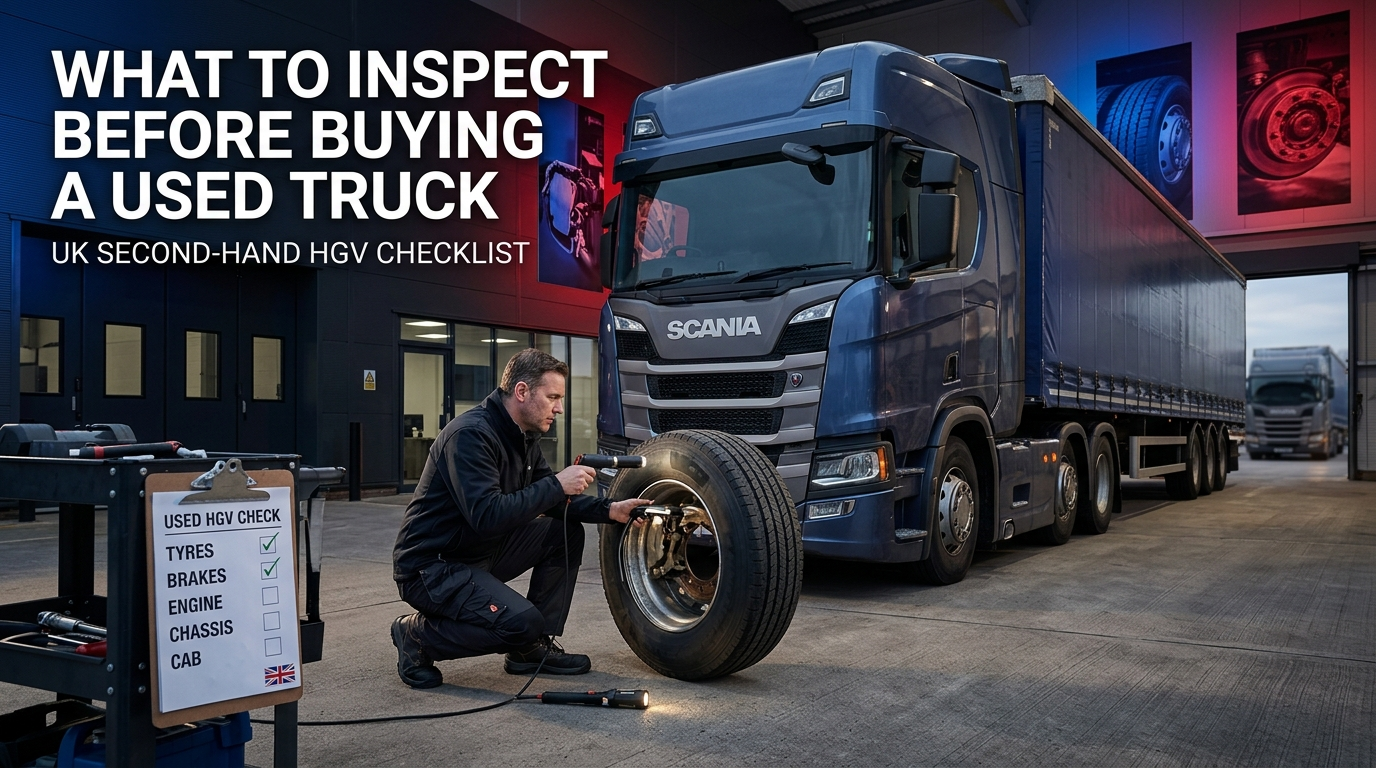
What to Inspect Before Buying a Second-Hand Truck | TopSellUKCars
What to Inspect Before Buying a Second-Hand Truck
Before you buy a second-hand truck, inspect the chassis for rust, cracks and weld repairs, check the engine and gearbox for leaks and noises, and confirm the V5C, plating certificate, annual test history and HPI check all match up. You also need to examine the brakes, suspension, tyres, bodywork and fifth wheel before agreeing a price. A commercial vehicle can hide expensive faults behind a tidy cab, so this inspection should be methodical rather than visual.
If you are new to commercial vehicles, our complete guide to buying a used truck in the UK covers the basics before you start viewing.
Check the paperwork before you travel
A lot of bad trucks can be ruled out before you leave the house. When you find a truck you like, ask the seller for the registration number, VIN/chassis number, current annual test certificate, plating certificate and service records. Then do these checks:
- DVLA vehicle enquiry: use the number plate to check the vehicle tax status, annual test expiry and registered details. If the truck is SORN or the details do not match, ask why.
- HPI check: a proper HPI check on a commercial vehicle shows outstanding finance, theft records, insurance write-off categories and mileage discrepancies. We explain what it covers in our guide to HPI checks.
- V5C logbook: view the original, not a photocopy. The registered keeper’s name and address should match the person or business selling the truck. A replacement V5C costs £25 from the DVLA, so there is no good reason for a seller not to have one.
- Plating certificate: this is sometimes called the Ministry plate or weight plate. It lists the maximum axle weights, gross vehicle weight and train weight, and the VIN. Check it against the V5C and the chassis stamp.
- Service history: a missing service history on a modern Euro VI truck is a bigger risk than on an old mechanically injected lorry. Look for regular oil changes, brake inspections and any aftertreatment repairs. We have a separate article on checking a used truck’s service history.
Since October 2014, vehicle tax does not transfer with a vehicle. You will need to tax the truck before you drive it away, so check the VED class based on the weight and axle configuration before budgeting.
If the seller cannot produce the V5C, or the VIN on the paperwork does not match the one on the chassis, walk away. That is not a paperwork technicality; it usually means the vehicle has a hidden past.
Check the MOT and annual test history properly
For trucks and other goods vehicles over 3,500kg, the annual test is the equivalent of an MOT. A current pass is not proof that the truck is in good condition. It only means the vehicle met the minimum roadworthiness standard on the day it was tested.
Ask the seller for the most recent annual test certificates and any advisory notices. You want to see what the tester flagged. A truck can pass with advisories for corrosion, brake wear or tyre condition, and those advisories tell you where the next bill is likely to be. If the same item appears across multiple tests, that suggests the operator patched the problem rather than fixing it properly.
You can check the DVSA test records for many HGVs online. If the seller has no paperwork and the test history is unavailable, treat that as a gap in the vehicle’s story.
Do not be fooled by a fresh annual test certificate. Brake pads, air springs and chassis sections can fail between tests, especially on a truck that has been standing or working hard since the test date.
Start with the chassis and cab structure
The chassis is the most expensive part of a truck to put right. Begin by walking around the vehicle and looking at it from a distance. Does the cab sit level? Are the axles sitting square? A twisted or sagging stance can point to suspension trouble or a bent chassis.
Then get underneath with a torch. Look at the chassis rails from front to back, paying attention to spring hangers, crossmember joints, behind the fuel tank and around the fifth wheel. Cracks often start at drilled holes or where brackets are welded to the rail. Surface rust is normal on an older working truck, but deep scaling, soft spots or flaking metal are not.
Tap suspect areas with a small hammer or a screwdriver handle. A dull thud instead of a clean ring can indicate hidden corrosion. Fresh underseal, wax injection or thick black paint on an older chassis is a warning sign, especially if it has been applied over rust. Some sellers do it to make the underside look clean, not to protect it.
Check the cab for rust around the windscreen, steps, door bottoms and wheel arches. Look for mismatched panel colours, uneven gaps and overspray. Accident repairs are not always a reason to reject a truck, but poor repairs are. If the cab has been repainted recently, ask whether it was for rust or accident damage.
Finally, find the VIN stamped on the chassis. It should match the V5C, the plating certificate and any cab plate. If the stamp is missing, painted over or difficult to read, be cautious.
Engine, gearbox and drivetrain: cold-start checks
Ask the seller not to start the truck before you arrive. A cold start tells you a lot about engine condition. If the engine has already been warmed up, you may miss smoking, rough idle or knocking that disappears as it warms.
With the engine running, remove the oil filler cap briefly. A small amount of crankcase vapour is normal; heavy chuffing smoke suggests excessive blow-by and worn bores or rings. Check the oil dipstick for milky residue and the coolant reservoir for oil film. These are signs of head gasket or oil cooler failure, both expensive on a heavy diesel.
Watch the exhaust when the engine starts. Blue smoke on start-up can indicate oil getting into the cylinders, white smoke can mean coolant or unburned fuel, and black smoke under load suggests overfuelling or injector wear. Modern Euro VI trucks have diesel particulate filters and selective catalytic reduction systems that are costly to fix. Ask for any fault codes to be read before you buy. AdBlue pump, NOx sensor and DPF problems are common bills on used HGVs. Look around the AdBlue filler for white crystallised deposits, which can indicate neglect.
Check the engine hours as well as the mileage. A truck with low mileage but high engine hours may have spent long periods idling or running a PTO, which causes its own wear. Service records should show oil changes at the manufacturer’s intervals, often based on hours, distance or a combination of both.
Look for oil leaks around the rocker cover, sump, turbo, gearbox and drive axle. A small misting on an older truck is common; drips on the floor are not. With the engine off, check the propshaft centre bearings and universal joints for play.
If the truck has a manual gearbox, check that the clutch bite is not right at the top of the pedal travel. On the test drive, accelerate hard in a high gear and watch for clutch slip. For automated or automatic boxes, listen for harsh changes and clunks when moving from drive to reverse.
Brakes, suspension and steering: look beyond the annual test
Brakes on a heavy truck are air-operated. Start the engine and let the air pressure build from empty. The low-air warning buzzer should stop as pressure rises, and the compressor should reach its cut-out pressure without taking an unreasonable amount of time. If the pressure drops quickly with the engine off and the foot brake held, there is a leak.
Drain the air tanks if the seller allows it. Water in the tanks suggests the air dryer is not doing its job, which can lead to frozen brakes in winter and internal corrosion in the air system. Oil in the air system can point to a failing compressor.
Look at the brake discs or drums where visible. Deep scoring, cracks, oil contamination or very thin linings mean a brake overhaul is likely. Check the brake actuator chambers for corrosion. With the wheels off the ground, a fitter can check for wheel bearing play and binding brakes, but even with the wheels on you can look for rust streaks around the wheel nuts and hub.
Check the suspension visually. Air springs should not be cracked or perished, and with the suspension raised you should not hear a constant hiss. Leaf springs crack most often at the ends and around the centre bolt. Leaking shock absorbers and worn bushes are less dramatic but still cause annual test failures and poor handling.
Steering wear is often hidden. With the wheels on the ground, rock the steering wheel and feel for excessive free play. Any clunk when the steering is turned from side to side can mean worn track rod ends or steering joints. On a loaded lorry, that play becomes dangerous.
Tyres, wheels and bodywork: what the condition tells you
Tyres are a good indicator of how the truck has been maintained. Check the tread depth across the full width of each tyre. For goods vehicles over 3,500kg, the legal minimum is generally 1mm across the central three-quarters of the tread, but a working truck should be nowhere near that. Look for cuts, cracks, bulges and exposed cords. Check the tyre age code on the sidewall; even if the tread looks deep, old tyres can fail suddenly.
Mismatched tyres across an axle or different wheel sizes are red flags. The tyres also need the correct load and speed rating for the axle weights. Check the wheel nuts for rust streaks, which can indicate loose or cracked wheels.
Bodywork matters because repairs and downtime cost money. For a box body or curtainsider, inspect the floor, roof, side raves and rear doors. A soft floor or daylight through the roof means water has been getting in, and freight damage claims follow. On a tipper, check the body hinges, tailgate catches and hydraulic rams for leaks. On a fridge truck, ask for temperature records and the fridge unit’s service history.
If the truck has a tail lift, operate it through a full cycle and look for bent arms, leaking rams and worn chains. A tail lift that fails under load can injure someone.
Fifth wheel, PTO and specialist equipment
On an artic unit, the fifth wheel is safety-critical. Check the mounting bolts where the fifth wheel attaches to the chassis, look for cracks around the plate, and inspect the jaw and kingpin for wear. Operate the release handle and make sure the slider works if fitted. A worn or poorly lubricated fifth wheel can lead to a trailer coupling failure.
If the truck has a power take-off, tipper gear, crane, fridge unit, road sweeper body or other specialist equipment, test it. Hydraulic rams should not creep or leak. Cranes and lorry loaders should have a current LOLER thorough examination report. Ask for the last report and any maintenance records. If the seller cannot produce one, you may be buying a lifting appliance that needs immediate inspection before it can legally be used.
Test drive: what to listen for and feel
A test drive in an unladen truck will not tell you everything, but it will expose the worst faults. Choose a route with hills, corners and stop-start traffic if possible.
On the road, the truck should brake straight without pulling. The steering should not wander, and there should not be vibration through the wheel. Listen for whine from the gearbox and drive axle, and for clunks when taking up drive or changing gear. If a manual gearbox jumps out of gear, the synchromesh or selector is worn. If an automated box changes harshly, it may need a software update or a repair.
Watch the gauges and warning lights. Oil pressure should stay steady when hot, coolant temperature should not climb, and the air pressure should not drop. The tachograph should power up and record correctly if the truck is used in scope.
A short unladen run does not replicate a loaded lorry. Brake faults, suspension wear and steering issues are often more obvious under load, which is why the static inspection matters so much.
Should you pay for an independent truck inspection?
If you are spending a significant amount on a used truck, yes. An independent HGV engineer can inspect the vehicle properly, including items that need a jack or diagnostic equipment. Expect to pay a few hundred pounds for an independent inspection, usually somewhere in the region of £200 to £500 depending on the truck and location. That is cheap compared with replacing a gearbox, repairing a DPF system or welding a chassis rail.
If a private seller refuses to let an independent inspector look at the truck, treat that as a red flag. A genuine seller with nothing to hide will usually allow an inspection. You can also ask the seller to have the truck inspected at a main dealer, but an independent inspector is better because they are working for you.
Used truck inspection checklist at a glance
| Area | What to check | Walk away if… |
|---|---|---|
| Documents | V5C, plating certificate, annual test history, HPI check, service records | VIN mismatch, no V5C, outstanding finance, clocked mileage |
| Chassis | Rust, cracks, weld repairs, straightness, VIN stamp | Fresh underseal hides rust, cracked chassis rail |
| Engine | Cold start, smoke, oil/coolant contamination, fault codes, hours | Head gasket signs, no service history, major engine codes |
| Drivetrain | Clutch, gearbox, propshaft, drive axle leaks/noise | Clutch slip, jumping out of gear, metal in oil |
| Brakes, suspension, steering | Air leaks, lining wear, air springs, leaf springs, steering play | Air loss, cracked spring, brake pull |
| Tyres and wheels | Tread, sidewalls, age, wheel nuts, load rating | Bulges, exposed cords, mismatched tyres |
| Body and equipment | Floor, roof, tail lift, fifth wheel, PTO, crane, LOLER report | Rotten floor, unsafe coupling, missing crane report |
| Road test | Straight braking, steering, gear changes, gauges | Brake pull, vibration, warning lights, overheating |
Before you collect it, make sure your licence covers the weight. Our truck licence categories guide explains C1, C and CE.
Final summary
A used truck can look right in photos and still be a financial disaster. The checks that matter most are the chassis, engine and drivetrain, brakes, tyres, bodywork and paperwork. If you are not mechanically confident, pay an independent HGV engineer to inspect the truck before you commit. A cheap truck with hidden chassis corrosion, a worn driveline or a failing Euro VI aftertreatment system can quickly cost more than the purchase price.