Electric Trucks UK: Diesel vs Electric HGV Guide for 2026 | TopSellUKCars
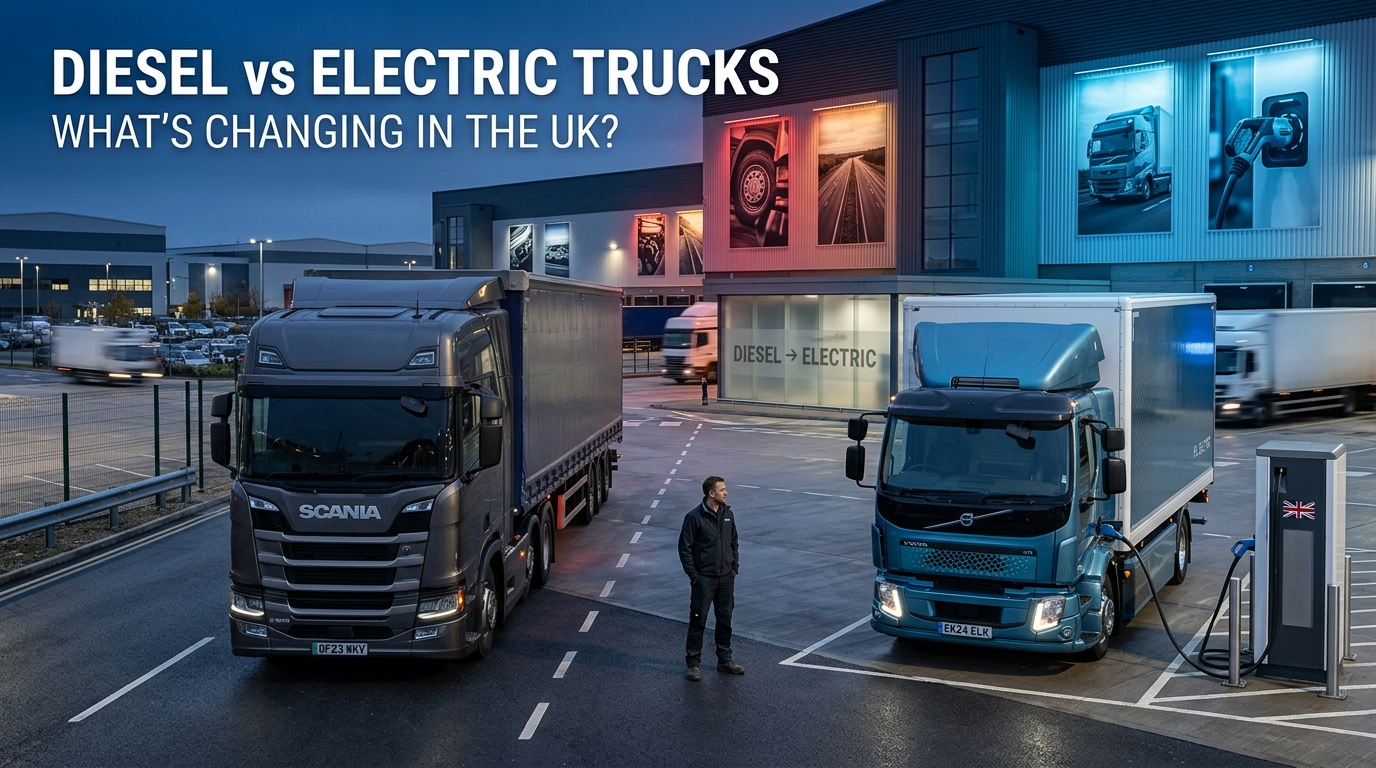
Electric Trucks UK: Diesel vs Electric — What’s Changing in the UK Market?
Electric trucks in the UK have moved from trial status to a genuine buying decision for many operators, but they are not a like-for-like replacement for every diesel HGV. For return-to-base regional and urban work under roughly 200 miles a day, electric HGVs can now beat diesel on whole-life running costs; for long-haul, maximum-weight or unpredictable routes, diesel is still the safer commercial choice. The biggest regulatory change is that the UK government plans to end the sale of new non-zero emission HGVs of 26 tonnes and under by 2035, and heavier HGVs by 2040, but existing diesel trucks can still be bought, sold and operated legally after those dates.
That distinction matters because a lot of the noise around electric trucks in the UK treats it as a simple countdown to diesel disappearing. The reality is more practical. Some operators around London, Birmingham, Manchester, Glasgow and the big distribution hubs are already running electric rigids and artics on fixed routes. Others in rural Scotland, the Highlands or long-distance trunking will be among the last to switch.
What is actually changing in the UK truck market?
The headline policy is the phase-out of new non-zero emission HGVs. The UK government’s current target is that new HGVs of 26 tonnes and under will need to be zero emission from 2035, and new HGVs over 26 tonnes from 2040. Zero emission in this context means battery electric or hydrogen fuel cell, not diesel hybrid.
It is not a ban on owning, selling or running a used diesel lorry. If you run a Euro VI diesel artic bought in 2021, you can keep using it and sell it after 2040 unless a future government changes the rules. What the phase-out does is signal to manufacturers and fleet buyers that the new truck market is being steered away from fossil fuels.
Alongside the national targets, local charging schemes are already pushing real-world decisions. London’s Ultra Low Emission Zone and Clean Air Zones in places such as Bath, Birmingham, Bradford and Bristol charge or restrict higher-emission HGVs in certain areas. Scotland’s low emission zones in Aberdeen, Dundee, Edinburgh and Glasgow operate on a similar principle. If your routes regularly cross those boundaries, the running cost of an older diesel can become more expensive than the sticker price suggests.
For buyers and sellers on a UK classified platform, this means two things. Clean used diesel HGVs still have a functioning resale market, but electric trucks are beginning to appear in used listings and fleet disposals. The market is splitting by duty cycle rather than one technology wiping out the other overnight.
Diesel vs electric truck: the honest comparison
The table below is the short version. Think of it as a starting point, not a guarantee; every operation is different.
| Factor | Diesel HGV | Electric HGV |
|---|---|---|
| Upfront cost | Lower purchase price; deep used market | Higher purchase price; limited used supply |
| Energy/fuel cost per mile | Varies with mpg and diesel price, often around 60-90p | Varies with tariff and consumption, often similar or lower on off-peak depot charging |
| Real-world range | 500 miles or more on one tank | Often 100-300 miles depending on battery, load and weather |
| Payload | No battery weight penalty | Can lose a tonne or more to battery weight |
| Refuelling/recharging | 10-15 minutes at a diesel pump | Overnight depot charge, or fast charge roughly 1-3 hours |
| Maintenance | Engine oil, filters, DPF, AdBlue, gearbox | Fewer fluids and brake wear, but high-voltage systems need specialist care |
| Noise | Louder, restricted for some night deliveries | Quieter, better for urban and out-of-hours work |
| Best duty cycle | Long-haul, remote, maximum payload | Urban, regional, fixed routes, return-to-base |
That table collapses a lot of nuance into a few rows, so it is worth unpacking the rows that cause the most confusion: range, payload and running cost.
Electric truck range and payload: what UK operators need to know
Electric truck range claims are not as standardised as the WLTP figures you see on cars and vans. A manufacturer may quote a range based on a particular drive cycle, load and temperature. In UK motorway running with a full payload, hills and a British winter, you should expect less.
As a rough guide, electric trucks in the 7.5-tonne to 19-tonne rigid segment are often quoted in the 150-250 mile bracket. Larger electric tractor units are now pushing towards 250-300 miles, but those are best-case or near-ideal figures. If your daily route is a 90-mile outbound leg, a 90-mile return and some contingency for traffic or diversions, that may be comfortable for many electric rigids. If you are doing Inverness to Birmingham in a day, it is not.
Payload is the other practical issue. Batteries are heavy. Depending on the truck and specification, an electric HGV can weigh one to three tonnes more than a comparable diesel before you load it. For weight-sensitive work—aggregates, milk tankers, some palletised freight—that lost payload can mean extra journeys or a smaller margin. You need to compare the actual unladen weight and gross vehicle weight of the specific chassis, not just the brochure headline.
Where the payload penalty is less painful is on volumetric work: parcels, retail distribution, urban food delivery, ambient goods that cube out before they weigh out. That is exactly why the first electric trucks in the UK have tended to appear in supermarket fleets, parcel hubs and last-mile distribution, not bulk construction haulage.
DAF, Volvo, Scania, Mercedes-Benz, Renault Trucks and IVECO all now offer electric HGVs through their UK dealer networks. The models are real and available to order, but the right choice depends heavily on the route profile and what the truck actually weighs before you load it.
Charging infrastructure and depot power: the real constraint
For many UK operators, the biggest barrier is not the truck price—it is the electricity supply at the yard. An electric HGV depot needs real power, often a 400V three-phase supply upgraded by the local Distribution Network Operator. Depending on your location and the local grid, that upgrade can take months. In parts of the South East, London and the West Midlands, grid constraints can push back installation dates.
If you have a depot and the trucks return every night, the model works cleanly: charge overnight on a cheaper commercial tariff and run the route during the day. If you do not have a depot, or your trucks are parked in different places, or you rely on public motorway refuelling, electric trucks are much harder to justify today.
Public HGV charging is not yet like the car network. You will not currently pull into every motorway services and find a row of megawatt chargers for artics. The Megawatt Charging System is being developed, and some dedicated commercial charging hubs are appearing, but the realistic near-term play is depot-based charging. Operators should talk to their DNO early, not after the truck arrives. A single high-power charger can draw more electricity than an entire small depot’s existing supply.
What does an electric HGV cost to run?
Running costs are where electric trucks make their strongest case, but the numbers only work if you can charge at a sensible rate.
A diesel HGV’s fuel cost depends on its mpg. An 18-tonne rigid might do 10-14 mpg in mixed work; a fully freighted 44-tonne artic might do 7-10 mpg. With diesel hovering around £1.50 per litre in many parts of the UK, that puts fuel somewhere in the region of 60-90p per mile, sometimes more.
An electric HGV’s energy use is less familiar to many operators. As a rough rule, depending on weight, route and temperature, an electric truck may use somewhere around 1.5 to 2.5 kWh per mile. At a commercial electricity rate of 35-50p per kWh, that could be anywhere from 50p to £1 or more per mile. The attractive figures come from off-peak overnight tariffs, on-site solar or a good depot energy contract. The unattractive figures come from relying on expensive public rapid charging all the time.
Take a simple illustration. A truck covering 25,000 miles a year at 12 mpg with diesel at £1.50 per litre would burn roughly £14,000 a year in fuel. An electric equivalent using 2 kWh per mile would use 50,000 kWh. At 20p per kWh off-peak, that is £10,000. At 40p per kWh on a standard commercial tariff, it is £20,000. The truck itself is only half the story; the electricity contract is the other half.
Maintenance is more predictable but not zero. Electric trucks do not need engine oil, filters, DPF cleaning or AdBlue. Regenerative braking reduces brake wear. But they still need tyre, suspension, steering, cooling and cab HVAC work, and the high-voltage system should only be touched by trained technicians. Some fleets report lower routine maintenance costs; others find the early teething problems with electric trucks erode the saving.
VED for HGVs works differently from cars, so do not assume an electric truck will be automatically free. The VED class and HGV Road User Levy are based on weight and axle configuration, and the position for zero-emission HGVs has changed before. Check the current rates for the specific truck you are considering. If you are VAT-registered, you can normally reclaim VAT on a commercial vehicle and depot charging hardware, but confirm the treatment with your accountant.
Grants, tax, licences and paperwork for electric trucks in the UK
The main purchase support in the UK has come through the Plug-in Van and Truck Grant. It has historically offered meaningful discounts on eligible new electric HGVs, with larger trucks attracting the biggest grants—previously up to £25,000 on some models. The exact rates, eligibility and whether a particular truck qualifies change regularly, so check the current scheme on gov.uk before you quote a price.
Paperwork does not disappear because the powertrain is electric. Electric HGVs over 3.5 tonnes still need an Operator’s Licence, and drivers still need the correct HGV licence category and Driver CPC. If you are moving from vans into a 7.5-tonne electric truck, your standard car licence may not cover it. The guide to truck licence categories in the UK explains the C1, C and CE requirements in plain English.
Tachograph rules still apply to electric HGVs used in scope of the regulations, just as they do for diesel. The same goes for MOT testing through the DVSA’s HGV testing scheme. The vehicle may be quieter, but the compliance folder is not optional.
Buying a used electric truck: what to check
The used electric truck market is still young in the UK. That has two consequences. First, there are not many comparable sales to anchor a valuation. Second, the condition of the battery is the single most important factor in what the truck is worth.
If you are looking at a used electric truck, treat it like a used commercial vehicle first, then add battery-specific checks. Get the full MOT history from the DVSA, check the V5C logbook against the number plate and the seller’s details, and run an HPI check to flag outstanding finance, write-off status or mileage discrepancies. The guide to buying a used truck in the UK covers those basics properly, and the used truck service history checklist walks through the records you should expect to see.
Then ask for a battery state of health report. Some manufacturers and dealers can provide one; on older vehicles you may need an independent inspection. Check whether the battery is owned or leased, because a leased battery can change the running cost and resale picture. Also check the service history for software updates, cooling system work and any high-voltage repairs. An HPI check is just as relevant on an electric HGV as it is on a diesel car or truck.
When diesel still makes sense
Diesel is not dead. If you run long-haul trunking, remote rural routes, maximum-weight loads or jobs where the truck may be away from base for days, a Euro VI diesel is still the practical choice in 2026. The refuelling network is everywhere, the payload is higher, and the upfront cost is lower—especially in the used market where diesel HGVs are abundant.
Used diesel trucks are also easier to value, insure and repair through an established network of workshops. If you are an owner-operator with one truck and no depot charging, an electric HGV may be a financial stretch that does not make sense yet.
That does not mean diesel operators can ignore the direction of travel. The 2035 and 2040 phase-out dates apply to new HGVs, but they will affect future residual values. A clean, well-maintained Euro VI diesel bought at the right price should still have years of useful life, but older or non-compliant trucks will face more pressure from Clean Air Zones and urban access rules.
What should UK truck buyers and sellers actually do?
If you are buying new or nearly new and your routes are urban or regional return-to-base, start comparing electric rigids on a whole-life cost basis, including depot charging and the Plug-in Van and Truck Grant. You may find the electric option is closer to diesel than you expected, especially if your work involves London’s ULEZ, the Scottish low emission zones or Clean Air Zones in the Midlands and North.
If you are buying used, run the usual commercial checks before anything else: MOT history, HPI check, V5C logbook, service records and a physical inspection. For diesel, focus on emissions equipment and maintenance history. For electric, focus on battery health, charging hardware and software support.
If you are selling, price honestly. A Euro VI diesel with good history still has a real audience, but buyers are starting to factor in future urban restrictions. An early used electric truck is harder to value, so transparent battery health information will help you sell faster than a vague advert.
The UK truck market is not facing a sudden switch where every diesel becomes worthless. It is facing a gradual split: electric for predictable, shorter, depot-based work; diesel for long, heavy and flexible work. That is the realistic picture for buyers, sellers and operators in England, Scotland, Wales and Northern Ireland.