Truck MOT UK: HGV Annual Test Requirements Explained (2026)
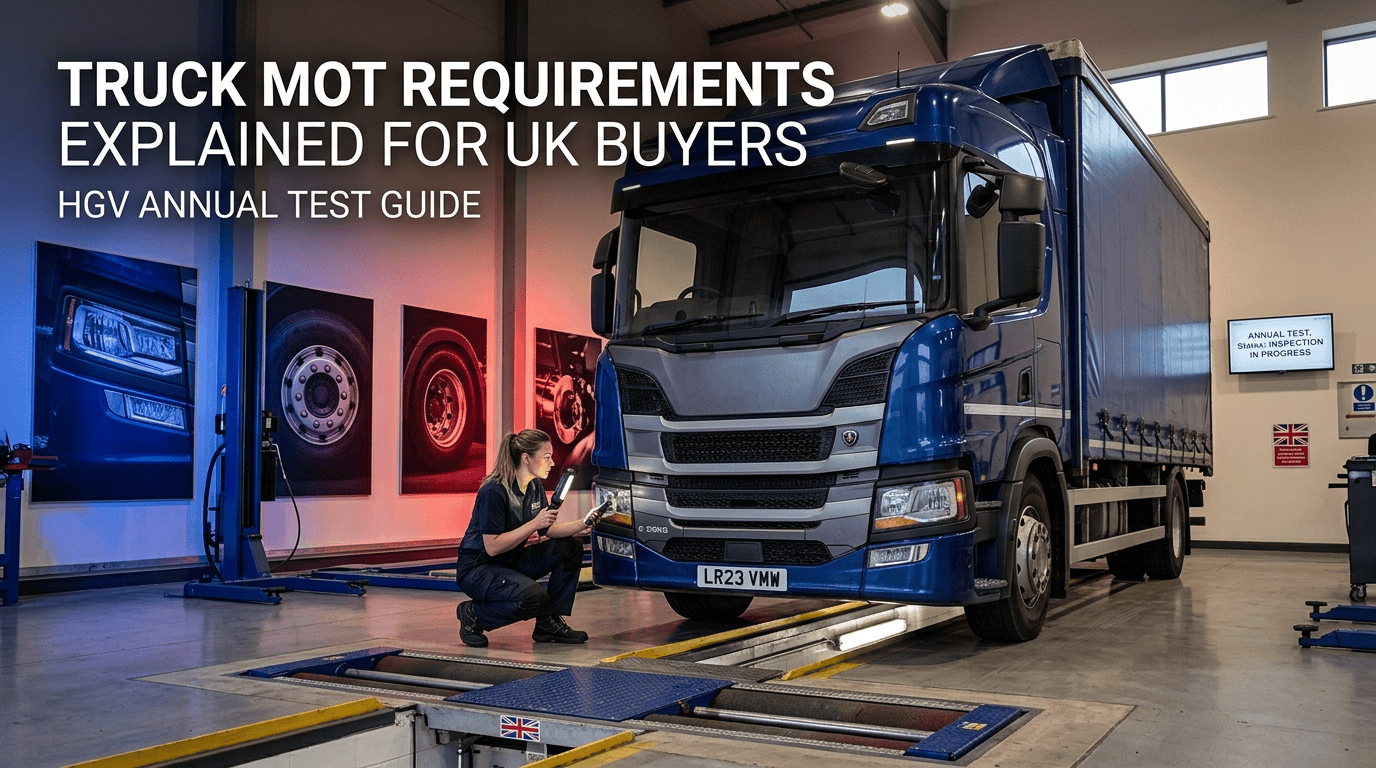
Most trucks over 3.5 tonnes in the UK do not get a standard car MOT. Instead, they need an annual test for heavy goods vehicles (HGVs) and public service vehicles (PSVs), commonly called the HGV MOT or truck MOT. This test is run by the Driver and Vehicle Standards Agency (DVSA), usually at an Authorised Testing Facility (ATF), and it confirms your lorry, tipper, tractor unit, or bus meets strict roadworthiness and environmental standards before it can legally stay on the road.
If you are buying a used truck privately or through a dealer, the first thing you need to know is that a valid HGV MOT certificate is not a guarantee of mechanical perfection. It is a snapshot of minimum safety standards on the day of the test. You should still carry out your own checks on the chassis, brakes, and service history before handing over any money.
What Exactly Is a Truck MOT in the UK?
For commercial vehicles, the term “MOT” is often used interchangeably with the “annual test”. While car owners take their vehicles to a local MOT garage, heavy vehicle owners take their trucks to a specialist site. The DVSA sets the rules, and the test is carried out by DVSA staff or authorised examiners at ATFs—these are often operated by commercial garages, dealerships, or dedicated HGV workshops across cities like Birmingham, Manchester, Leeds, and Glasgow.
The test covers the same fundamental principles as a car MOT but is far more rigorous. A truck carries significantly more weight, travels longer distances, and operates under commercial pressure. The braking system, suspension, steering, and emissions are scrutinised to a much higher tolerance.
Which Vehicles Need an HGV MOT?
The rules are based on Gross Vehicle Weight (GVW) and usage.
- Goods vehicles over 3,500kg GVW: Required to have an annual test.
- Trailers over 3,500kg GVW: Required to have an annual test.
- Trailers between 1,020kg and 3,500kg: Required if used commercially and the combination exceeds 3,500kg.
- Buses and coaches (PSVs): Required regardless of weight if used for hire or reward.
If you are driving a pickup truck like a Ford Ranger or a Nissan Navara, you are usually in the car MOT bracket (Class 4) unless it has been specially modified or plated for commercial heavy use. If you are buying a 7.5-tonne box van or a 44-tonne artic tractor unit, you are firmly in HGV territory.
Truck MOT vs Car MOT: What Is the Difference?
The difference is significant. A car MOT might take 45 minutes and cost around £50. A truck MOT is a scheduled event.
| Feature | Car MOT | Truck/HGV MOT |
|---|---|---|
| Governing body | DVSA (via local garages) | DVSA (via ATFs or DVSA sites) |
| Test location | Local garage | Specialist ATF or DVSA test station |
| Typical cost | £54.85 (max for cars) | £100 – £200+ (plus lane fees) |
| Frequency | Annually (after 3 years) | Annually (from first registration) |
| Brake test | Roller brake test | Roller brake test + load simulation |
| Emissions | Standard exhaust check | Stricter diesel smoke opacity test |
| Paperwork | MOT certificate | Pass certificate + plating certificate update |
The HGV test is often referred to as the “MOT” because the pass certificate looks similar and the DVSA records it on the same digital database. When you buy a used truck, you can check its MOT history online using the number plate, just as you would with a car.
What Do They Check During an HGV MOT?
The annual test is divided into specific inspection categories. If you are preparing a truck for sale or purchase, these are the areas where vehicles commonly fail.
1. Brakes and Air Systems
The brake test is the most common reason for failure. The examiner checks the brake performance using a roller brake tester. For air-braked vehicles, they inspect the compressor, air dryer, reservoirs, and the operation of the parking brake. Air leaks are an instant fail—you cannot have a system that loses pressure too quickly.
2. Steering and Suspension
Heavy steering boxes, worn kingpins, and excessive play in the drag link or track rod ends are common failures. The examiner will also check the suspension air bags for chafing or cracks. A split air bag on a rear axle will fail the test.
3. Lights and Electrical Systems
This includes the headlights, side markers, indicators, brake lights, and number plate lights. Because trucks operate in poor weather and at night, the lighting requirements are stricter regarding colour, positioning, and visibility.
4. Tyres and Wheels
The examiner checks the load rating and speed rating of the tyres. A tyre may have legal tread depth but still fail if the load index is too low for the plated weight of the axle. Cracked wheel rims or missing wheel nut indicators are also fails.
5. Chassis and Bodywork
Corrosion is a major issue, but not just surface rust. The examiner looks for structural weakness, cracked crossmembers, and insecure body mountings. If the truck has a tipper body, the locking mechanisms and safety props are checked.
6. Emissions (Smoke Test)
Modern trucks with Euro 6 engines have complex exhaust after-treatment systems. The examiner performs a smoke opacity test. A clogged DPF (diesel particulate filter) or a faulty EGR valve will result in a fail.
How Much Does a Truck MOT Cost in the UK?
There is no single fixed price for an HGV MOT because the market is privatised through ATFs.
The DVSA sets the fees for the test itself, but the ATF adds a “lane fee” for the use of their facility and equipment. You can expect to pay:
- Goods vehicle (2 axles): roughly £115 to £160 total.
- Goods vehicle (3 axles): roughly £150 to £200 total.
- Tractor unit: roughly £160 to £200 total.
- Trailer MOT: roughly £80 to £120 total.
These prices vary depending on where you are in the UK. Operating costs in London and the South East tend to push prices higher than in the North East or Wales. It is always worth phoning two or three ATFs near you to compare the combined test fee and lane fee.
When Is the First HGV MOT Due?
Unlike cars, which get a three-year grace period, a brand-new truck requires its first annual test one year after the date of first registration. This catches many new operators out. If you buy a new 18-tonne rigid truck in January, you must have it tested by the anniversary of that registration date, not three years later.
The vehicle can be tested up to two months before the expiry date without losing the anniversary. This means if your test is due on 1st June, you can present the vehicle from 1st April onwards. If it passes, the new certificate is valid from the original expiry date, so you do not lose time.
How to Check a Truck’s MOT History Before Buying
If you are looking at a used truck on TopSellUKCars, do not rely on the seller’s word. The DVSA makes MOT history publicly available.
- Go to the GOV.UK website.
- Select “Check the MOT history of a vehicle”.
- Enter the number plate (registration number).
- View the pass and fail history, including the mileage recorded at each test.
This history is useful for spotting potential issues. If the truck failed on brake efficiency three years running, the seller might be patching it up just to pass the test rather than fixing the root cause. You should also check the mileage progression—a sudden drop in recorded mileage could suggest a replaced tachograph or dashboard, though this is less common on modern vehicles.
For a broader check on the vehicle’s financial history, you should also run an HPI check to ensure there is no outstanding finance. We cover this in detail in our guide on what an HPI check is and why UK buyers should never skip one.
What Documents Do You Need for a Truck MOT?
When you present a truck for its annual test, the ATF or DVSA examiner needs to see:
- The V5C logbook or a copy of it (to confirm vehicle identity).
- The current MOT certificate (if applicable).
- The plating certificate (if it is a goods vehicle). This shows the maximum authorised masses and axle weights.
- Proof of a valid Operator’s Licence is not strictly required for the MOT test itself, but you will need it for the vehicle to be used commercially.
- The fee (usually paid to the ATF, not the DVSA directly).
If the vehicle fails the test, you must repair the defects and present it for a retest. The retest is often free if the vehicle stays at the ATF, but if you take it away to repair it, you will usually have to pay a partial retest fee.
What Is the Difference Between an MOT and a Roadside Check?
A passed MOT does not mean the vehicle will not be stopped by the DVSA at the roadside. The DVSA has enforcement teams that conduct random checks across the UK, often near ports like Felixstowe or major motorway junctions.
If a truck is found to be unroadworthy at the roadside, the driver and operator can be penalised even if the MOT is still valid. This is why fleet managers do not treat the annual test as the only maintenance schedule—it is a minimum standard, not a maintenance plan.
Common Reasons Trucks Fail the HGV Test
To give you a realistic picture, these are the issues that come up most often in ATF lanes across the country.
- Air leaks: The vehicle cannot hold air pressure, often due to perished air lines or a faulty brake chamber.
- Brake imbalance: One side of an axle brakes harder than the other, causing the vehicle to pull.
- Tyre load ratings: The wrong tyres fitted for the axle weight.
- Worn steering joints: Excessive play in kingpins or track rod ends.
- Lighting faults: Multiple bulbs out or incorrect lens colours.
- Emissions failures: High smoke opacity readings, usually on older Euro 5 or poorly maintained Euro 6 engines.
- Chassis corrosion: Structural rust around the suspension mounts or crossmembers.
What Does a Truck MOT Pass Certificate Look Like?
It is a paper certificate (VT20 for goods vehicles) that states the vehicle registration, chassis number, test date, and expiry date. The record is also stored digitally by the DVSA. When you sell a truck, the buyer can verify the MOT status online using the number plate, so a physical certificate is not as critical as it used to be, but it is still useful to keep with the service records.
Is an HGV MOT Transferable When You Buy a Used Truck?
The MOT is registered against the vehicle, not the owner. This means the certificate remains valid when ownership changes. There is no need to retest a truck just because it has been sold. However, you must ensure the vehicle is taxed (VED) in the new owner’s name before it is used on the road. For heavy goods vehicles, Vehicle Excise Duty is handled differently than for cars—it is usually based on the weight and axle configuration, and you cannot transfer the tax between owners.
How to Prepare a Truck for Its MOT to Avoid a Fail
If you are selling a truck privately, presenting it with a fresh MOT significantly increases its value. Here is a practical checklist before you book the lane.
Check the Simple Things First
Walk around the truck with the engine running and the lights on. Check every bulb, including side markers and number plate lights. Check the windscreen for chips in the driver’s line of vision. Check the wipers and washers. These are basic fails that are easy to avoid.
Drain the Air Tanks
Moisture in the air system causes corrosion in the valves. Park on level ground, chock the wheels, release the parking brake, and drain the air tanks. If a significant amount of water comes out, you may have a faulty air dryer.
Inspect the Tyres
Use a tread depth gauge across the full width of the tyre. Check the sidewalls for cuts. Check the load index on the tyre sidewall against the plating certificate. If the tyre is rated for 3,000kg but the axle is plated at 3,500kg per side, it will fail.
Check the Brakes
Listen for air leaks with the engine off. The system should hold pressure without the compressor running. If you hear a constant hiss from a brake chamber, you have a leak.
Clean the Chassis
Examiners cannot inspect what they cannot see. A chassis caked in mud and grease makes it impossible to check for cracks. A steam clean of the chassis rails and suspension components before the test is standard practice for professional operators.
What Happens if You Drive a Truck Without a Valid MOT?
Driving an HGV without a valid MOT certificate is a serious offence. The maximum fine is £1,000 for using a vehicle without a test certificate. However, for commercial vehicles, the penalties go further. The Driver and Vehicle Standards Agency can issue an S-marked prohibition notice if they find the vehicle at the roadside. This takes the vehicle off the road immediately until the defect is fixed and the vehicle is retested.
It also affects your operator’s licence. The Traffic Commissioner can call you to a public inquiry if you have a history of running vehicles without valid tests. This can result in the suspension or revocation of your operator’s licence, which effectively puts you out of business.
There is one exception: you can drive a truck without a valid MOT if you are driving it to a pre-booked MOT test at an ATF or DVSA test station. You must be able to prove the appointment if stopped. You cannot drive it to a garage for repairs first unless that garage is on the route to the test.
Where Can You Book a Truck MOT?
You can book directly with an ATF or through a third-party booking service. The easiest way is to search for “HGV MOT ATF near me” and check the DVSA’s list of authorised testing facilities. You will need to provide the vehicle registration and the type of test required. If you are testing a trailer, you book a separate trailer test.
Buying a Used Truck: What Should You Look For?
If you are in the market for a used truck on TopSellUKCars, the MOT is just one part of the picture. You should:
- Check the MOT history online using the number plate.
- Ask for the service history, especially for the brakes and air system.
- Look at the chassis for signs of welding or repairs.
- Check the tyres—a full set of 22.5-inch tyres for an 18-tonne truck can cost over £2,000, so condition matters.
- Run an HPI check to confirm there is no outstanding finance or a recorded write-off.
Our guide on how to check a used truck’s service history before buying covers this in more depth. If you are new to the HGV world, start with our complete beginner’s guide to buying a used truck in the UK. And if you are unsure what licence you need to drive the truck you are buying, our guide on truck licence categories C1, C, and CE explained will help you avoid a costly mistake.
Summary
A truck MOT in the UK is the annual test for HGVs and PSVs over 3.5 tonnes, carried out by the DVSA at an Authorised Testing Facility. It covers brakes, air systems, steering, suspension, lights, tyres, chassis, and emissions, and it must be done every year from the vehicle’s first registration date.
When buying or selling a used truck, always check the MOT history online using the number plate. A current pass certificate is a legal requirement for road use, but it is not a substitute for a proper inspection—especially on a commercial vehicle that works for a living.