
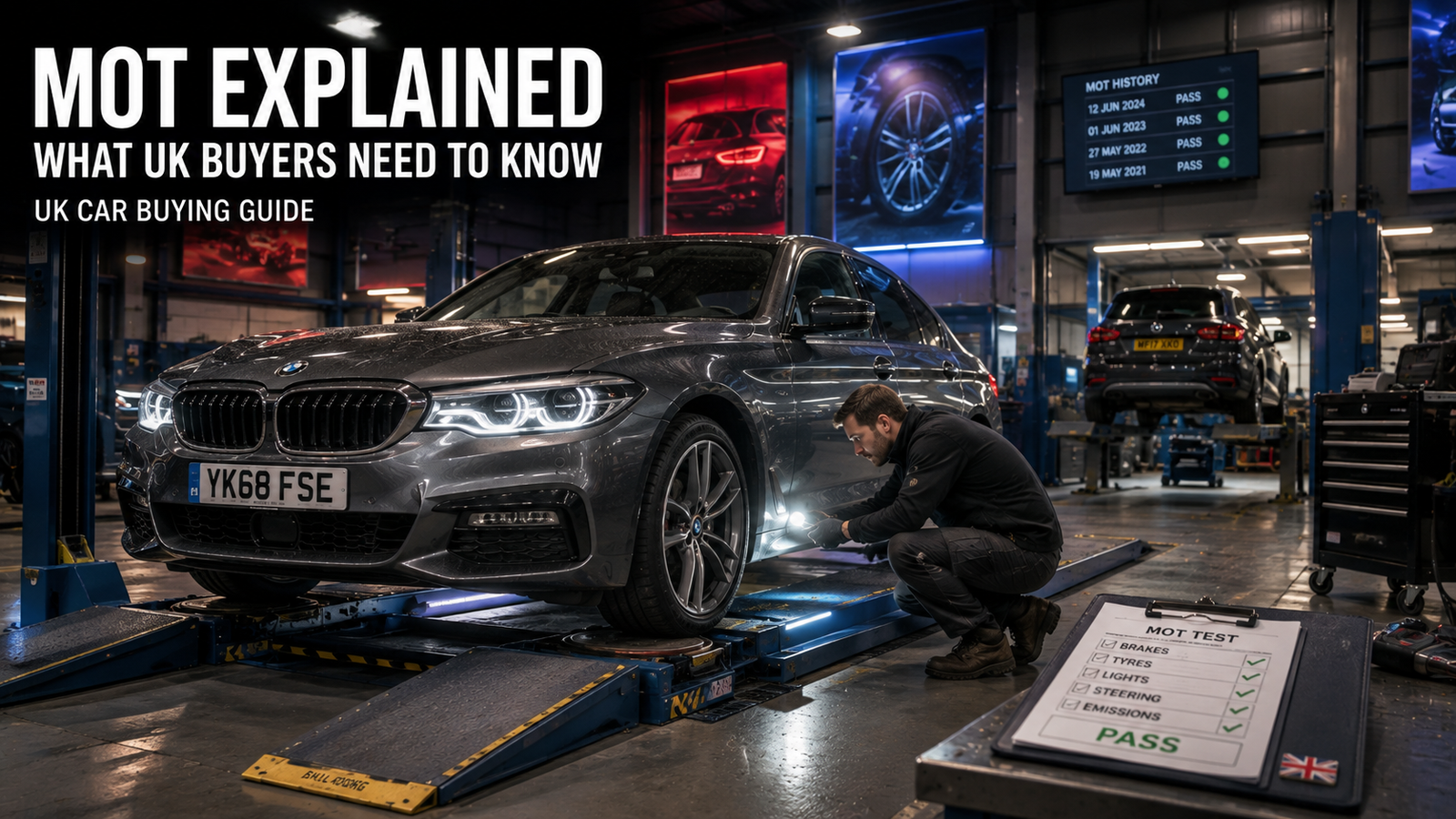
MOT Explained: What UK Car Buyers Need to Know
MOT Explained: What UK Car Buyers Need to Know
An MOT is an annual safety and roadworthiness check required by law for most vehicles over three years old in the United Kingdom. You cannot legally drive or park your vehicle on public roads without a valid MOT certificate, unless you are driving to a pre-booked test appointment. The test is conducted by authorised garages and covers everything from your brakes and lights to emissions and structural corrosion.
What Is an MOT Test?
The Ministry of Transport test—universally known as the MOT—was introduced in 1960 and has been a legal requirement for decades. Despite the name, it has nothing to do with the current Department for Transport directly running the tests. The Driver and Vehicle Standards Agency (DVSA) now oversees the MOT scheme, setting the standards and rules that every authorised test centre must follow.
An MOT is not the same as a service. A service involves changing oil, filters, and wearing parts to keep the car running well. An MOT is purely a safety inspection. A car can pass an MOT and still be due a service, just as it can fail an MOT despite having been recently serviced.
The test itself typically takes between 45 minutes and an hour. You can wait at the test centre while it is carried out, though many garages will ask you to leave the vehicle with them for the morning or afternoon.
When Does a Vehicle Need Its First MOT?
The rules differ depending on the type of vehicle.
For cars and motorcycles, the first MOT is due on the third anniversary of first registration. If you bought a brand-new car registered on 15 March 2023, its first MOT is due on 15 March 2026. You cannot get an MOT earlier than one month minus one day before the due date and still preserve the anniversary. So for that car, the earliest you could test it would be 16 February 2026.
Light goods vehicles up to 3,500kg, including most vans, follow the same three-year rule. Larger vehicles and buses face stricter requirements. Buses, minibuses, and coaches must have their first MOT test before they are first used to carry passengers, and then annually after that. Lorries over 3,500kg and goods vehicles need an annual test from the first anniversary of registration, though this is technically the Heavy Goods Vehicle (HGV) test managed by DVSA rather than the standard MOT scheme.
Taxis and private hire vehicles need an MOT from the first anniversary, regardless of vehicle type.
Here is a quick reference table:
| Vehicle type | First MOT due | Test frequency after first MOT |
|---|---|---|
| Car | 3rd anniversary of registration | Every 12 months |
| Motorcycle | 3rd anniversary of registration | Every 12 months |
| Van (up to 3,500kg) | 3rd anniversary of registration | Every 12 months |
| Taxi / private hire | 1st anniversary of registration | Every 6 or 12 months depending on local licensing |
| Bus / coach | Before first use carrying passengers | Every 12 months |
| HGV (over 3,500kg) | 1st anniversary of registration | Every 12 months |
What Does the MOT Test Check?
The MOT inspection covers a wide range of components, but it does not check the engine, gearbox, or clutch. That surprises many first-time car owners. A car with a worn clutch or a noisy gearbox can still pass an MOT, because those items are not considered safety-critical in the same way as brakes or tyres.
The main areas examined during an MOT include:
Lights and electrical equipment. Every light on the vehicle must work, be the correct colour, and be aimed properly. Number plate lights, indicators, hazard lights, and the horn are all checked.
Brakes. The tester will assess brake performance on a rolling road, checking that the vehicle stops evenly and efficiently. Handbrake or electronic parking brake function is also tested.
Tyres and wheels. Tyres must have a minimum tread depth of 1.6mm across the central three-quarters of the tread, around the entire circumference. Any cuts, bulges, or exposed cords will cause a failure.
Suspension and steering. Worn ball joints, damaged shock absorbers, leaking power steering fluid, and excessive play in the steering rack are all checked.
Body and structure. Corrosion within 30cm of a load-bearing area, such as a seatbelt mount or suspension point, is a failure. The tester will inspect the sills, floor pan, chassis legs, and boot floor.
Exhaust and emissions. The tester will check that the exhaust is secure and not blowing, and will measure emissions against the manufacturer’s specifications. Diesel vehicles face a stricter smoke test than petrol cars.
Seats and seatbelts. All seatbelts must be present, correctly mounted, and in working order. The driver’s seat must be securely fixed and adjustable.
Windscreen and wipers. The windscreen must be free of damage in the driver’s direct line of vision. Wipers and washers must work and clear the screen effectively.
Mirrors. All mandatory mirrors must be present, secure, and adjustable.
Fuel system. Leaks, damaged pipes, and insecure fuel caps are failures.
Registration plates. Plates must be legible, correctly spaced, and made of reflective material.
What Are the Most Common MOT Failure Items?
The DVSA publishes regular data on the most common reasons vehicles fail the MOT test. For cars, the top failure items year after year are remarkably consistent.
Lamps, reflectors, and electrical equipment account for a significant proportion of failures. A blown bulb is one of the cheapest repairs, yet it remains the single most common reason for MOT failure. Checking every light on your car before the test takes five minutes and could save you a retest fee.
Suspension problems are the next big category. Worn coil springs, broken shock absorbers, and perished rubber bushes are common on older cars and often go unnoticed because the deterioration is gradual.
Brake faults range from worn pads and discs to corroded brake pipes. On older vehicles, brake pipe corrosion is particularly prevalent, especially on cars that have spent years parked near the coast or driven through salted winter roads.
Tyres fail for low tread depth, cuts, or uneven wear. A tyre with uneven wear often points to a suspension or tracking problem, so it is worth investigating rather than simply fitting a new tyre.
Windscreen damage, wiper blades, and number plate condition round out the most frequent failure points. A cracked number plate or a wiper blade that smears instead of clearing can be enough to fail.
How to Check a Vehicle’s MOT History Before Buying
Checking the MOT history of a used car is one of the most useful things you can do before handing over any money. The DVLA makes this information freely available through the gov.uk website.
The MOT history check shows every test the vehicle has had since records were digitised in 2005. For each test, you can see the date, the result, the mileage recorded, and the exact reasons for any failure. If the vehicle failed on corrosion or repeated suspension faults, you will see those details listed.
This information is far more useful than a simple pass or fail. A car that has failed several times for the same issue suggests either poor maintenance or a previous owner who only fixed the bare minimum to get it through the test. A car that has passed consistently with only minor advisories suggests it has been looked after.
Advisories are items the tester noted as being close to the legal limit but not yet a failure. They are recorded on the MOT certificate and in the online history. When viewing a used car, ask the seller about any advisories and whether they have been addressed. A tyre advisory from nine months ago might mean the car now has bald tyres.
To check the MOT history, you need the vehicle registration number. You can also see the car’s MOT expiry date, tax status, and whether it has been declared SORN (Statutory Off Road Notification).
What Should Sellers Do Before an MOT?
If you are selling a vehicle on TopSellUKCars, presenting it with a fresh MOT makes the listing noticeably more attractive to buyers. A car with 12 months of MOT left removes a major objection buyers have and lets them test drive and collect the vehicle without worrying about trailer hire or immediate garage visits.
Before the test, do a basic pre-MOT walkaround yourself. Check every light, including indicators, brake lights, reversing light, and number plate light. Check the tyre tread depths. Test the wipers and washers. Fill the washer fluid. Check the horn. Clean the number plates if they are dirty.
If any warning lights are illuminated on the dashboard, get them diagnosed before the test. An engine management light is now an automatic failure for petrol and diesel cars.
It is also worth asking the tester to explain any advisories verbally. Some advisories are trivial, but others might affect a buyer’s decision, and it is better to know before the car is listed.
Can You Drive Without an MOT?
No. Driving without a valid MOT is a criminal offence. The penalty is a fine of up to £1,000, and your vehicle could be seized if it is deemed dangerous.
There is one exception: you may drive a vehicle without an MOT if you are driving it to a pre-booked MOT test appointment at a test centre. The appointment must be booked in advance, and you should be able to prove it if stopped. Driving to a garage for repairs before an MOT is not an exemption, nor is driving to a garage hoping they might fit you in.
You also cannot legally park a vehicle without an MOT on a public road. It does not need to be driven to attract a penalty. Vehicles parked on public roads must be taxed, insured, and have a valid MOT unless they are declared SORN.
How Much Does an MOT Cost?
The DVSA sets a maximum fee that test centres can charge for cars and motorcycles. For a car, the maximum is £54.85. For a motorcycle, it is £29.65. Many garages charge less than the maximum, particularly if they are competing for local business in cities like Birmingham, Manchester, or Glasgow.
The test fee does not include any repairs needed to pass. If the vehicle fails, you can leave it with the garage to have the work done, or you can take it away to fix it yourself or have another garage do the work. You cannot drive it away if the failure is classed as dangerous, even to another garage.
If you return the vehicle to the same test centre within 10 working days for a partial retest, the retest is often free or charged at a reduced rate, depending on which items need rechecking. A full retest after 10 working days costs the full fee again.
What Is a Valid MOT Certificate?
The paper MOT certificate is no longer the primary proof of a vehicle’s MOT status. The DVSA now maintains a digital record, and the police, DVLA, and insurance companies can access it automatically through the vehicle registration.
When you pass an MOT, you will still receive a paper certificate, but it is essentially a receipt for your records. The legal record is the digital one held by the DVSA.
If you lose the certificate, you can check the vehicle’s MOT status online using the number plate. You can also get a replacement certificate from any MOT test centre by showing the V5C logbook.
How Does the MOT Interact with VED and Insurance?
The MOT does not exist in isolation. To tax a vehicle, the DVLA requires a valid MOT unless the vehicle is exempt. When you apply for VED (vehicle tax) online, the system automatically checks the MOT and insurance databases. If the MOT has expired, you will not be able to tax the vehicle until it passes.
Your insurance policy typically requires the vehicle to be roadworthy. Driving without an MOT does not automatically invalidate your insurance, but if you are involved in an accident and the vehicle is found to be unroadworthy, your insurer may reduce or refuse a payout. The association between lack of MOT and increased risk is well documented in insurance claims data.
Classic Cars and MOT Exemptions
Some vehicles are exempt from the MOT test. Vehicles over 40 years old that have not been substantially modified can be exempt. This is a rolling exemption, meaning a vehicle registered in 1985 becomes exempt in 2025, provided it has not had significant changes to the chassis, engine, suspension, or body.
Even if exempt, the vehicle must still be maintained in a roadworthy condition. You can voluntarily submit an exempt vehicle for an MOT, and many classic car owners do this as an independent safety check.
Vehicles of historical interest must also be taxed in the historic vehicle class to qualify for the exemption. If you are unsure whether your vehicle qualifies, the DVLA provides guidance on the gov.uk website.
What to Do When an MOT Goes Wrong
If you believe a test centre has failed your vehicle unfairly, you can appeal. The appeal must be lodged with the DVSA within 14 working days of the test. You will need to complete a VT17 form or use the online service.
There is a fee for the appeal, which is refunded if your appeal is upheld. However, you must not have the failure items repaired before the DVSA re-inspection, otherwise the evidence is lost. That creates a practical problem: you may be without a car for up to two weeks while the appeal is processed.
In practice, most people simply have the work done and retest. The appeals process is there for genuine disputes, but it is rarely worth the delay for a £54.85 test.
Summary
The MOT is a legal requirement, not an optional health check. For most cars, it is due every year from the third anniversary of registration, and driving without one is a criminal offence with a fine of up to £1,000. Before buying any used car, check its MOT history on the gov.uk website—the failure history and advisories tell you more about how the car has been maintained than any sales description will. For sellers, a fresh MOT removes buyer hesitation and makes the vehicle genuinely easier to sell. If you are listing a car, van, truck, or bike on TopSellUKCars, take ten minutes to check the lights, tyres, and wipers before the test. It costs nothing and could save a retest fee.















Comments
7
[…] a used truck in the UK. For background on how MOT history works and what it reveals, see our MOT explained guide. If you are also looking at cars, our used car history check guide covers the equivalent […]
[…] an MOT, but you cannot lawfully use it on the road until it has a valid test. Our guide to MOT rules for UK buyers explains the basics for cars and vans, and the same principle applies to trucks: no valid MOT […]
[…] more detail on checking a used car’s MOT history before buying, see our guide to MOT history checks. The basic principles are the same even though the test categories […]
[…] advice on buying, selling and running vehicles in the UK, have a look at our other guides on MOTs explained, road tax and VED, and how to spot common scams. If you are thinking about larger […]
[…] For more detail on how MOT records work, read our MOT explained guide. […]
[…] Often, the answer is yes, even if the car has minor issues. A fresh MOT certificate is a powerful selling tool. It removes the buyer’s biggest fear (the unknown) and allows them to drive the car away legally. If the car needs less than £200 of work to pass, you will almost always recoup that cost and more in the final sale price. A car with 12 months of MOT is simply a more valuable asset. We cover this in more depth in our guide on what car buyers need to know about MOTs. […]
[…] Often, the answer is yes, even if the car has minor issues. A fresh MOT certificate is a powerful selling tool. It removes the buyer’s biggest fear (the unknown) and allows them to drive the car away legally. If the car needs less than £200 of work to pass, you will almost always recoup that cost and more in the final sale price. A car with 12 months of MOT is simply a more valuable asset. We cover this in more depth in our guide on what car buyers need to know about MOTs. […]