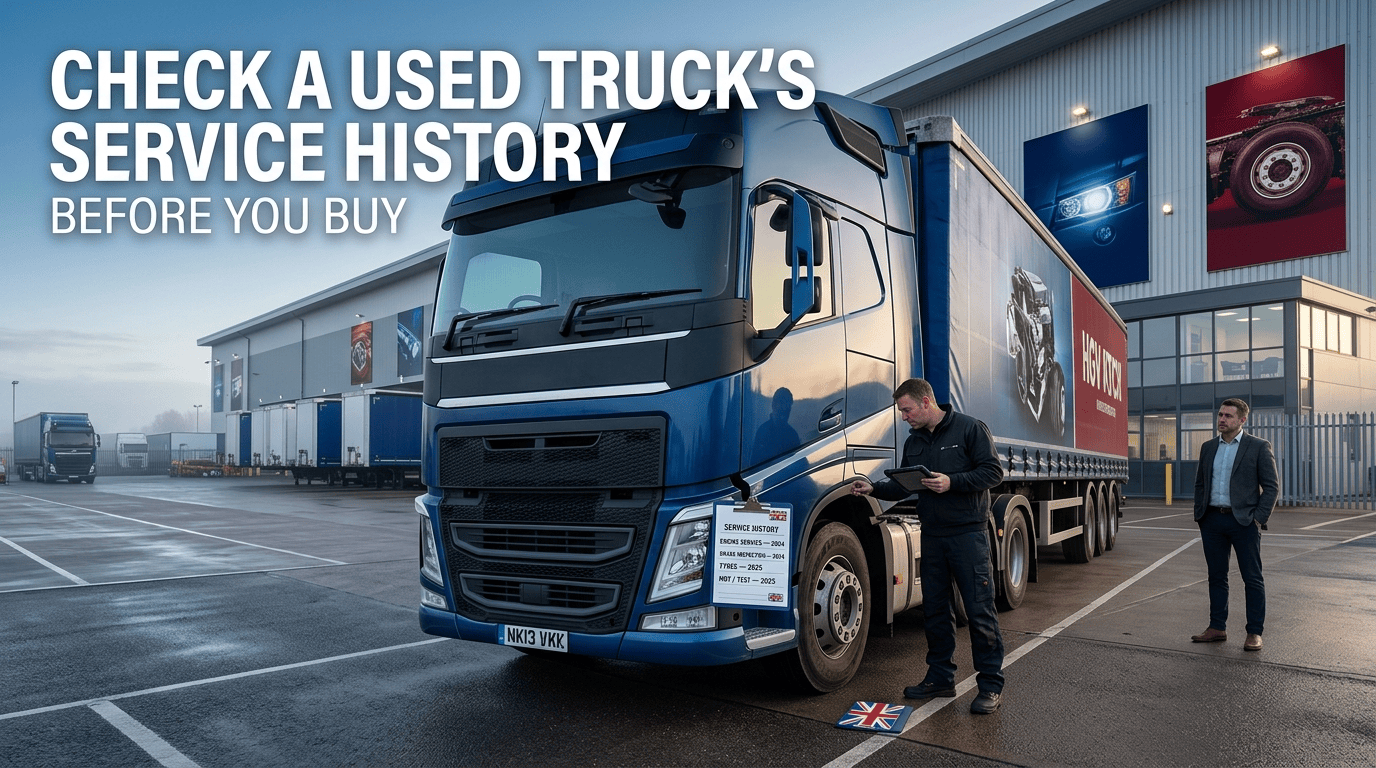
How to Check a Used Truck’s Service History Before Buying (UK Guide
How to Check a Used Truck’s Service History Before Buying
To check a used truck’s service history before buying, start by getting the registration number and VIN, then use the DVSA’s free MOT history service to see every test result and recorded mileage. After that, ask the seller for the paper service book or digital maintenance records, and cross-check the stamps, dates and mileages against the MOT data. Finally, run a commercial vehicle history check through a provider that covers finance, write-offs and mileage discrepancies.
A truck’s service history is not the same as a car’s. It tells you whether the vehicle was maintained to a schedule that keeps it road-legal and commercially reliable, and gaps in that record can hide serious problems. This guide walks through the entire process for buyers in the United Kingdom, from the documents you need to the questions that catch sellers out.
What Does a Truck Service History Actually Include?
A proper service history for a commercial vehicle is more than a stamped book. It should include several layers of evidence.
The first layer is the routine maintenance record. For trucks, this usually follows the manufacturer’s recommended intervals, but in practice it is often tied to the operator’s maintenance planner. For a 7.5-tonne rigid or an 18-tonne curtain-sider, that might mean oil and filter changes every 25,000 to 40,000 miles, depending on the engine and use. The record should show who did the work and at what mileage.
The second layer is the safety inspection record. Under the DVSA’s Guide to Maintaining Roadworthiness, commercial vehicles need regular safety inspections. Many operators do this every six to twelve weeks, separate from the annual MOT. These inspection sheets are not always handed over when a truck is sold, but a well-run fleet or owner-operator should be able to produce at least some of them.
The third layer is the repair history. This covers anything beyond routine servicing: brake replacements, clutch work, DPF issues, injector failures, gearbox repairs, suspension work and electrical faults. A vehicle with a documented repair history is easier to assess than one where you are told “it’s all been fine.”
The fourth layer is digital records. Many modern trucks, especially anything built after 2015, will have service data stored by the manufacturer’s dealer network or by fleet management software. If the seller cannot produce paper records, ask whether digital records exist and who holds them.
A genuine service history will usually be a combination of all four. A stamped book alone is not enough for a commercial vehicle purchase.
Where Do You Start a Truck Service History Check?
Start with the basics before you pay for anything.
Get the registration number and VIN
Ask the seller for the registration number and the Vehicle Identification Number. On a truck, the VIN is usually stamped on the chassis rail, often on the nearside (left-hand side when sitting in the cab) near the front wheel arch or behind the cab. It may also be on a plate inside the cab door frame.
Do not skip the VIN. The registration number can be changed, cloned or transferred. The VIN is the vehicle’s unique identity.
Check the V5C logbook
The V5C shows the registered keeper, not necessarily the legal owner. Look for:
- The VIN on the V5C matching the VIN on the chassis
- The vehicle description matching what you are looking at (engine size, body type, number of axles)
- The number of former keepers
- Any note of “substantially repaired or restored” in the special notes section
A mismatched VIN is an immediate walk-away situation. It may indicate cloning, ringing or that the truck is made from parts of more than one vehicle.
Check the MOT history before you travel
The DVSA’s MOT history service is free and does not require the V5C. You only need the registration number. It shows:
- Every MOT test result since 2005 for most vehicles
- The recorded mileage at each test
- The failure reasons and advisory notes
- The test location
This is often the fastest way to spot a clocked truck. If the mileage drops between tests, something is wrong. If the mileage barely moves for years but the truck looks heavily worn, something is wrong.
The MOT history also tells you what kind of life the truck has had. Repeated failures for tyres, brakes or steering components suggest an operator who ran the vehicle on the edge. Repeated advisories for corrosion can point to structural issues that will cost thousands.
A full MOT check is part of the foundation of any truck service history check. You can read more about how MOT history works for cars in our separate guide, but the same principles apply to commercial vehicles.
How to Check a Truck’s MOT History Online
The process takes less than five minutes.
- Go to the DVSA MOT history service at gov.uk/check-mot-history
- Enter the truck’s registration number
- Review the full test record, not just the current pass
Look at three things carefully.
Mileage progression. Plot the mileage at each test in your head. A truck doing 40,000 miles a year should show roughly 40,000 miles between annual tests. Big gaps, sudden drops, or mileage that stalls for two or three years are red flags.
Failure patterns. One failed MOT for a bulb is normal. Three failures in a row for brake efficiency, suspension play or emissions suggests the truck was not being maintained properly between tests.
Advisory patterns. Advisories are items that were not bad enough to fail at the time but needed watching. If the same advisory appears year after year, it tells you the operator ignored it. That is useful information when you are negotiating price.
The MOT history covers the safety side. It does not tell you whether the oil was changed on time or whether the DPF was cleaned, which is why the MOT check alone is not enough.
What a Full Commercial Vehicle History Check Should Cover
A commercial vehicle history check goes beyond MOT data. The main UK providers include HPI, Experian AutoCheck and the RAC. They pull data from finance houses, insurance companies, the DVLA and the Police National Computer.
Here is a summary of what a decent check covers and why it matters for a truck buyer:
| Check | What it reveals | Why it matters for a truck |
|---|---|---|
| Outstanding finance | Whether the truck is still on a hire purchase or lease agreement | You could lose the vehicle if the finance company repossesses it |
| Stolen vehicle register | Whether the truck is recorded as stolen | Buying a stolen truck means you own nothing |
| Insurance write-off status | Whether the truck has been written off (Cat A, B, S or N) | Write-offs may be unsafe or difficult to insure |
| Mileage discrepancy | Whether recorded mileage conflicts with DVLA or finance records | Indicates clocking |
| Number plate changes | Whether the plate has been changed multiple times | Can indicate an attempt to hide history |
| Previous keepers | How many keepers the truck has had | High turnover can signal recurring problems |
| Scrapped status | Whether the DVLA has recorded the vehicle as scrapped | The truck should not be on the road |
A basic £10 text check is not enough for a truck. Pay for the full report. When you are spending £15,000 to £60,000 on a used rigid or tractor unit, the £20 to £30 cost of a full check is trivial compared with what it can save you.
How to Cross-Check the Service Book Against the MOT History
This is where the real detective work happens.
Open the service book and go through it entry by entry. For each service stamp, note:
- The date
- The mileage
- The garage name and location
- The type of service (interim, full, major)
Then compare each entry against the MOT history.
Mileage should match. If a service stamp says 210,000 miles in March 2023, but the MOT in April 2023 says 180,000 miles, someone is lying. The mileage on a truck only goes one way.
Dates should be plausible. A service interval of 30,000 miles should happen roughly once a year for an average truck doing 30,000 miles annually. If the book shows five services in nine months and then nothing for two years, ask why.
Garages should be real. Phone the garage if the purchase price justifies it. Many independent commercial garages are happy to confirm whether they serviced a particular vehicle, especially if you explain you are buying it. They will not always share detailed records due to data protection, but they can often confirm dates and mileage.
Ink and stamp wear should be consistent. A brand-new stamp in an otherwise old book, or handwriting that changes noticeably halfway through, can indicate a fabricated history. Some sellers do buy blank service books and stamp them themselves.
A service history check is about consistency. Genuine records look a bit messy. They have different pens, different stamps, slightly different handwriting, occasional smudges. A book where every stamp is perfectly aligned and every entry looks identical is more suspicious than reassuring.
What to Ask the Seller Before You View the Truck
Most sellers will not volunteer information. You have to ask for it.
“Can you send me the last three service records and the last two MOT certificates before I come to see it?”
This saves you a wasted trip. If the seller hesitates, makes excuses or says they are “in a lock-up somewhere,” be wary. Most genuine sellers can produce service records within a day or two.
“Who maintained the truck?”
A one-truck owner-operator who used the same local garage for years is a better answer than “various places.” If the truck came from a fleet, ask for the fleet maintenance records. Some fleets sell trucks with full documentation; others sell them with nothing.
“Has it had any major repairs — gearbox, engine, DPF, injectors?”
Listen carefully. If the seller says “only routine stuff,” then you later find an invoice for a new clutch, the trust is broken. Ask for invoices for any major work. A new gearbox fitted 40,000 miles ago with an invoice is good news, not bad news.
“Why are you selling it?”
The answer is rarely “because it’s perfect.” Common honest answers include contract ending, moving up to a bigger truck, retiring, or the truck being surplus to requirements. Vague answers or hostility to the question are warning signs.
“Can I speak to the garage that serviced it?”
Not every seller will agree to this, especially if it is a dealer who never used the truck. But for a private sale or a small operator, it is a reasonable request. If the seller refuses without a good reason, treat it as a gap in the history.
Where to Find Digital Service Records for Modern Trucks
Paper service books are becoming less common. Many newer trucks have digital service histories held by the manufacturer or by dealer groups.
For example, a DAF or MAN truck serviced within the dealer network will usually have its records on the manufacturer’s system. A Volvo or Scania truck is similar. If the truck has been serviced outside the dealer network, the independent garage may hold records on its own workshop software.
When you view the truck, ask the seller:
- Which garage or dealer has been servicing it?
- Is the service history digital or paper?
- Can they produce a printout from the garage’s system?
Some manufacturers allow a new owner to access digital records if you prove ownership and contact a main dealer with the VIN. It is worth doing if you are spending serious money on a late-model truck. Ring the dealer’s service department, give them the VIN, and ask what they can see. They may not share everything, but they can often confirm the last service date and mileage.
What If There Is No Service History?
Many used trucks in the UK are sold with little or no service history. That does not automatically mean you should walk away, but it does change how you buy.
Without service history, you are buying the truck as it stands. You cannot verify when the oil was last changed, whether the brake pads were replaced at the correct interval, or whether the DPF has been cleaned. You have to assume the worst and price that in.
If there is no history, do this instead:
- Get an independent inspection. Commission a commercial vehicle inspection from a qualified HGV mechanic or an organisation like the RAC or a local independent. They will check the mechanical condition more thoroughly than a standard pre-purchase check.
- Use the MOT history as a floor. The MOT history will tell you the safety-critical items that have been tested. If the MOT history is clean for several years, that is not the same as a service history, but it is better than nothing.
- Budget for immediate servicing. Assume you will need a full service, all fluids, filters and a brake check within the first month of ownership. On a big truck, that could cost £500 to £1,500 depending on what needs doing.
- Negotiate harder. A truck with no history should be cheaper than an identical truck with a full history. How much cheaper depends on the truck and the market, but the gap is often 10 to 20 percent.
A missing service history is a negotiation point, not necessarily a deal-breaker. But you need to know what you are getting into.
How a Truck’s Service History Differs from a Car’s
It is worth pausing to explain why trucks demand a more rigorous check than cars.
A used car might cover 8,000 to 12,000 miles a year. A used truck in commercial use might cover 50,000 to 80,000 miles a year, sometimes more. A truck that has missed a service has missed the equivalent of several car services in one go.
Commercial vehicles also operate under different legal pressures. Operators must keep vehicles roadworthy under the DVSA’s Guide to Maintaining Roadworthiness. If a truck is stopped at the roadside and found to have serious defects, the operator can face a prohibition, fines or a public inquiry before the Traffic Commissioner. That regulatory environment means maintenance records are not just nice to have — they can be part of a legal defence if something goes wrong.
The financial stakes are higher too. A blown turbo on a truck engine can cost £2,000 to £4,000. A replacement engine on a modern Euro 6 truck can run to £15,000 or more. A car buyer might gamble on a patchy history because the worst-case repair is manageable. A truck buyer should not take that gamble lightly.
Common Tricks Sellers Use and How to Spot Them
Not every seller is dishonest, but you should know what some people do.
Clocking. This is reducing the displayed mileage to make the truck look less used. Check the MOT history for mileage progression. On modern trucks with digital dashboards, clocking is harder than it used to be but still possible. If the mileage seems low for the age and type of truck, be suspicious.
Fake service stamps. Blank service books can be bought online, and some sellers stamp them with fake garage names. Cross-check the garage names against Companies House or a simple web search. Ring one or two of them.
“Lost” service book. The book was “lost in a house move” or “the previous owner had it.” Often this means the seller does not want you to see the real history. Ask for digital records or garage invoices instead. If none exist, treat the truck as having no history.
Plate changes. A seller might change the registration to make a truck harder to trace. The full history check will reveal previous plates. If a truck has had three plates in five years, ask why.
The “mate who works at the garage” story. Some sellers claim the truck was maintained by a friend who works in a garage but “didn’t do paperwork.” That means there is no verifiable history. You are being asked to take the seller’s word for it. Do not.
Should You Buy a Truck Without a Full Service History?
The honest answer is: sometimes, but only at the right price and after an independent inspection.
A full service history reduces risk. It tells you the previous owner spent money on maintenance rather than running the truck until it broke. It gives you a paper trail if you later sell the truck on. And it helps you plan future maintenance because you know what has been done recently.
But a full history is not a guarantee. A truck can be serviced on schedule and still have a major failure. And a truck with no history can turn out to be mechanically sound. The service history is one piece of evidence, not the whole picture.
The key is to combine the service history check with:
- A full MOT history review
- A commercial vehicle history check
- A physical inspection by someone who knows HGVs
- A test drive that includes motorway speeds and cold starting
If all of those align, a truck with a patchy history might still be a reasonable buy. If the service history is missing and the MOT history is poor and the seller is evasive, walk away. There will be another truck.
A Practical Checklist Before You Hand Over Any Money
Use this checklist when you have found a truck you are serious about.
- □ VIN on the chassis matches the V5C and the vehicle history report
- □ MOT history reviewed on the DVSA website — no unexplained mileage drops
- □ Service book or digital records obtained and cross-checked against MOT mileage
- □ Garage names verified where possible
- □ Full commercial vehicle history check completed — no outstanding finance, no write-off, not stolen
- □ Previous keepers consistent with the seller’s story
- □ Seller has answered questions about major repairs and maintenance provider
- □ Independent inspection booked or completed
- □ Road test completed, including a cold start
- □ Price adjusted for any gaps in history or condition issues
If every box is ticked, you have done more due diligence than most buyers. If some boxes are unticked, you can still proceed, but you must price the risk accordingly.
Summary
A truck service history check is not complicated, but it is methodical. Start with the free MOT history from the DVSA and the VIN check against the V5C. Then ask for the paper or digital service records and compare every stamp and date against the mileage you already know. Run a full commercial vehicle history check to rule out finance, write-off and theft issues. And if the history is missing or patchy, either negotiate a lower price or commission an independent inspection before you commit.
Buying a used truck in the UK is a bigger financial decision than buying a car. The trucks themselves cost more, the repairs cost more, and the downtime if something goes wrong costs even more. A careful service history check takes an hour or two and can save you from buying a vehicle that looks clean but has been run hard and maintained badly. That hour is almost always worth it.
If you found this guide useful, read our broader advice on buying a used truck in the UK. For background on how MOT history works and what it reveals, see our MOT explained guide. If you are also looking at cars, our used car history check guide covers the equivalent process for smaller vehicles.