UK Motorbike Licence Categories Explained: CBT, A1, A2 & A (2026 Guide)
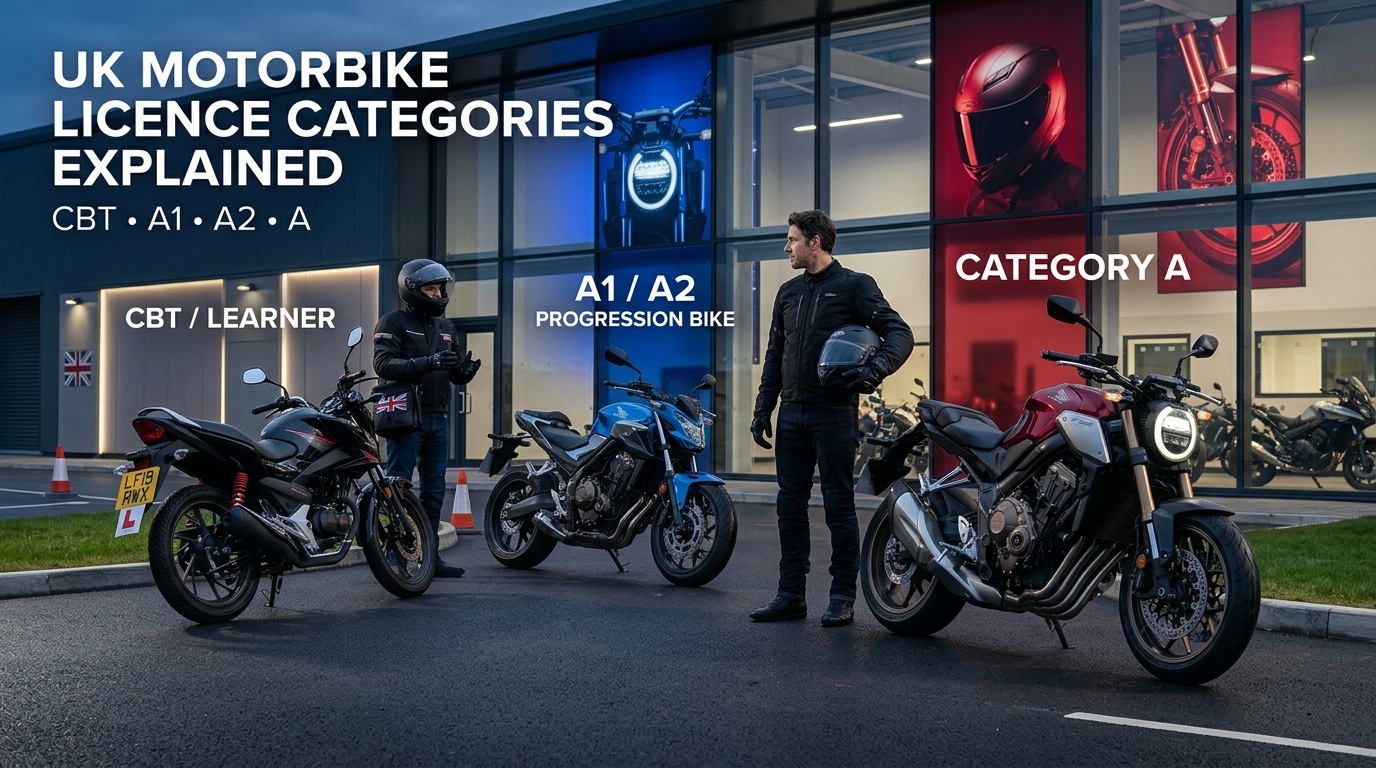
If you want to ride a motorcycle or scooter on UK roads, the licence category you need depends on your age and the power of the bike. In short, the main motorcycle licence categories are AM (mopeds), A1 (125cc learner-style bikes), A2 (mid-power bikes up to 35kW), and A (unrestricted motorcycles). Before you can ride anything larger than a 50cc moped, you will almost always need to complete a Compulsory Basic Training (CBT) course first.
The system is deliberately structured so you progress from smaller, slower machines to bigger bikes as you gain experience. Here is exactly what each category allows, what you have to do to get it, and how the rules change depending on when you were born.
What are the main UK motorbike licence categories?
The DVLA (Driver and Vehicle Licensing Agency) issues photocard driving licences with categories printed on the back. For motorcycles, there are four key categories you need to know. The table below summarises the essentials before we go into more detail.
| Category | Minimum age | What you can ride | Power limit |
|---|---|---|---|
| AM | 16 | Mopeds and light quadricycles | 50cc, max 28mph |
| A1 | 17 | Light motorcycles up to 125cc | 11kW (14.6bhp) |
| A2 | 19 | Mid-range motorcycles | 35kW (46.9bhp) |
| A | 24 (or 21 via progressive access) | Any motorcycle, no restriction | Unlimited |
There is also a Category B entitlement, which is the standard car licence. It allows you to ride a 50cc moped without taking a CBT, but only if you passed your car test before 1 February 2001. If you passed after that date, you still need at least a CBT certificate to ride a moped.
What exactly is a CBT and who needs one?
A Compulsory Basic Training (CBT) certificate is not a full licence. It is a training certificate that allows you to ride on the road as a learner. Most riders get a CBT before doing their full test, but many commuters in London, Manchester and Birmingham simply renew their CBT every two years and ride a 125cc scooter or motorbike with L-plates.
The CBT usually takes a single day, although many training schools in cities like Leeds, Bristol or Glasgow will spread it over two days if you have never been on two wheels before. It costs anywhere from £130 to £180 depending on the school and whether you need to hire a bike and helmet. The training covers five elements:
- Introduction and eyesight check
- Practical on-site training (basic controls, slow riding, braking)
- Practical on-site riding (junctions, U-turns, emergency stop)
- A classroom-style briefing on road safety and the Highway Code
- A minimum two-hour road ride with an instructor
You cannot fail a CBT in the traditional sense, but the instructor can refuse to issue the certificate if they think you are not safe. The certificate lasts two years. If you have not passed your full motorcycle test by then, you can either take the CBT again or stop riding.
CBT riders must display L-plates front and rear, cannot carry a pillion passenger, and cannot use motorways. That last point catches a lot of people out, especially around the M25 or M60 where a short motorway hop would be convenient.
What is the AM category for 16-year-olds?
The AM licence is the entry point for a 16-year-old. It covers mopeds with a maximum design speed of 28mph and an engine no larger than 50cc. You still need a CBT before riding on the road unless you are only riding off-road or on private land with permission.
To get a full AM licence — which means no L-plates and the ability to carry a passenger — you must pass the motorcycle theory test and then a two-part practical test: Module 1 (off-road manoeuvres) and Module 2 (on-road riding). The practical test is exactly the same format as the bigger bike tests, just taken on a moped.
AM is also useful for people who want to ride a light quadricycle, but that is a niche market in the UK. Most 16-year-olds use it for a 50cc scooter to get to college or a part-time job.
How does the A1 licence work?
The A1 category is often called the “125cc licence” because it allows you to ride a motorcycle up to 125cc with a maximum power output of 11kW. You have to be at least 17. The route is:
- Complete a CBT
- Pass the motorcycle theory test (multiple choice plus hazard perception)
- Pass Module 1 (off-road manoeuvres, including slow riding, slalom, figure of eight and emergency stop)
- Pass Module 2 (on-road test, usually around 40 minutes)
Once you hold a full A1 licence, you can remove L-plates, carry a pillion passenger and use motorways. You are still restricted to 125cc, which makes it practical for city commuting but less ideal for long motorway runs. A 125cc bike will sit at 60-65mph, but you will not have much in reserve for overtaking on a busy A-road.
Many riders skip A1 and instead stay on a CBT for a year or two, then go straight for A2 at 19. That is legal and often cheaper, but it does mean renewing the CBT and never being able to carry a passenger.
What does the A2 licence allow?
The A2 category is the middle step. It allows a motorcycle with a maximum power of 35kW (46.9bhp) and a power-to-weight ratio no higher than 0.2kW per kilogram. You have to be at least 19.
There is a common misconception that A2 is just “up to 500cc”. It is not. Engine size is not the defining factor; power output is. A restricted Kawasaki Z650 or Yamaha MT-07 can be ridden on an A2 licence, provided the restriction kit brings it down to 35kW. The bike cannot originally produce more than 70kW (roughly 94bhp) before restriction, so you cannot take a 200bhp superbike and fit a restrictor kit to make it A2-legal.
The A2 test is identical in structure to A1: theory, Module 1, Module 2. You just take the test on a bike that meets A2 requirements. Once you pass, you can ride any A2-compliant motorcycle without L-plates, carry passengers and use motorways.
If you get an A2 licence at 19, you can then upgrade to a full Category A licence at 21 without taking another theory test, but you still need to take the Module 1 and Module 2 practical tests again. This is called “progressive access”. The two-year wait effectively becomes your experience buffer.
When can you get a full Category A licence?
Category A is the unrestricted motorcycle licence. There are two routes, and both depend on your age:
- Direct access at 24 or over: If you have not held an A2 licence for two years, you must be at least 24 to take the Category A tests.
- Progressive access at 21 or over: If you have held a full A2 licence for at least two years, you can upgrade to A at 21.
Both routes require the theory test (unless you already have a valid motorcycle theory pass) and both practical modules. Once you have a full A licence, you can ride any motorcycle regardless of engine size or power output. There are no further steps up the motorcycle licence ladder.
The direct access route is popular with riders in their late 20s and 30s who have been driving a car for years and want a big bike for weekend touring or commuting. A typical direct access course, including CBT, theory and practical training, costs between £800 and £1,200 depending on the school and how many days of training you need. Schools in the South East and London tend to be at the higher end of that range.
Do you need to pass a theory test for a motorbike?
Yes, unless you are only riding on a CBT. The motorcycle theory test is the same format as the car theory test but with motorbike-specific questions. It costs £23. There are 50 multiple-choice questions and a hazard perception section with 14 video clips. You need to score at least 43 out of 50 on the multiple-choice part and at least 44 out of 75 on hazard perception.
The theory pass lasts two years. If your practical test keeps getting cancelled or you do not get around to it, the theory expires and you have to pay and sit it again.
What do the Module 1 and Module 2 practical tests involve?
The Module 1 test takes place off-road at a DVSA (Driver and Vehicle Standards Agency) test centre. It takes around 20 minutes and includes:
- Wheeling the bike and using the stand
- Slalom and figure of eight
- Slow ride
- U-turn
- Cornering and controlled stop
- Emergency stop (minimum speed 31mph)
- Hazard avoidance (minimum speed 31mph)
The pass mark is zero serious or dangerous faults, and no more than five minor faults. Module 1 has a reputation for being the trickier of the two tests because the slow-speed control requires deliberate practice.
Module 2 is the on-road test. An examiner follows you on a motorcycle or in a car and gives directions via a radio earpiece. It lasts around 38 to 40 minutes and includes a variety of road types, from quiet residential streets to faster dual carriageways where available. The examiner is assessing your observations, road positioning, speed management and ability to ride independently for a section using road signs rather than turn-by-turn instructions.
The combined cost of both modules varies by test centre but is typically around £15.50 for Module 1 and £75 for Module 2 on weekdays, with higher fees for evening and weekend slots.
What if you already have a full car licence?
Holding a full UK car licence does not automatically give you motorcycle entitlement. It only provides limited benefits.
If you passed your car test before 1 February 2001, you can ride a 50cc moped without a CBT and without L-plates. You cannot carry a passenger unless you have a full AM licence, but you can ride solo.
If you passed your car test on or after 1 February 2001, you must complete a CBT before riding even a 50cc moped. The car licence gives you no exemption for anything larger.
For any motorcycle above 125cc, your car licence is irrelevant. You still need the correct motorcycle category.
Does the UK licence system apply in Northern Ireland?
The motorcycle licence categories are the same across the United Kingdom, but the administration differs. In Northern Ireland, the DVA (Driver and Vehicle Agency) handles testing rather than the DVSA, which covers England, Wales and Scotland. The practical test routes and standards are essentially identical. The theory test in Northern Ireland is booked through the DVA rather than the DVSA.
If you hold a Northern Ireland motorcycle licence and move to England, Wales or Scotland, your entitlements carry over without issue. The same applies in reverse.
Can you ride an electric motorbike on these licence categories?
Yes, but the power ratings matter in the same way they do for petrol bikes. An electric motorcycle or scooter is categorised by its continuous rated power, not peak power. This catches some buyers out.
An electric moped like the NIU NQi or a Super Soco CUx falls under AM or A1 depending on its rated output and top speed. A Zero SR/F or a LiveWire has far too much continuous power for an A2 licence and requires a full Category A. Some electric bikes sit in a grey area where the peak power is high but the continuous rating is low, so it is worth checking the manufacturer’s stated continuous power figure against the DVLA category before buying.
The good news is that an A1 or A2 electric bike is often more usable in real-world riding than a petrol equivalent because electric motors produce full torque from a standstill. A restricted A2 electric bike can be genuinely quick away from traffic lights.
What should you check when buying a bike to match your licence?
If you are buying a used motorbike or scooter through a classified platform, check the V5C logbook to see what category the bike is registered under, but do not rely on that alone. The seller might have modified the bike or removed a restrictor kit. An A2 bike that has been de-restricted to full power is no longer legal for an A2 rider, even if the V5C still says 35kW.
Ask the seller directly if the bike has been restricted or de-restricted, and if there is documentation for the restriction kit. A reputable seller should be able to show a receipt or fitting certificate. If you are buying privately and the seller is vague about the restriction, factor in the cost of having a garage fit a new kit — typically £100 to £300 depending on the bike — or walk away.
It is also sensible to run a history check on any used bike before handing over money. Stolen motorcycles are a bigger problem in cities like London, Manchester and Birmingham than many buyers realise, and an HPI check can flag outstanding finance or a category write-off that the seller has not mentioned. For more on that, read our guide on how to check a used vehicle’s history before buying.
If you are moving from a 125cc to an A2 or A bike, remember to tell your insurer. Riding a bike you are not licensed for invalidates your insurance. The police can and do seize bikes from riders who have only a CBT but are on a 600cc machine.
Do the motorbike licence rules change with age?
The minimum ages are fixed: 16 for AM, 17 for A1, 19 for A2, and 24 for direct access to A. There is no upper age limit for any category, provided you meet the medical standards and can pass the tests.
What changes with age is the route you can take. A 21-year-old who has held an A2 licence for two years can get a full A licence. A 21-year-old who has never ridden cannot. They must either wait until 24 for direct access or start at A2 now and upgrade two years later.
The other thing worth knowing is that a standard driving licence expires when you reach 70. You have to renew it with the DVLA and declare any medical conditions. Your motorcycle entitlement does not automatically disappear, but the DVLA can remove it if a medical condition affects your ability to ride safely. Eye conditions, epilepsy and certain heart conditions are the most common reasons for entitlement being withdrawn.
How much does it cost to get a motorbike licence in total?
The total depends on your age, your experience and where you live. As a rough guide for a complete beginner going for a full Category A via direct access:
- CBT: £150
- Theory test: £23
- Module 1: £15.50
- Module 2: £75 (weekday)
- Training: £700 to £900 for a three-to-four day DAS course
That puts the realistic total somewhere between £950 and £1,150 for most riders doing direct access. You also need your own protective gear. Some schools include helmet and glove hire in the course fee, but you will want your own helmet, gloves, jacket and boots sooner rather than later. A reasonable starter kit costs £300 to £500.
If you go the progressive route via A2 at 19 and A at 21, you will pay for two sets of practical tests and two rounds of training, so the total will be higher than direct access, but you get two years of riding a mid-sized bike first.
For a complete beginner who just wants a 125cc scooter for commuting, the cost can be as low as the CBT fee plus a theory and A1 test if they want full entitlement. Many riders in London, Bristol and Edinburgh never go beyond CBT and simply renew it every two years. That is legal and practical for city riding, but it does mean you cannot carry a passenger or use motorways, and your insurance will generally be more expensive than a full licence holder.
What are the most common mistakes riders make with licence categories?
The single biggest mistake is buying a bike that is too powerful for the licence held. It happens all the time: someone passes their CBT, gets excited, buys a 600cc sports bike from a private seller, and then discovers they cannot insure it and are riding illegally. The bike sits in a garage while they wait to do their full test.
The second mistake is assuming that because a bike is physically small, it is legal on an A1 or A2 licence. A 400cc naked bike might be smaller than a 125cc cruiser in physical dimensions, but the power output matters, not the seat height or weight.
The third is letting the theory test expire. It is valid for two years, and practical test slots can be hard to come by in some parts of the country, especially in the summer. If your theory runs out, you start again.
The fourth is forgetting that a CBT certificate is not a full licence. It does not appear on the back of your driving licence as a category. When a police officer stops you, they will check the DVLA database for your entitlements. If you are on a CBT and the certificate is out of date or you have not got it with you, you can be prosecuted.
Quick summary of the motorcycle licence routes
If you want the shortest possible version of this article, here it is:
- Aged 16: CBT, then AM test for a 50cc moped.
- Aged 17: CBT, then A1 test for a 125cc bike, or stay on CBT with L-plates.
- Aged 19: CBT, then A2 test for a bike up to 35kW.
- Aged 21 with two years on A2: Upgrade to full A via progressive access.
- Aged 24 or over: Direct access to full A, regardless of previous experience.
Every route except the moped-only AM entitlement starts with a CBT. Every full licence requires a theory test and two practical modules.
Before buying any bike — whether it is a 125cc commuter scooter in Leeds or a unrestricted litre bike in Glasgow — confirm the category printed on your licence matches the bike’s power output. If you are unsure, speak to a local training school or check the DVLA’s vehicle enquiry service using the number plate.
For more practical advice on buying, selling and running vehicles in the UK, have a look at our other guides on MOTs explained, road tax and VED, and how to spot common scams. If you are thinking about larger vehicles, we also have a detailed breakdown of truck licence categories for HGVs.