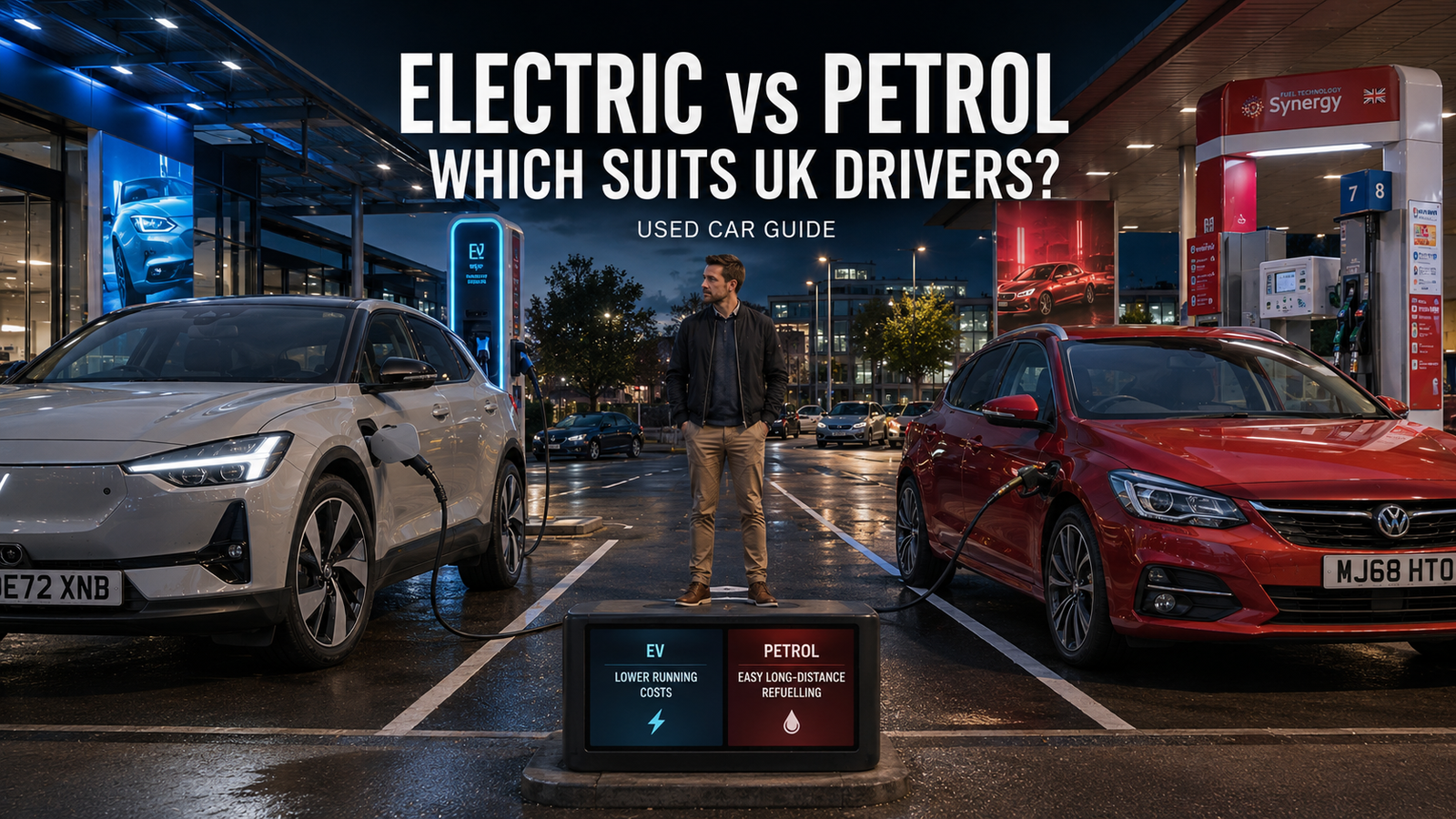
Electric vs Petrol: Which Used Car Suits UK Drivers Best?
Electric vs Petrol: Which Used Car Suits UK Drivers Best?
For most UK drivers covering average mileage with off-street parking, a used electric car is now cheaper to run and tax than a petrol equivalent, but it costs more to buy upfront. A used petrol car remains the more practical choice if you regularly drive long distances, lack home charging, or have a tighter purchase budget. The right answer depends far less on the technology and far more on your postcode, your mileage, and where you can plug in.
What actually costs less to run: a used EV or a petrol car?
Running costs are where electric vehicles (EVs) win decisively, provided you can charge at home. On a standard domestic tariff, charging a typical used EV like a Nissan Leaf or Renault Zoe costs roughly 8 to 10 pence per mile. A petrol car averaging 45 mpg with fuel at £1.45 per litre costs around 15 pence per mile. That is a substantial gap if you cover 8,000 miles a year.
Charging on the public network changes the maths significantly. Rapid chargers at motorway services or supermarket hubs often cost between 60p and 80p per kWh. At those rates, an EV can cost as much per mile as a petrol car, sometimes more. If you cannot install a home charger—common for terraced streets in Manchester, Birmingham, or Glasgow—the financial benefit shrinks or disappears entirely.
Vehicle Excise Duty (VED), commonly called road tax, also favours EVs until April 2025. Fully electric cars currently pay zero VED. From April 2025, EVs will pay the standard rate, though cars first registered before April 2017 will move to a lower band. A petrol car’s VED depends on its CO2 emissions if registered after March 2001, or engine size if older. Some older petrol cars pay over £300 a year.
Insurance for EVs tends to run slightly higher than for equivalent petrol cars, largely because repair costs for battery packs and specialist labour are steeper. Servicing is usually cheaper on an EV—no oil changes, fewer moving parts—but tyre wear can be heavier due to the weight.
How far can a used electric car really go?
Range anxiety is less of an issue than it was in 2018, but it still matters. A first-generation Nissan Leaf (2011–2017) with a 24kWh battery often returns 70 to 80 miles on a full charge in real-world UK conditions. That suits school runs and city commuting but becomes tedious on a trip from Leeds to Cornwall.
A later 40kWh Leaf or a Hyundai Kona Electric (64kWh) can realistically cover 180 to 250 miles. For a second car used around town or for a commute under 50 miles each way, a used EV with a degraded battery may still be perfectly adequate. The key figure to check is the battery’s State of Health (SOH). Many dealers and independent garages can run a diagnostic that gives this as a percentage. A car showing 85% SOH or above is generally a sound buy.
Petrol cars face no such degradation concerns. A well-maintained petrol engine can cover 150,000 miles or more without major work. Fill-ups take five minutes anywhere in the country. For buyers who regularly drive from Newcastle to the Highlands or across rural Wales, a petrol car remains far less hassle.
What should I check when buying a used electric car in the UK?
Buying a used EV involves all the standard checks—HPI check, MOT history, logbook (V5C), and a test drive—plus a few specific to electric drivetrains.
First, check the battery warranty. Most manufacturers warrant the battery for 8 years or 100,000 miles, whichever comes first. A 2019 Kia e-Niro or Hyundai Kona still has warranty remaining; a 2014 Leaf does not. The battery lease situation also matters. Many early Renault Zoes were sold with leased batteries. If the lease is still active, you will pay a monthly fee. Some were later bought out, so check the V5C and any finance agreements carefully.
Second, verify the charging cables and onboard charger type. Some older EVs only charge at 3.6kW on AC, which means a full charge from empty takes 8 to 10 hours even on a 7kW home charger. Newer models with 7kW or 11kW onboard chargers are far more convenient.
Third, ask about the granny charger—the 3-pin plug cable. If missing, replacement costs £150 to £300. Finally, run an HPI check on any used EV just as you would on a petrol car. Outstanding finance on a used EV is common because many were bought on PCP deals.
Where can I charge a used EV if I don’t have a driveway?
Around 40% of UK households do not have off-street parking, and this is the single biggest barrier to EV ownership. If you live in a Victorian terrace in Bristol or a tenement in Edinburgh, relying on public chargers requires planning and patience.
The public network has improved. Zapmap lists over 60,000 public charging points across the UK as of 2025, including rapid chargers at many supermarkets, retail parks, and motorway services. But reliability varies by region. Drivers in London and the South East have abundant choice, while parts of rural Scotland, Northern Ireland, and the South West remain patchy.
Some councils run on-street charging schemes, where lamppost chargers or dedicated bays are installed. Check your local council’s website before ruling out an EV. The On-Street Residential Chargepoint Scheme (ORCS) has funded installations in cities including Liverpool, Sheffield, and Nottingham.
If you cannot charge at home and your workplace has no charger, a petrol car—or a plug-in hybrid—may be the more realistic choice. A used plug-in hybrid like a Mitsubishi Outlander PHEV can cover 20 to 30 miles on electric power and then switch to petrol, giving flexibility without the charging dependency.
The purchase price is the main barrier. A used EV typically costs £3,000 to £8,000 more than a comparable petrol car of the same age and mileage. A 2018 Volkswagen Golf petrol might sell for £12,000, while a similar-age Nissan Leaf 40kWh costs around £10,000 to £13,000. The gap narrows on older cars but never fully closes.
Charging infrastructure installation is another cost. A 7kW home charger costs £800 to £1,200 installed, though grants and manufacturer schemes can reduce this. If your property needs an upgraded fuse or long cable run from the consumer unit, the bill rises.
Depreciation on EVs has been steep. Early adopters paid heavily, and used values fell sharply between 2022 and 2024. That is good news for used buyers—you can now pick up a usable EV for under £8,000—but it means your own resale value may soften further. Petrol cars depreciate more predictably.
One cost people forget is the MOT. EVs still need an annual MOT once they reach three years old. There is no emissions test, but tyres, brakes, suspension, and lights are checked as normal. EVs tend to pass their first MOT at a high rate because there is less to fail, but when things do go wrong—suspension bushes, air conditioning, charging ports—repairs can be pricey.
Electric vs petrol: a quick comparison for UK used buyers
The table below summarises the key differences for a typical UK driver covering 8,000 to 10,000 miles a year.
| Factor | Used Electric Car | Used Petrol Car |
|---|---|---|
| Purchase price | Higher upfront, typically £3,000–£8,000 more | Lower upfront, more choice under £10,000 |
| Fuel/charging cost | 8–10p per mile on home charging; 15–20p on public rapid chargers | 14–18p per mile depending on mpg and fuel prices |
| VED (road tax) | £0 until April 2025, then standard rate | £20–£600+ depending on CO2/engine size |
| Servicing | Cheaper, fewer items; tyre wear higher | More frequent oil and filter changes |
| Range/refuelling | 70–250 miles real-world; charging takes 30 min to 10 hrs | 400–600 miles per tank; refuels in 5 minutes |
| Home charging needed? | Strongly recommended for cost benefit | Not applicable |
| MOT | Standard MOT after 3 years, no emissions test | Standard MOT with emissions test |
| Best for | Home charger, under 150 miles daily, urban/suburban use | No driveway, high mileage, rural areas, tight budget |
So which should you buy?
If you have off-street parking and your daily driving is under 100 miles, a used electric car will save you money within two to three years, even accounting for the higher purchase price. Models like the Nissan Leaf 40kWh, Hyundai Kona Electric, and Kia e-Niro offer genuine usability without the new-car premium.
If you cannot charge at home, regularly drive over 200 miles in a day, or need a car for under £10,000 with maximum practicality, a used petrol car remains the sensible choice. A well-maintained petrol hatchback or estate is still the most flexible vehicle for UK roads.
The honest answer is that neither is universally better. The best used car for a driver in a London flat is different from the best one for a driver in a rural Norfolk village with a garage. Match the car to your circumstances, check the history carefully, and do not pay a premium for an EV unless you can actually access cheap charging.
For buyers comparing specific models, browse used electric cars for sale across the UK or explore the full range of used petrol cars to see what fits your budget and postcode.