Buying a Used Motorbike in the UK: A Beginner’s Checklist
Buying a used motorbike in the UK is safest when you treat it as two separate jobs: prove the bike’s identity and history before you pay, then inspect the mechanical condition and paperwork in person. Work through a proper used motorbike checklist and you’ll catch most stolen, clocked, financed or accident-damaged bikes before they become your problem. This guide covers the checks in the order you should actually do them, from your first phone check to taxing the bike in your name.
Start with the history checks before you travel
Before you arrange a viewing or hand over any money, do the checks you can do from your phone or laptop. Ask the seller for the registration number, the MOT test number if the bike has one, and the VIN/chassis number. If a seller refuses to share the registration or VIN, that alone is a red flag.
The DVLA offers a free MOT history service at gov.uk/check-mot-history. It shows every MOT test result recorded since 2005 for bikes over 3 years old, including pass or fail outcomes, mileage at each test, advisory items, and test dates. Compare the mileage in the advert with the MOT history. If the numbers don’t line up, or if there are missing tests when the bike should have been tested, ask the seller to explain before you travel. A bike that has repeated fails for corroded brake lines, worn tyres or leaking forks has probably been neglected.
Next, run a paid HPI check. An HPI check on a motorbike covers stolen status, outstanding finance, insurance write-off categories, mileage discrepancies, and number plate changes. A basic DVLA check is not enough. A seller can show you a V5C logbook and still not own the bike outright because it is on finance. If a bike is still on finance, the finance company has a legal claim to it until the loan is settled. Never skip this step. You can read our full guide on what an HPI check is and why UK buyers should never skip one.
If you want the full step-by-step process for digging into a vehicle’s past, see our guide on how to check a used vehicle’s history before buying in the UK. For bikes, the principle is the same as a car: the paperwork checks come first.
Paperwork checks to do before you view
| Check | What to do | Red flag |
|---|---|---|
| V5C logbook | Ask for the document reference number or see it before paying; check the seller’s name, address, VIN and number plate match | Seller’s name or address not on the V5C, missing V5C, alterations |
| MOT history | Use the DVLA’s free checker and compare mileage | Missing tests, mileage drops, repeated fails |
| HPI check | Run a paid check using the registration or VIN | Outstanding finance, stolen marker, Cat A/B/S/N write-off, plate change |
| VIN and engine number | Check they match the V5C and the frame stamp | Missing, damaged, or mismatched numbers |
| VAT status | If buying from a dealer, ask whether the price includes VAT | Trade advert priced “plus VAT” when you expected the retail price |
What documents should the seller have?
The main document is the V5C logbook, but it is not proof of ownership. It tells the DVLA who is the registered keeper, not necessarily who legally owns the bike. That distinction matters when there is outstanding finance or a dispute. Check the V5C has a DVLA watermark, the seller’s name and address match their photo ID, and the VIN and engine number on the bike match the document. If the seller says the V5C is “in the post” or they have lost it, be wary. A replacement V5C can be applied for before a sale, but you need the new keeper slip or full V5C to tax the bike in your name.
Service history on a used motorbike is often less formal than a car’s. Look for receipts, a stamped service book, MOT certificates, and invoices for parts. A thick folder of receipts for oil, filters, chain and sprockets is usually more useful than a stamped book with no detail. Ask about valve clearance checks on high-mileage bikes — many Japanese four-cylinder machines need them at specific intervals, and ignoring the schedule can lead to expensive engine work. If the seller cannot show any history, price the bike accordingly rather than assuming it has been looked after.
Also ask for any spare keys, the owner’s manual, and any original parts that were removed, such as the standard exhaust, pillion seat or mirrors. Missing keys are not a deal-breaker, but they can be expensive to replace on modern bikes with coded ignition systems.
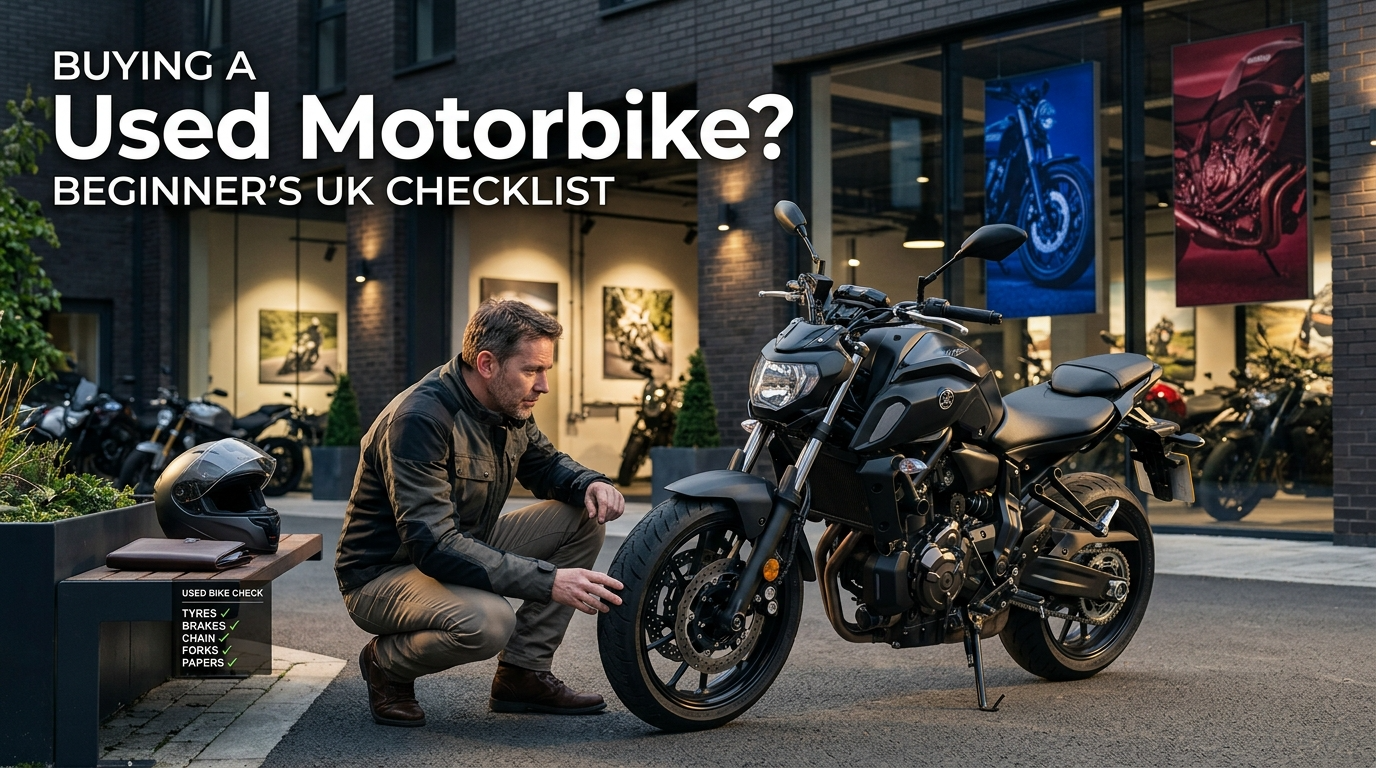
A used motorbike physical checklist for the viewing
Always view a used motorbike in daylight and, if possible, when the engine is cold. A warm engine can hide cold-start problems, so tell the seller you want to see it start from cold. If you arrive and the engine is already warm, ask why. The answer can be innocent — they may have just moved it — but it is worth noting.
Use a torch and take your time. Check the VIN on the frame matches the V5C and the number plate. On many bikes the VIN is stamped on the headstock or a frame rail. If it looks tampered with, has fresh paint over the stamp, or the numbers are hard to read, walk away.
| Area | What to check | Red flags |
|---|---|---|
| Frame and bodywork | Look for cracks, dents, scrapes, repainted sections, misaligned panels | Cracked frame, fresh paint over crash damage, signs of stunting |
| Forks and suspension | Check fork seals for oil, pitted stanchions, smooth damping | Leaking fork oil, rusted or pitted fork tubes |
| Chain and sprockets | Look for tight spots, rust, wear, alignment, adjuster position | Rusty chain, hooked sprocket teeth, adjusters near maximum |
| Tyres | Check tread depth, age from the DOT code, cuts, cracks, uneven wear | Tyres over 5 years old, cracks, less than 1mm tread in places |
| Brakes | Check disc thickness, score marks, pad material, brake fluid colour | Warped or thin discs, spongy lever, dark or milky brake fluid |
| Engine and fluids | Check oil level and colour, coolant, leaks, unusual noises when started | Milky oil, oil leaks, knocking or rattling from cold |
| Electrics | Test lights, indicators, horn, dash, kill switch, charging system | Flickering lights, battery warning, non-working switches |
| Steering and wheels | Rock the steering for head bearing play, spin wheels, check alignment | Notchy steering, play in wheel bearings, bent rims |
Some of these checks need the bike on a centre stand or paddock stand. If the seller has a stand, use it. If not, ask them to hold the bike upright while you check the steering and wheels. Pay particular attention to the chain and sprockets, because a worn chain and sprocket set can cost several hundred pounds to replace on a larger bike.
When you start the bike from cold, listen for rattles that disappear as the engine warms, excessive smoke, or a clutch that drags. A small amount of condensation from the exhaust on a cold morning is normal, but blue smoke on a four-stroke engine is not.
The test ride: insurance, licence and what you’re actually looking for
On a private sale, the seller’s insurance will not usually cover you to ride the bike. Many standard bike policies do not include riding other bikes, so never assume you are covered just because the seller says “you’re insured.” You need your own insurance that covers riding other bikes, or you need the seller to have a policy that allows named riders — which is rare on a private sale. If you ride without insurance, you are committing an offence and the bike could be seized. If you cannot arrange cover, ask the seller to ride the bike while you follow in a car, or have the bike inspected by a mechanic before you buy.
Also confirm you have the correct licence for the bike. In the UK, that usually means a CBT for a 125cc if you are a learner, or a full A1, A2 or A category licence for larger machines. If the bike has been modified to exceed its original power-to-weight ratio, it can change the licence category, so be careful with restricted bikes. A dealer selling a restricted A2 bike should be able to show the restriction certificate or proof of work.
On the ride itself, check that the bike pulls cleanly, brakes in a straight line, and does not weave or shake at speed. Ride at low speed and work the clutch and gearbox through all gears. Check that the steering does not feel notchy around the centre position and that the bike tracks straight with your hands lightly on the bars. After the ride, look again for leaks and smell for burning oil or coolant. A bike that was clean before the ride but dripping after has a problem.
Questions to ask the seller before you agree a price
Ask the seller how long they have owned the bike, why they are selling, and how many previous keepers are recorded on the V5C. Ask whether it has ever been crashed, dropped, used on track, or written off. Ask if there is any outstanding finance. Ask about the last service, the last oil change, and whether any major work such as a valve clearance check, suspension rebuild or clutch replacement has been done.
If the seller hesitates on basic questions or gives answers that don’t match the MOT history, treat that as a warning. A seller who has owned the bike for a year but does not know when the oil was last changed may not have maintained it.
If you are buying from a dealer, ask whether the bike comes with a warranty and exactly what it covers. The Consumer Rights Act 2015 gives you legal protection when buying from a trader: the bike must be as described, fit for purpose and of satisfactory quality. Private sales have far less legal protection. For a fuller look at the differences, see our guide to choosing between a private sale or dealer.
Before you start haggling, use the condition of the tyres, chain, brake pads and any missing service items as negotiation points. A bike that needs tyres and a chain soon is not worth the same as one with fresh items. Our practical guide to negotiating the price works for motorbikes as well as cars.
How to pay and finalise the sale safely
Never pay a deposit or the full amount before seeing the bike and its documents in person. Be especially wary of sellers who ask for a deposit to “hold” a bike or want payment by bank transfer before you have viewed it. These are common patterns in vehicle scams. When you agree a price, use a bank transfer or another traceable method and keep evidence of payment. Avoid paying large sums in cash unless you are both comfortable and you write a proper receipt.
Write a simple receipt with the bike’s registration, VIN, mileage, sale price, date, and both parties’ names and addresses. Both of you should sign it. This matters if there is later a question about the sale, the mileage, or what was included.
If something feels off — pressure to pay quickly, a seller who won’t show ID, a bike that is “already at a shipping depot” — walk away. There are always more bikes for sale. You can see the most frequent patterns in our article on common vehicle scams and how to avoid them.
Legal steps after buying: tax, insurance and V5C
Road tax, officially called VED, does not transfer with a used motorbike, even if the seller has just taxed it. You must tax the bike in your name before you ride it on the road. You can do this online using the 12-digit reference number on the green new keeper slip from the V5C, or by using the full V5C if the seller passes it to you.
Insure the bike before you tax it. The DVLA’s online tax system checks the Motor Insurance Database and MOT status automatically. If the bike is over 3 years old, it needs a valid MOT unless it is exempt. Historic vehicles over 40 years old can be MOT exempt if they have not been substantially changed, but you still need to tax them.
Keep the green new keeper slip until the new V5C arrives in your name, usually within 2 to 4 weeks. If it does not arrive, contact the DVLA. The seller should notify the DVLA online or by post, but you can also apply for a new V5C if needed.
Bottom line
Most bad used motorbike purchases happen because a buyer skips the history checks or buys on emotion. Do the DVLA MOT check and HPI check before you travel, check the V5C and VIN in person, inspect the bike cold, and do not ride it without insurance. If anything feels off, walk away. Sort out insurance and road tax in your name before you ride home, and keep a signed receipt.
For more buyer’s guides and practical vehicle advice, browse the TopSellUKCars blog.