How to Check a Used Motorbike’s History Before Buying in the UK
How to Check a Used Motorbike’s History Before Buying
To check a used motorbike’s history in the UK, start with the free DVLA MOT history and vehicle enquiry tools, then run a paid HPI check (or an equivalent history check from another provider) to uncover stolen status, outstanding finance, insurance write-offs and plate changes. You’ll need the registration number, and before any money changes hands you should compare the VIN/chassis number stamped on the bike with the V5C logbook and the HPI report.
What a motorbike history check actually shows
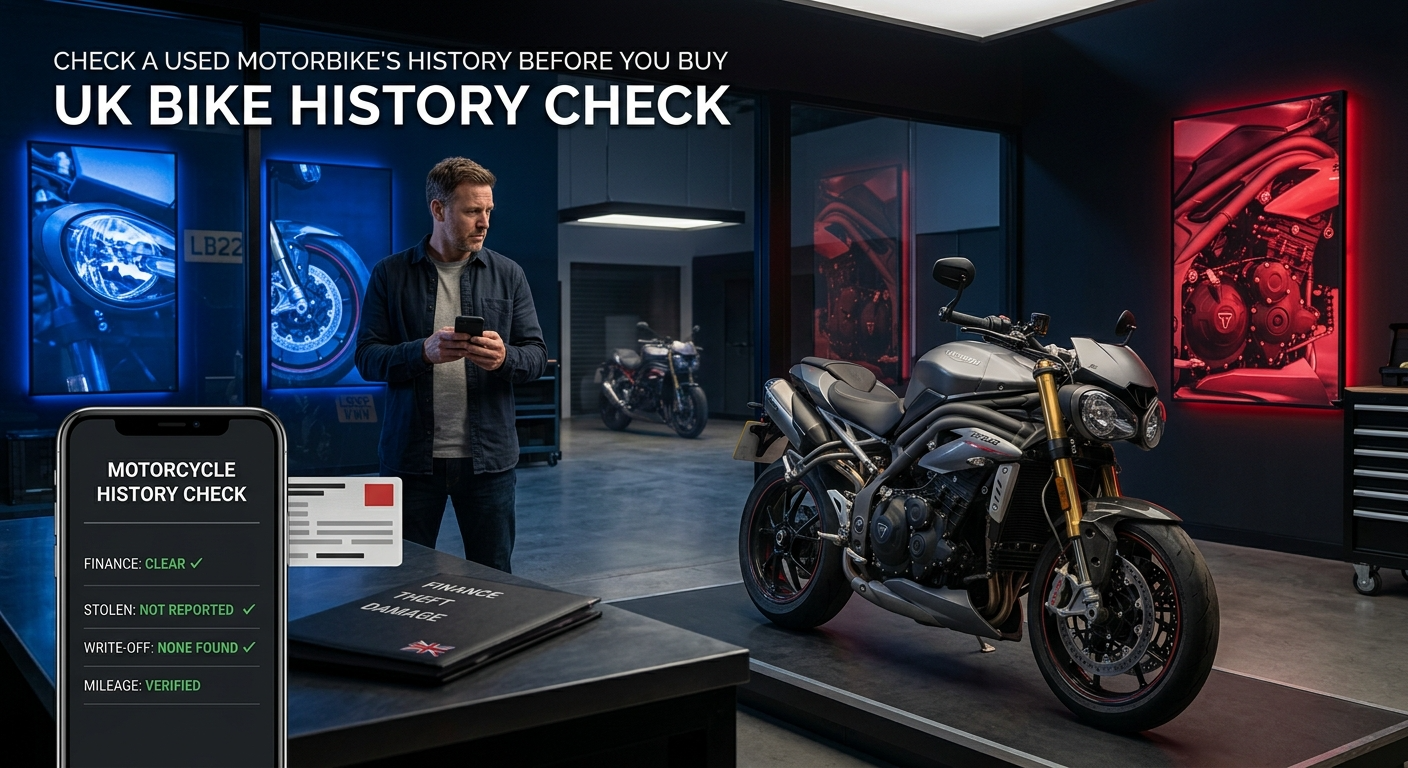
A proper motorbike history check answers four key questions: Is the bike stolen? Does it have outstanding finance? Has it been written off? And does the physical bike match the DVLA records? The free checks cover some of the basic vehicle data, but only a paid HPI check pulls in the finance, theft and write-off information.
A history check won’t tell you how good the engine is, whether the clutch is about to go, or whether the fork seals were replaced properly. It tells you about the bike’s recorded past, which is different from its current mechanical condition. You still need to inspect the bike or have it inspected before buying.
Start with the free DVLA checks
Check the MOT history first
Go to gov.uk/check-mot-history and enter the registration number. It’s free and gives you the bike’s MOT test results, dates, recorded mileage and any advisory or failure items. Motorbikes in Great Britain need an MOT once they’re over three years old, so a nearly new bike may have no MOT history yet. That’s not a red flag on its own.
The most useful part is the mileage record. Look at every test from the oldest to the most recent. A bike might show 14,000 miles in 2023, 21,000 in 2024 and 19,500 in 2025. That drop or jump needs explaining. Sometimes an MOT tester enters the mileage incorrectly, but you can’t assume that. Use the recorded history to challenge the seller.
Advisories are just as important as failures. A repeated advisory for a worn tyre, a notchy head bearing or a leaking fork seal tells you how the previous owners maintained the bike. One advisory might mean normal wear; the same advisory year after year usually means neglected maintenance. If there’s a long gap in the MOT history, ask why. The bike could have been stored, declared SORN, or off the road after an accident. The DVLA records won’t tell you which, so you need to ask.
For more detail on how MOT records work, read our MOT explained guide.
Use the DVLA vehicle enquiry
The second free tool is the DVLA’s vehicle enquiry service. Enter the same registration number and you’ll see whether the bike is taxed or SORN, when it was first registered, its engine size, and the colour recorded by the DVLA.
This is your first check against a cloned or misdescribed bike. If the advert says it’s a 2022 blue Yamaha but the DVLA says it’s a 2018 black Honda, do not go further. If the bike is SORN, that’s not illegal, but it means you can’t test ride it on the road without taxing it, and the seller should be able to explain why it has been off the road. The current VED (road tax) status is also useful because a bike that has been taxed continuously is more likely to have been in regular use than one that has been SORNed for years.
If you are buying in Northern Ireland, vehicle records are managed by the Driver & Vehicle Agency rather than the DVLA, but the same principle applies.
Free vs paid bike history checks at a glance
| Check | Cost | What it shows | What it won’t show |
|---|---|---|---|
| DVLA MOT history | Free | MOT results, dates, recorded mileage, advisories | Finance, theft, write-offs |
| DVLA vehicle enquiry | Free | Tax/SORN, first registration, engine size, colour | Ownership, VIN, accident damage |
| Paid HPI/bike history check | Usually £10-£20 | Outstanding finance, stolen register, write-off category, plate changes, VIN match, mileage discrepancy | Mechanical condition |
Why a free check isn’t enough on its own
A clean MOT history does not mean a bike is safe to buy. The DVLA’s free tools don’t show whether a finance company still owns the bike, whether it has been reported stolen, or whether an insurer wrote it off after a crash. Those are the problems that can leave you without the bike and without your money.
A bike can pass an MOT with no advisories and still be on hire purchase. A stolen bike can have a current MOT if the thief or a previous owner tested it before it was stolen. A written-off bike can be repaired and put through an MOT, but the write-off marker stays on the record and affects its value. Free checks simply can’t see these things.
HPI check for motorbikes: what it covers
HPI Check is the best-known vehicle history check in the UK. It’s a specific brand, but people often use the phrase “HPI check motorbike” to mean any thorough paid bike history check. Several providers, including HPI Ltd, Experian AutoCheck and MotorCheck, offer comparable checks. The important thing is to use one that includes finance, theft and write-off data, not just a basic DVLA lookup.
A full motorbike HPI check should cover:
- Outstanding finance, including hire purchase, PCP and secured loans
- The stolen vehicle register, using data supplied by UK police and insurers
- Insurance write-off categories, including Cat A, B, S and N, with data from the Motor Insurers’ Anti-Fraud and Theft Register (MIAFTR)
- Previous plate changes
- VIN/chassis number matching against DVLA records
- Mileage discrepancies
- Import or export markers
Most full checks cost roughly £10 to £20. Some providers offer a free initial result and then charge for the full report, which is fine if the final report is clear about what it includes. Run the check yourself after you’ve seen the VIN on the bike. Don’t accept a printed HPI certificate from a seller as proof. It can be altered, or it may have been run on a different bike months ago.
If you want a deeper explanation of how these checks work, read our HPI check guide.
Stolen motorbike check: how to avoid buying a stolen bike
There is no free public database where you can enter a registration and get a definitive stolen status. The stolen vehicle data used by UK police is not openly searchable by the public. The practical way to check whether a motorbike is stolen before buying is to run a paid history check that includes the stolen vehicle register.
There are also warning signs that a bike may be stolen. A seller who won’t give you the registration number before you view is a major red flag. So is a VIN that looks scratched, ground down, painted over or re-stamped. If the bike’s asking price is far below similar examples, that’s another classic sign. Stolen bikes are sometimes sold from car parks, lay-bys or industrial estates rather than a home address, and the seller may have no V5C or a flimsy story about why it’s missing.
If you have a genuine suspicion that a specific bike is stolen, you can call 101 with the registration and VIN, but the police will not run a full history check for a buyer who is simply curious. If the check shows the bike is stolen, do not buy it, and report what you know.
How to verify a motorbike’s identity: VIN, engine number and V5C
A history check is only useful if the bike in front of you is the bike in the report. Cloned and rung bikes exist, and a clever seller can swap plates and documents. That’s why the physical identity check matters.
Find the VIN, also called the chassis number, on the steering head of the frame. It should be clearly stamped and match the V5C logbook and the HPI report. Look closely at the area around the stamp. Fresh paint, file marks, heat discolouration or a VIN plate that looks newer than the rest of the bike are reasons to walk away. Thieves sometimes cover a ground-down VIN with a sticker or paint.
Check the engine number too. The V5C usually lists it, so compare it with the number on the engine casing. If the engine number has been removed or doesn’t match, something is wrong. A bike with a replacement engine can be legitimate, but it must be recorded properly, and the seller should have paperwork to prove the engine’s origin.
The V5C logbook is important, but it is not proof of ownership. It shows the registered keeper, not necessarily the legal owner. A bike can have a V5C in the seller’s name but still be owned by a finance company. The V5C should be the original paper document. A seller who only has a photo or a scan and never produces the original before payment is a risk.
Outstanding finance on a motorbike
Motorbikes are often bought on hire purchase, PCP or a personal loan secured against the vehicle. Until that finance is settled, the lender retains a financial interest in the bike. If you buy a bike with outstanding finance, the lender can repossess it from you even if you bought it in good faith and the seller gave you the logbook.
A paid history check will flag outstanding finance. If it does, ask the seller for a settlement letter from the finance company and verify it yourself. The safest way to complete the sale is to pay the finance company directly and pay the seller only any remaining balance. If the seller won’t give you the lender’s details or suggests you pay them in full and trust them to settle the finance, walk away.
If you are buying from a dealer, outstanding finance should be settled before you take the bike. Ask for written confirmation as part of the sale paperwork. Our private sale vs dealer guide explains some of the other differences between buying privately and from a trade seller.
Insurance write-offs: Cat A, B, S and N
Insurance write-offs can mean very different things. A bike that has been written off is not always dangerous, but you need to know the category.
The current UK write-off categories are:
- Cat A – scrapped; the entire bike must be crushed and cannot return to the road
- Cat B – the frame must be crushed, but some parts can be reused
- Cat S – structurally damaged but repairable
- Cat N – non-structural damage, usually cosmetic or electrical, repairable
A Cat N bike might have been written off because a cracked fairing panel and labour costs exceeded its value. It could be perfectly usable after a repair. A Cat S bike has had structural damage, so it needs a proper inspection by a mechanic who understands motorcycle frames and suspension. Cat A and Cat B bikes should never reappear on the road as complete bikes.
An MOT pass later does not remove a write-off marker. The history stays with the bike. You also need to tell your insurer if you buy a written-off bike, because some insurers won’t cover it or will only offer reduced cover.
What documents should you ask for?
When you view a motorbike, ask for:
- the original V5C logbook
- the current MOT certificate if the bike is over three years old, though you can also check this online
- service history and receipts for parts and work
- owner’s manual and spare keys
- proof of the seller’s address
A missing V5C is not always a deal-breaker, but it adds risk and delay. The seller can apply to the DVLA for a replacement before the sale. If a private seller has the V5C in someone else’s name and says it’s a friend or relative, be cautious. They should be able to explain and prove why.
If you buy from a VAT-registered dealer, the invoice should show VAT. Private sellers don’t charge VAT, so the price you agree is the price you pay.
Red flags in the advert or when you view
Some bikes are wrong before you even run a history check. Watch for:
- No registration number in the advert, or the plate is blanked out in every photo
- “Quick sale needed” combined with a very low price
- Seller refuses a daytime viewing or wants to meet somewhere random
- No service history but a story about how well it was maintained
- MOT history shows a mileage drop or a long gap
- VIN or engine number looks tampered
- The seller asks for a deposit before you’ve seen the bike
These are similar to the patterns in car scams, and the same caution applies. Our guide to common used vehicle scams goes into more detail.
What to do if the check reveals a problem
If the HPI check shows the bike is stolen, do not buy it. Report it to the police on 101, or anonymously through Crimestoppers. If you haven’t paid, you’ve lost nothing but a check fee.
If the check shows outstanding finance, decide whether you’re willing to deal with the lender directly. If the seller won’t cooperate, move on.
If the bike is a Cat S or Cat N write-off, it doesn’t have to be a deal-breaker, but it should be priced lower than an equivalent bike without a write-off marker. Get a mechanical inspection and check with your insurer before committing.
If the mileage doesn’t match, ask for evidence. A one-off MOT tester typing error can happen, but you can’t assume that’s the cause. If the seller can’t explain it, find another bike.
If the VIN doesn’t match the V5C or the HPI report, do not buy it. There is no version of that situation that ends well.
Quick pre-purchase checklist
Before you hand over any money:
- Run the free MOT history check at gov.uk/check-mot-history.
- Run the free DVLA vehicle enquiry.
- Run a paid HPI check after you’ve seen the VIN.
- Compare the VIN and engine number with the V5C.
- Check the V5C is in the seller’s name and looks genuine.
- Confirm the tax or SORN status and what it means for a test ride.
- Get a written receipt with the bike details, VIN, price, date, and seller’s name and address.
Honest summary
Checking a used motorbike’s history before buying is about putting the paperwork and physical bike together before any money moves. Free DVLA checks come first, a paid HPI check covers the risks the DVLA can’t see, and a physical VIN check ties the report to the machine in front of you. Most bad purchases show up in one of those three places, and catching a problem before payment is far cheaper than trying to sort it out after.
For a similar process on four wheels, read our used car history guide. If you’re still deciding where to buy, the private sale vs dealer guide is also useful. For more buying and selling guides, visit the TopSellUKCars blog.
Meta title: How to Check a Used Motorbike’s History in the UK (Free + Paid Checks)
Meta description: Need to check a used motorbike’s history before buying? Use free DVLA MOT checks, a paid HPI motorbike check, and a physical VIN/V5C comparison. Here’s the right order.