Electric Motorbikes UK: Are They Worth Buying Used? | TopSellUKCars
Yes — for many UK riders, a used electric motorbike is absolutely worth buying, particularly if your daily riding is under around 60 miles and you have a reliable place to charge at home or work. The running costs are far lower than a petrol equivalent, but the battery is the single most expensive component, so the real question is not “electric or petrol?” but “how healthy is this specific battery?”
This guide explains what to check, what an electric motorbike really costs to run in the UK, and where a used electric bike makes sense.
What Actually Counts as an Electric Motorbike in the UK?
Electric motorbikes in the UK are not taxed or licenced by engine size. Instead, the DVLA classes them by continuous power output in kilowatts (kW), which maps onto the same licence categories as petrol bikes.
An AM moped is limited to around 28 mph and 4 kW. An A1 machine is up to 11 kW, an A2 is up to 35 kW, and anything above that is a full category A motorcycle. In practical terms, many used electric motorbikes on the UK market are A1-class commuters such as the Super Soco TC Max or the Maeving RM1, while larger models from Zero fall into A2 or A territory.
There is no clutch or gearbox on the vast majority of electric motorbikes, so they are twist-and-go. That makes them easy to ride in stop-start city traffic, but it also means you do not get the mechanical involvement some petrol riders actively want.
What Are the Real EV Motorbike Running Costs in the UK?
Charging is the obvious win, but the full picture is a little more nuanced.
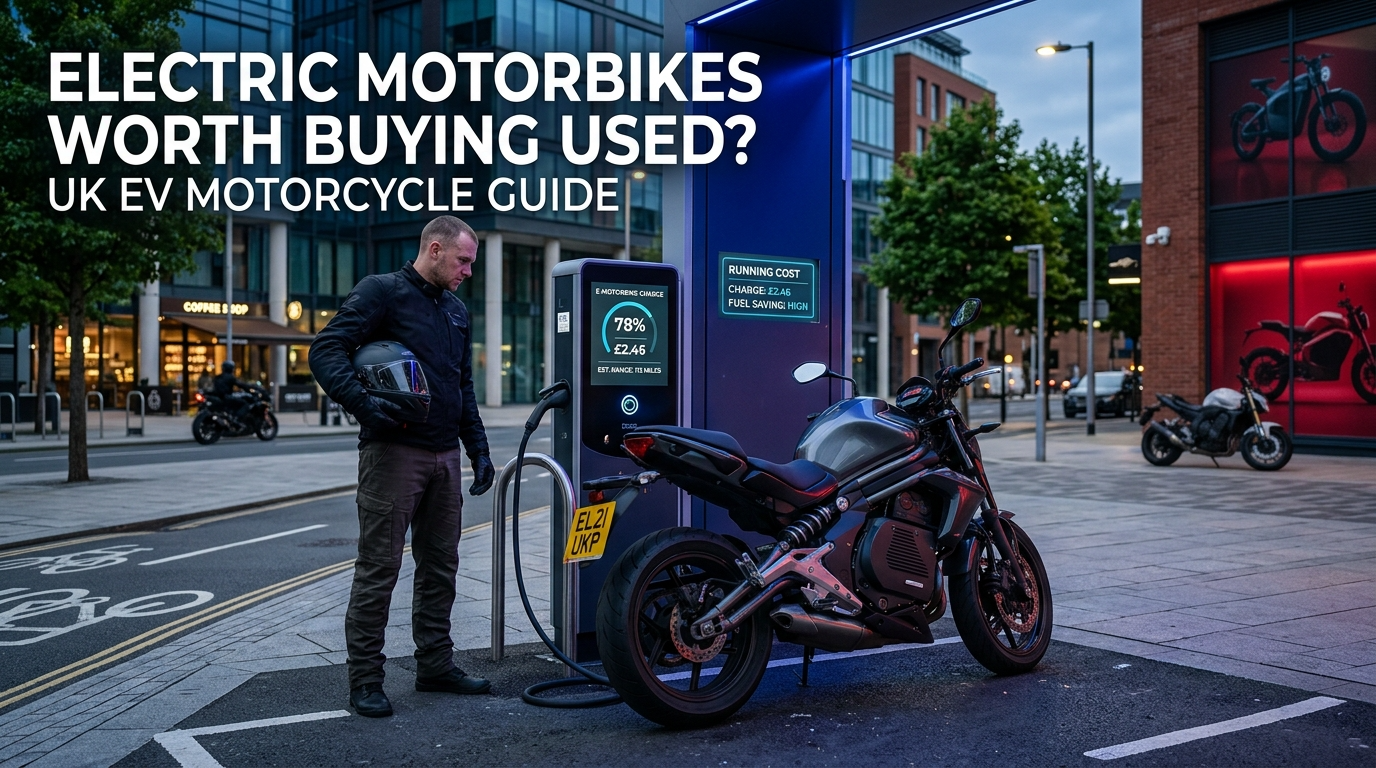
A typical small electric motorbike battery might be around 5.4 kWh, while a larger Zero might have a 7.2 kWh or 14.4 kWh pack. At a home tariff of roughly 28p per kWh, a full charge on a 7.2 kWh battery costs about £2.02. If that returns 60 miles in real urban riding, you are looking at roughly 3.4p per mile in energy.
A 125cc petrol commuter at 90 mpg with petrol at £1.45 per litre costs about 7.3p per mile, and a larger petrol bike is worse.
Servicing is usually cheaper on an electric motorbike because there is no engine oil, oil filter, air filter or spark plug to replace. You still need brake pads, tyres, chain or belt checks and brake fluid changes, and the reduction gear or belt drive still needs inspection, but the routine service list is shorter.
Insurance can go either way. It depends heavily on the model, theft risk, your postcode and whether you have secure off-street parking. Some riders find electric motorbike insurance cheaper than a petrol equivalent; others find it more expensive because parts availability and repair costs can be less predictable.
VED is a point where you should not assume anything. Many older used electric motorbikes are zero-rated or very low, but VED rules for electric vehicles have changed in recent years. Always check the exact annual VED rate for the specific registration on the DVLA vehicle enquiry service before you buy. For a deeper look at how road tax works, see our guide to VED (road tax).
What’s the Real-World Range of a Used Electric Motorbike?
Manufacturer range claims are usually optimistic. In real UK conditions — stop-start town traffic, cold mornings, a bit of dual carriageway — a small commuter electric bike with a 5-6 kWh battery will generally do 40 to 70 miles on a full charge.
A larger Zero with a 14.4 kWh battery might return 90 to 120 miles in mixed riding if ridden gently. Cold weather has a noticeable effect. A 5°C winter morning can reduce range by 20-30%, especially if you use heated grips or ride at higher speeds.
On a used bike, battery degradation also matters. A battery that originally offered 70 miles may only deliver 55-60 miles after several years. Always ask the seller for a realistic range figure based on their current riding, not the brochure.
Why Battery Health Matters More Than Mileage or Age
On an electric motorbike, the battery is the single most expensive component. A replacement pack can run into several thousand pounds, often more than the value of the used bike itself. That is why battery health matters far more than mileage or age.
Battery state of health, usually called SoH, is expressed as a percentage of original capacity. A battery with 90% SoH holds 90% of its original energy. If a manufacturer app or dealer diagnostic can show SoH, insist on seeing it.
If the seller cannot or will not provide any battery health evidence, treat that as a major warning sign. A low-mileage electric motorbike with a neglected battery can be a worse buy than a higher-mileage example that has been charged sensibly and stored properly.
What Should You Check Before Buying a Used Electric Bike in the UK?
The used electric bike UK market is still smaller than the petrol equivalent, so choice is narrower but quality examples do appear. Before you view a bike, run the same checks you would on any used vehicle.
- Check the MOT history on gov.uk if the bike is over three years old. For more detail on how MOTs work, our MOT explained guide covers the basics.
- Run an HPI check to rule out outstanding finance, theft markers or insurance write-offs. We explain why this matters in our HPI check guide.
- Verify the V5C logbook, VIN and number plate all match.
- Ask for battery state of health evidence, ideally from a dealer diagnostic or manufacturer app.
- Confirm the original charger and any cables are included. Replacement chargers can cost hundreds of pounds.
- Check the service history and any software updates.
- Inspect the charging port for damage or corrosion.
- Take a test ride with enough charge to assess real-world performance.
Before you go further, start with a full history check. Our guide to checking a used vehicle’s history before buying in the UK walks through the exact steps.
Used Electric vs Used Petrol Motorbike: The Practical Comparison
The table below uses a typical UK city commuter doing about 4,000 miles a year. It is illustrative rather than a quote for any specific model, but it gives a fair sense of where the differences appear.
| Factor | Used electric motorbike | Used petrol 125cc commuter |
|---|---|---|
| Energy/fuel cost per mile | 3-5p at home | 7-9p |
| Annual energy/fuel, 4,000 miles | £120-£200 | £280-£360 |
| VED | Often zero or very low, but check reg | Varies by engine size |
| Routine servicing | No oil, filter or spark plug | Oil, filter, spark plug |
| Charging/refuelling | 4-8 hours on a home socket | 2 minutes at a petrol station |
| Real-world range | 40-120 miles | 150-250 miles |
| ULEZ/clean air zones | Zero emission, no charge | May incur a charge if older or non-compliant |
| Noise | Very quiet | Louder |
For a broader look at how the two compare, see our article on electric versus petrol running costs.
Which Used Electric Motorbikes Are You Likely to See in the UK?
You will not see as many used electric motorbikes as petrol bikes, but certain models appear regularly on UK classifieds.
Super Soco TC Max is a common A1-class machine with a top speed around 60 mph and a realistic urban range of roughly 40-55 miles. It is popular with new riders because it is light and easy to handle.
Maeving RM1 is aimed squarely at city riders. It uses removable batteries, so you can charge them indoors without needing a garage or driveway socket. Top speed is around 45 mph, so it is not a dual carriageway tool.
Zero S, SR and DS models are the more established larger electric motorbikes. They are available with 7.2 kWh or 14.4 kWh batteries, sit in A2 territory, and are better suited to faster roads and longer rides, though they cost more used.
Horwin CR6 and Silence S01 also appear regularly in the urban commuter segment, usually with removable or easily accessible batteries.
These are examples of what you will see, not a ranked list. Research the specific model’s parts availability, dealer support and software updates before committing.
Where Does a Used Electric Motorbike Make Sense in the UK?
Electric motorbikes make the most sense for urban and suburban riding. In London, the zero-emission status means no ULEZ charge, and many other clean air zones treat them the same.
If you commute from a suburb into Manchester, Birmingham, Bristol, Glasgow or another large city, and you can park in a garage or driveway with a socket, the savings add up. You also avoid petrol station trips and the wear that short cold journeys inflict on a petrol engine.
They are less convincing if you regularly do 100-mile motorway trips, live in a flat with no off-street parking, or rely on public chargers. Public charging for motorbikes is still patchy and slower than petrol refuelling, and a flat battery cannot be fixed with a jerry can.
How to Buy a Used Electric Motorbike Safely in the UK
Buying a used electric motorbike is not radically different from buying a used car or petrol bike, but the battery adds an extra layer.
- Check the MOT history online using the registration number. Look for advisories, fails or gaps.
- Run an HPI check before you travel far or leave a deposit.
- Verify the V5C and make sure the seller’s name and address match the logbook.
- Get battery health evidence. A verbal “it still holds charge fine” is not enough.
- Inspect the bike in daylight and check the charging port, cables, brakes and tyres.
- Test ride it from a full or near-full battery so you can see what the range display actually does.
- Pay securely. Avoid bank transfers to strangers and be wary of deals that seem too cheap.
What About Selling a Used Electric Motorbike?
Because buyers are rightfully nervous about battery health, a seller who can show a recent battery health report, the original charger and a full service record will attract more serious interest.
Price it realistically against similar petrol and electric models. Do not assume your bike’s original list price holds up well, because battery degradation and the fast pace of new model launches pull used values down.
Be upfront about real-world range rather than quoting the brochure. A buyer who trusts your description is more likely to complete the sale than one who discovers the truth on the test ride.
Final Verdict: Are Used Electric Motorbikes Worth Buying in the UK?
For the right rider, yes. If you have off-street charging, your typical journey is under 60 miles, and you find a used electric motorbike with a verified healthy battery, the running costs are compelling and the riding experience is smooth and quiet.
If you cannot charge at home or work, need long motorway range, or cannot get battery health evidence, walk away and look at a used petrol bike instead. The worst used electric motorbike purchase is a cheap bike with a tired battery and no way to charge it properly.